
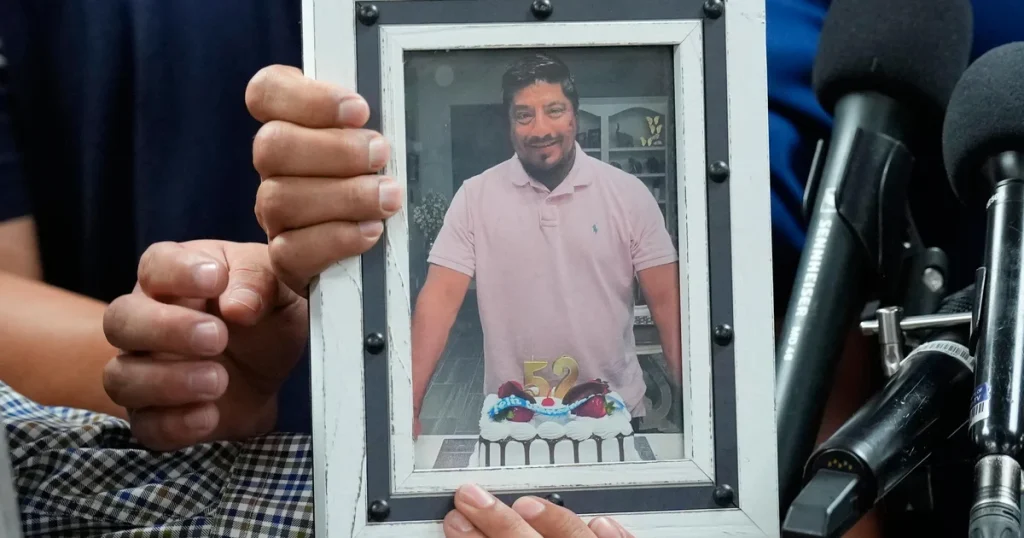
Attorney Says Detainees Witnessed ICE Officer Shoot Houston Driver Through Passenger Window
Wertynews.com – The attorney for Lorenzo Salgado Araujo, a 52-year-old homebuilder, claims that three detainees in a van observed the fatal shooting of the Mexican man by an ICE officer through the passenger window during a traffic stop in Houston. Hugo Balderas-Ibarra, the lawyer, detailed the account during a press briefing on Friday, emphasizing that the officer was not directly positioned in front of the vehicle when the shots were fired. “The detainees confirmed the officer was not in the driver’s line of sight at the time of the incident,” Balderas-Ibarra stated, underscoring the discrepancy between the officer’s version of events and the witnesses’ accounts.
Detainees’ Accounts Challenge ICE’s Narrative
According to Balderas-Ibarra, the three individuals in the van—Salgado Araujo’s brother and two others—reported that the officer shot the driver from the side of the vehicle, not from the front. “They confirmed the shots came from the passenger window, not from a direct confrontation,” the attorney said. This contradicts the ICE officer’s claim that Salgado Araujo collided with the vehicle and ignored commands before being shot. The detainees, who were in the van at the time, described the scene as chaotic but noted that no officer was in immediate danger.
The attorney’s assertion has sparked renewed scrutiny of the ICE officer’s actions. Balderas-Ibarra highlighted that the van appeared undamaged after the shooting, raising questions about the accuracy of the officer’s account. “If the officer was directly in front of the van, there would have been more visible signs of impact,” he argued. However, the absence of physical evidence has left investigators relying heavily on testimonies from the detained individuals, who claim the officer’s position was unclear and the timing of the shots was ambiguous.
Family and Community Reactions Highlight Concerns
Salgado Araujo’s family expressed shock at the incident, stating that the man had lived in the U.S. for over 30 years and had no criminal record. They emphasized his efforts to secure residency, which was nearing completion. “He was just trying to get his life together,” his brother said during a separate interview. The attorney stressed that the detainees’ accounts are critical to the investigation, as they provide firsthand perspective on the events that led to the fatal shooting.
Community leaders in Houston have also voiced alarm over the incident, citing a pattern of ICE encounters where officers have used unmarked vehicles without lights. “This raises questions about transparency and the use of force during routine stops,” said one local activist. The attorney added that the detainees’ statements could play a pivotal role in determining whether the officer’s actions were justified or if negligence contributed to the tragedy. As the investigation unfolds, the focus remains on verifying the sequence of events and the conditions under which the shooting occurred.
Department of Homeland Security Faces Pressure to Provide Evidence
The Department of Homeland Security, which oversees ICE, has yet to release concrete evidence supporting the officer’s version of the incident. A statement from DHS on Thursday mentioned that agents were searching for a different individual when they stopped the van, though the name of the target was not disclosed. Balderas-Ibarra called this lack of transparency “inconvenient” for the investigation, noting that the absence of video or photographic documentation could affect the credibility of the case.
ICE’s reliance on field agents without body cameras has also drawn criticism, as the agency cited previous government shutdowns as a reason for the lack of equipment. “This incident occurred during a time when many officers were operating without recording devices,” the attorney pointed out. With no footage to corroborate the officer’s claims, the detainees’ testimonies become even more significant in piecing together the full story. The case has become a focal point for debates about ICE’s use of force and its interactions with detainees during routine operations.
As the situation continues to unfold, the attorney’s claims have added another layer of complexity to the already contentious issue of immigration enforcement. Balderas-Ibarra reiterated that the detainees witnessed the shooting and that their accounts must be taken seriously. “This is not just a case of a single officer’s actions—it reflects a broader pattern of how ICE engages with individuals in the U.S.,” he said. The legal community and advocacy groups are closely monitoring the developments, with some calling for a thorough review of the incident and its implications for immigrant rights.
The shooting of Salgado Araujo has also reignited discussions about the risks faced by Mexican nationals in U.S. immigration enforcement. With the Trump administration’s policies emphasizing strict border control, cases like this highlight the potential for conflict between ICE officers and detainees. Balderas-Ibarra’s advocacy underscores the need for accountability, particularly as the incident has become a symbol of the tensions that arise during high-stakes encounters. As more details emerge, the case could influence public perception and policy debates surrounding immigration enforcement in the years to come.