
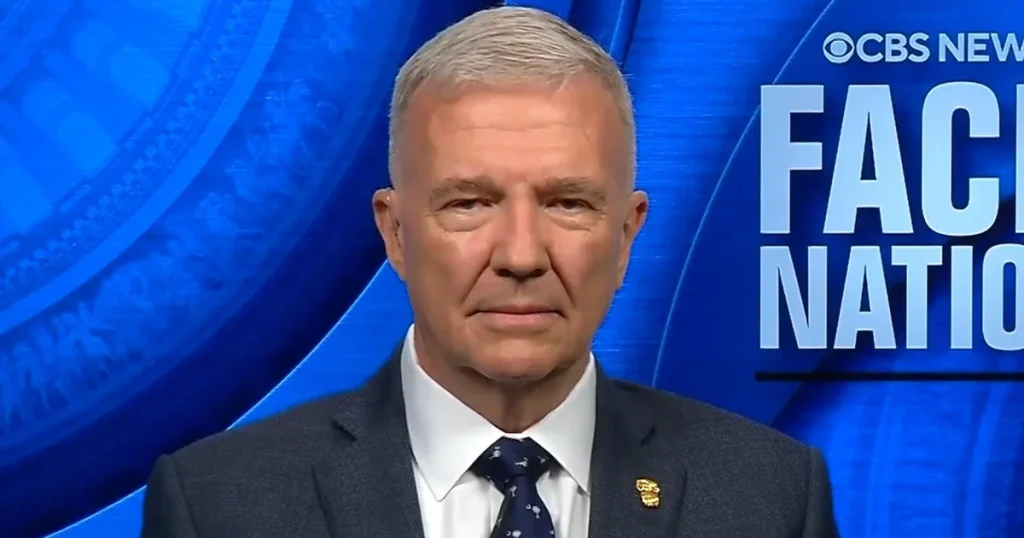
Retired Gen. Frank McKenzie on ‘Face the Nation’ Transcript, July 12, 2026
Interview Overview
Wertynews.com – The transcript of retired General Frank McKenzie’s appearance on “Face the Nation with Margaret Brennan” on July 12, 2026, offers a detailed analysis of U.S. military strategy in the Persian Gulf. McKenzie, who previously commanded U.S. Central Command and now leads The Citadel, discusses the potential for direct military engagement to secure strategic assets. His insights, featured in the transcript, highlight the balance between diplomatic efforts and military readiness, providing a comprehensive view of current geopolitical tensions.
In this transcript, McKenzie addresses questions about the U.S. military’s preparedness and the role of Iran in regional conflicts. The interview underscores key themes such as the importance of the Strait of Hormuz, Iran’s negotiation tactics, and the broader implications of military actions. The transcript serves as a valuable resource for understanding the strategic thinking of a former military leader in today’s volatile landscape.
Control of the Strait of Hormuz
Brennan begins the transcript by referencing a previous discussion with Senator Lindsey Graham, who argued that President Trump might use force to assert control over the Strait of Hormuz. She asks McKenzie how the U.S. can achieve such dominance. McKenzie explains that the goal is not complete control but to ensure unimpeded navigation through sustained pressure and readiness.
“The U.S. military is fully capable of securing the Strait of Hormuz,” McKenzie states. “Our focus is on applying force when necessary to deter Iranian interference. This approach allows us to maintain strategic leverage without escalating to full-scale conflict. The president’s strategy emphasizes demonstrating strength to achieve diplomatic outcomes.”
Military Readiness and Strategic Context
The transcript details McKenzie’s assessment of military readiness, noting that CENTCOM has already deployed assets to monitor the region. Brennan questions whether this level of preparedness aligns with the idea of unrestricted traffic through the strait. McKenzie clarifies that while the Navy is equipped to operate in narrow waters, the objective is to create a buffer zone that reduces Iranian influence without full closure.
“We’ve stationed forces to monitor activity and respond quickly to threats,” McKenzie explains. “The key is to project capability without overcommitting. This allows us to adjust tactics based on Iran’s reactions. The strait’s control is part of a larger strategy to stabilize the region and prevent escalations.”
Iran’s Negotiation Tactics
Brennan shifts the conversation to Iran’s negotiation style, citing recent missile strikes as evidence of their persistence. She asks if McKenzie is surprised by Iran’s refusal to compromise despite financial incentives. McKenzie acknowledges the challenges but emphasizes the need for sustained pressure to break their resistance.
“Iran’s tactics are clear,” McKenzie says. “They prolong negotiations to avoid immediate concessions, knowing the U.S. is willing to take decisive action. This strategy has worked in the past, but our military assets and readiness ensure we can enforce outcomes. The transcript highlights how we must remain adaptable in our approach.”
Recent Missile Incidents
The transcript includes Brennan’s inquiry about Jordan’s recent experience of three missiles landing in its territory. McKenzie explains that these attacks are part of Iran’s broader campaign to test U.S. and allied defenses. He notes that such incidents are not isolated but reflect a calculated effort to expand Iran’s influence.
“These strikes demonstrate Iran’s willingness to escalate tensions,” McKenzie remarks. “By targeting U.S. allies, they aim to create a sense of vulnerability. The transcript reveals that our response must be both swift and proportional to avoid drawing the region into wider conflict.”
Future Implications and Strategic Outlook
Mckenzie concludes the transcript by addressing the long-term consequences of current military strategies. He stresses that the goal is not to dominate Iran but to reshape its behavior in a way that aligns with U.S. interests. The transcript suggests that a combination of diplomatic engagement and military presence is essential for stability.
“The focus should remain on modifying Iran’s actions, not toppling their regime,” McKenzie emphasizes. “By maintaining a credible military posture and engaging in strategic dialogue, we can achieve our objectives while avoiding unnecessary risks. This transcript outlines a path forward that balances strength and diplomacy.”