
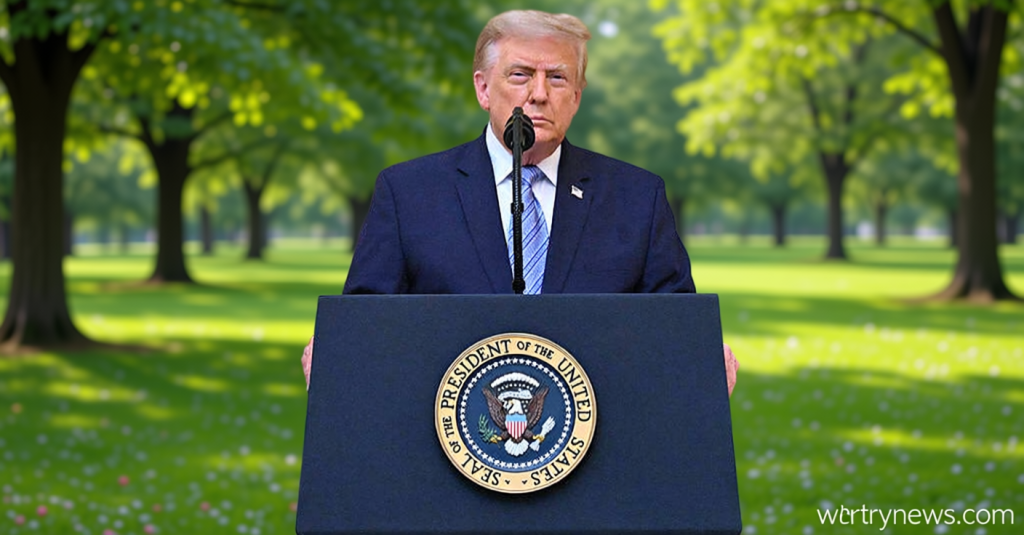
Trump Gives Primetime Speech on Elections Amid Chinese Data Access Allegations
Wertynews.com – President Trump delivered a primetime speech on elections on July 16, 2026, as the White House raised concerns about Chinese access to voter data. The address, broadcast on CBS News, focused on allegations of foreign interference in the U.S. electoral process, with Trump emphasizing the need for stricter safeguards to ensure election integrity.
“The integrity of our elections is under threat. The Chinese government has access to critical voter data, and we must act now to prevent foreign manipulation,” Trump asserted during his remarks.
The speech followed recent reports suggesting the administration had identified potential vulnerabilities in voting systems. David Becker, executive director of the Center for Election Innovation & Research, acknowledged the claims but pointed out that the findings lacked substantial evidence. “The White House’s revelations about Chinese data access are part of a broader narrative that has been debated for years,” Becker noted, highlighting the need for more transparency.
Voter Fraud and Infrastructure Concerns
Throughout the speech, Trump reiterated his stance on voter fraud, accusing the current administration of downplaying its severity. He cited intelligence reports indicating that voting machines and counting systems could be “compromised by foreign actors,” particularly the Chinese government. However, experts argued that the evidence supporting these claims remains anecdotal and not fully substantiated.
“We’ve spent 18 months investigating this issue, but the results are still questionable. The data shows a pattern of conspiracy theories without concrete proof,” Becker added, critiquing the administration’s approach.
Trump’s focus on infrastructure vulnerabilities was underscored by his call to revisit the 2024 election procedures. While he praised the “speed and efficiency” of mail-in voting during the pandemic, he warned that these systems could be exploited if not properly regulated. This narrative aligns with his broader campaign to scrutinize the electoral process and restore public confidence in American democracy.
Mail-In Ballots and Non-Citizen Voters
One of the central topics of the speech was the role of mail-in ballots in the 2024 election. Trump claimed that these ballots, which accounted for over 100 million votes in the 2024 general election, were “prone to corruption.” He argued that expanding mail-in voting without adequate oversight could jeopardize election outcomes. However, data from the U.S. Postal Service revealed that the system processed 99.2 million ballots in the 2024 election, with only a negligible fraction flagged for discrepancies.
“Mail-in ballots are not the same as in-person voting. They require strict verification to ensure every vote is legitimate,” Trump emphasized, citing his own use of mail-in ballots in a recent Florida special election as a point of contention.
Trump also highlighted the issue of non-citizen voters, referencing a Department of Homeland Security review that identified 278,000 non-citizens on federal voter rolls. While this figure sparked debate, election analysts noted that it represented a small fraction of the total electorate. For example, North Carolina found 34,000 deceased individuals on its voter rolls in April, which the state clarified were not necessarily linked to illegal voting. Similarly, non-citizen participation in the 2024 election was minimal, with only 35 individuals voting out of 277 confirmed cases in Iowa.
The speech concluded with Trump urging Congress to pass the SAVE America Act, a proposed reform aimed at tightening voting regulations. He argued that the legislation would address the perceived risks of mail voting and non-citizen participation, ensuring a more secure electoral process. While the act has bipartisan support in principle, its implementation faces challenges due to the need for state-level adjustments and funding.