
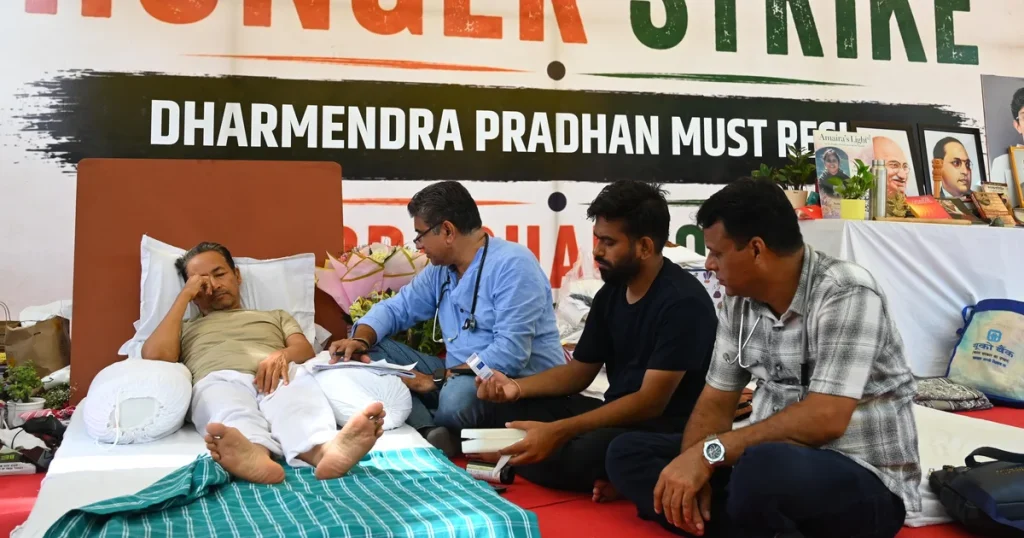
Appeals for Indian Activist’s Hunger Strike Over Education Reforms
Wertynews.com – Concerns are growing about the health of Sonam Wangchuk, a prominent Indian activist, as he continues his 20-day hunger strike to push for urgent education reforms. The 59-year-old Ladakh-based engineer and advocate has lost 21 pounds, raising alarms among medical professionals about potential organ damage. His protest, organized by the satirical Cockroach Janta Party (CJP), follows the cancellation of a crucial medical entrance exam after an exam paper leak disrupted millions of students’ academic schedules. Supporters are now calling for his health to be prioritized, with appeals for prominent Indian activist Wangchuk to end his fast.
Legal Intervention and Protest Dynamics
The Delhi High Court has intervened, directing the government to monitor Wangchuk’s health and provide medical support if necessary. This marks a critical moment in the ongoing appeal for prominent Indian activist to show signs of recovery. The CJP, which emerged in May as a satirical movement, initially targeted Chief Justice Surya Kant for his remark that India’s unemployed youth were “cockroaches” and “parasites.” Last month, the group escalated its efforts with a sit-in at Jantar Mantar, Delhi’s designated protest site. While permits were granted for demonstrations there, authorities denied access to other locations, citing the need to prevent logistical disruptions.
Wangchuk and Abhijeet Dipke, a Boston University student and CJP founder, have vowed to march to the Indian parliament on July 20, signaling their resolve. “I am weak from the outside but very strong inside,” Wangchuk declared during a recent speech, vowing to persist until their demands are met. “If you don’t come and July 20 is not successful, I will come back as a ghost,” he added, underscoring the significance of the appeal for prominent Indian activist in the national discourse.
Political and Public Support
Political leaders, Bollywood celebrities, and public figures have voiced support for Wangchuk’s cause, though they urged him to consider ending his hunger strike. The Indian National Congress (INC) has called on the Modi government to address the protesters’ demands, emphasizing the role of the appeal for prominent Indian activist in highlighting systemic issues. “In a democracy, peaceful protest is a constitutional right,” Congress leader Pawan Khera wrote on X. “When citizens undertake a fast to be heard, the government’s duty is to listen — not look away.”
Bollywood icons like Aamir Khan and Sonakshi Sinha have also joined the appeal for prominent Indian activist, using their platforms to draw attention to the movement. Sinha lamented, “Why is nobody listening? Nobody cares. Nobody is open for a dialogue,” in a video shared on Instagram. This public solidarity underscores the broader implications of Wangchuk’s protest, as it now symbolizes a call for educational transparency and reform across India.
Background and Advocacy
Wangchuk, a renowned engineer from Ladakh, is best known for his innovative work in creating artificial glaciers, or “ice stupas,” which help farmers store winter snow for spring irrigation. Beyond environmental achievements, he has been a vocal advocate for education reforms in the region, particularly in improving access and quality for marginalized communities. In 2018, his efforts earned him the Ramon Magsaysay Award, recognizing his contributions to education and climate resilience.
The appeal for prominent Indian activist has also gained traction beyond Ladakh. As the hunger strike enters its second week, critics argue that the government’s inaction risks public unrest. “Repeated exam leaks and delayed responses have eroded student confidence,” said a Congress party member, Kumari Selja. “The appeal for prominent Indian activist is not just about one person — it’s about the system failing the youth.” This sentiment echoes among students and educators, who see Wangchuk’s struggle as a microcosm of larger systemic challenges.
Impact on Education System
Wangchuk’s hunger strike has sparked a nationwide debate on the integrity of India’s education system. The cancellation of the medical entrance exam, due to a leaked paper, has left thousands of students anxious about their futures. “This is a direct appeal for prominent Indian activist to address the root causes of such failures,” noted a statement from the CJP. The movement highlights the need for stricter examination protocols and more accountability in educational institutions.
As the hunger strike continues, its ripple effects are becoming evident. Social media platforms have amplified the appeal for prominent Indian activist, with hashtags like #WangchukHungerStrike trending. Public figures and ordinary citizens alike are rallying behind the cause, pressuring the government to respond swiftly. “The appeal for prominent Indian activist is a wake-up call for policymakers to prioritize the needs of students,” said a recent op-ed in a national newspaper, emphasizing the urgency of the situation.