
Greece Faces Intensifying Wildfire Threat as France Begins Recovery
Wertynews.com – While western Europe experienced some relief from its ongoing wildfire crisis on Saturday, the most critical situation moved eastward to Greece. Powerful winds pushed flames through a coastal resort town, compelling hundreds of residents to escape via boat while simultaneously complicating aerial firefighting efforts.
The timing carried particular significance for Greece. In 2018, a devastating fire in Mati—a coastal community close to Athens—claimed 104 lives, establishing it as the continent’s most lethal wildfire of the current century.
French Fires Show Signs of Containment
Southwestern France saw firefighters successfully maintain boundaries around a massive blaze. Approximately 198,000 residents received permission to return to their homes following what could rank as the nation’s greatest evacuation during peacetime. Interior minister Laurent Nunez confirmed that the Gironde fire “is now under control with vigilance points in a few sectors.”
Meanwhile, southeastern France continues to deploy roughly 1,500 firefighters toward containing another wildfire in the Var region. Spain’s major fires ceased their advance, and Portugal’s primary blaze also came under control.
A secondary French fire halted its expansion overnight after covering 10 square kilometers (4 square miles) within just six hours on Friday. The prefecture described this movement as “faster than a horse at full gallop.” Despite this progress, the fire remained active on Saturday with 2,500 people still barred from returning home.
These improvements represent a dramatic shift from the crisis peak, when fires across France and Spain alone displaced 300,000 people from residences and holiday destinations, depopulated towns during summer vacations, and stretched emergency resources across multiple simultaneous incidents.
Greece Battles Gale-Force Winds
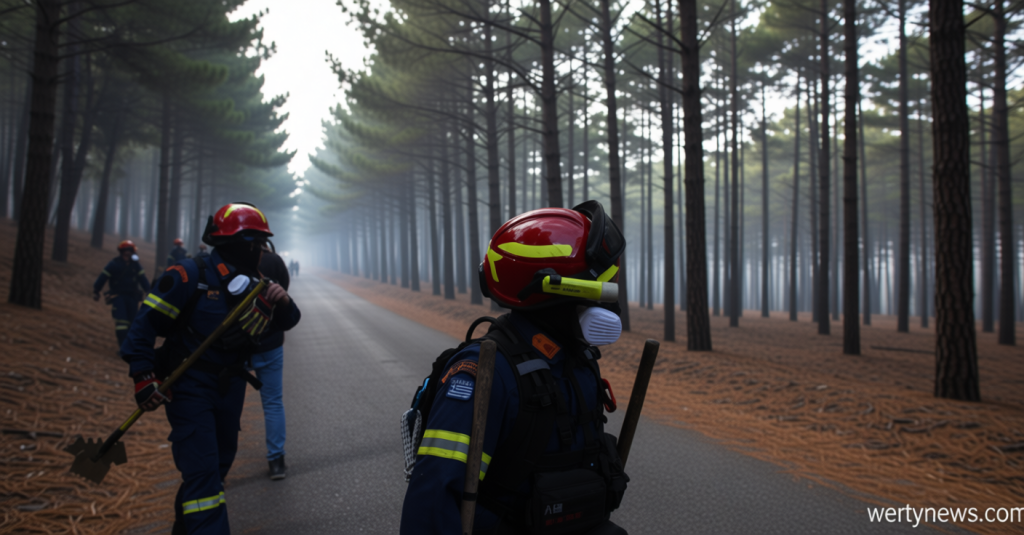
Nearly 500 firefighters worked on Saturday to safeguard Porto Germeno, a favored destination along the Gulf of Corinth. Flames consumed dense pine woodland while thick smoke obscured daylight.
The fire originated Friday near the adjacent coastal settlement of Agios Vasileios. Authorities evacuated approximately 300 people by water and issued additional evacuation directives on Saturday.
“A pristine forest, a paradise, was surrendered to the hands of the fire,” said Minas Tzortzanis, a 60-year-old farmer and local resident. “There are no words to explain what has happened. Destruction. Total destruction.”
Theodore Giannaros, a wildfire meteorologist with the National Observatory of Athens, calculated that between 40 and 50 square kilometers (15 to 19 square miles) sustained damage. Officials had not yet released an official figure for the burned area.
The response effort incorporated specialized forest-fire units, crews temporarily reassigned from France and Romania, 19 water-dropping aircraft, and 11 helicopters. Additional fires broke out across Greece, with a blaze east of Nafpaktos triggering evacuation warnings for at least four villages.
“The very strong to gale-force winds continue to create exceptionally difficult conditions,” Climate Crisis and Civil Protection Minister Evangelos Tournas said.
He noted that extreme turbulence prevented certain aircraft from gathering water or approaching fires closely enough to execute drops.
Western France Maintains Vigilance
The Gironde fire consumed 420 square kilometers (162 square miles) of pine forest west of Bordeaux—an area four times larger than Paris. Although contained within established boundaries on Saturday, officials had not yet declared it “fixed,” meaning crews could not confirm the fire had stopped advancing. Active zones and buried hot spots continued to exist.
While authorities reopened additional communities on Friday, several areas remained largely empty on Saturday. Much of the forested Cap Ferret peninsula stayed evacuated due to a nearby hot spot that could reignite, potentially severing limited road connections and trapping returning residents.
“Today, the fire is still not fixed. It is contained,” Lt. Col. Eric Pitault told reporters.
Crews conducted tactical burns overnight. Along 240 kilometers (149 miles) of fire perimeter, heat could remain concealed underground and erupt once more.
Climate Context and Future Outlook
Europe stands as Earth’s fastest-warming continent, heating at more than double the global average since the 1980s according to the European Union’s Copernicus climate service. Escalating temperatures combined with extended drought periods leave vegetation drier and more combustible, enabling fires to propagate more rapidly and burn with greater intensity.
In the Mediterranean Var region, defensive lines surrounding the Gros Bessillon fire held through the night with no additional ground consumed, Var Prefect Simon Babre reported to French media on Saturday. The blaze had been declared fixed earlier in the week before mistral gusts revived embers on Friday and sent it racing once more.