
As the Danube River Dries: WWII Shipwrecks and Ancient Mammoth Bones Emerge
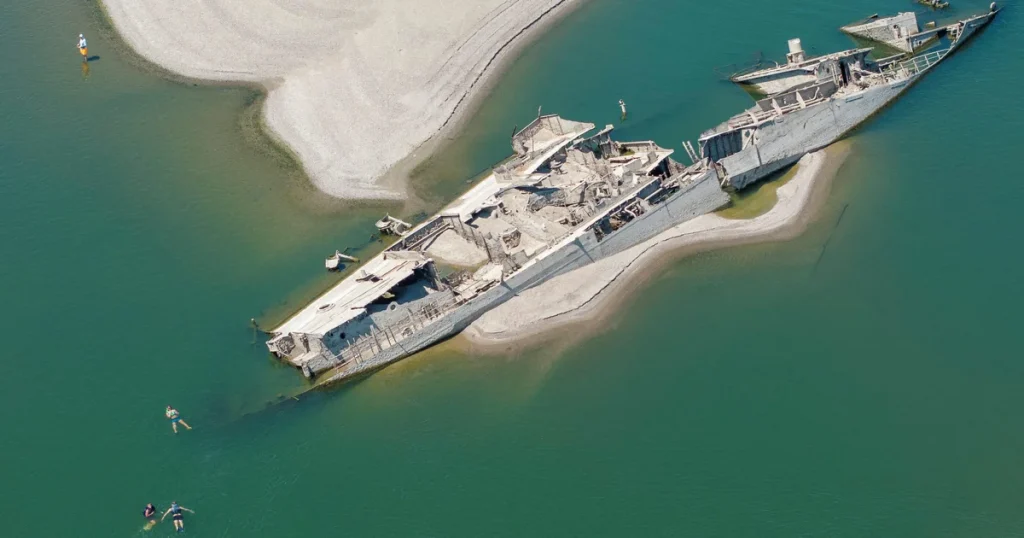
Wertynews.com – As the Danube River dries to record levels, a remarkable window into history is opening. Water levels on Europe’s second-longest river have plummeted due to severe drought, revealing the hulks of dozens of World War II German battleships alongside the ancient remains of a woolly mammoth. This extraordinary phenomenon offers a curious distraction from the ongoing summer heat crisis across Central and Eastern Europe.
The consequences extend beyond historical artifacts. As the Danube River dries, power plants along its banks face the brink of shutdown, prompting governments to implement emergency electricity conservation measures. The situation has also disrupted vital shipping routes, with commercial vessels struggling to navigate the shallow waters.
Hidden Warships Surface Near Prahovo
In the middle of the river separating Serbia and Romania, near the Serbian port of Prahovo, a rusty hull now breaks through the water’s surface. A broken mast stands where the Nazi flag once flew. These vessels, some still carrying weapons, belonged to Nazi Germany’s Black Sea fleet, which the Germans deliberately sank as they retreated from Romania and as Soviet forces advanced deeper into Europe near the war’s end.
Historians estimate that up to 200 German warships were scuttled in September 1944 near Prahovo in the Danube gorge as they came under Soviet fire. The strategic goal was to slow the Soviet advance through the Balkans. Although Nazi Germany surrendered months later in May 1945, the ships remained hidden until now. At least 20 World War II wrecks of various sizes are currently visible to the naked eye from the banks of Prahovo.
Ivica Gavrilovic, who has spent his entire life living beside the Danube, noted that public interest in the wrecks is high, though access remains challenging. “People still don’t know how to access the ships themselves,” he explained while guiding a family of three on his small boat.
Mammoth Bones Reveal Ice Age Secrets
While As the Danube River dries reveals wartime history, it has also uncovered prehistoric treasures. Falling water levels in the Bulgarian section of the Danube unveiled bones of a mammoth, according to a local museum director. The bone fragments found near the northeastern city of Ruse “very likely” belonged to a woolly mammoth that lived during the Ice Age, said Nikolay Nenov, director of the Regional Historical Museum.
Specialists have identified a jawbone, fragments of tusks, part of a shoulder blade, and a femur with its articular head among the collection. The animal is believed to have been young, and the dark coloration of the bones suggests it spent considerable time in a marshy environment. These bones represent an important discovery because they are exceptionally well preserved and “were concentrated in the same place,” indicating they all belonged to a single animal, Nenov stated.
The old vessels have emerged before. In 2024, a trove of sunken Nazi ships, still decked out with explosives, appeared in the Danube following a blistering summer drought. Dozens of scattered ships operated by Nazi Germany’s Black Sea fleet also appeared in 2022 near Prahovo after water levels reached record lows. Krsta Brandic, a Prahovo resident, observed that low water levels have almost halted ship traffic: “As you can see, the (big) ships can’t pass anymore.”
For decades, scientists have been recovering bits and pieces of mammoth tusks, bones, teeth, and hair. Woolly mammoths coexisted with early humans who hunted these cold-resistant herbivores for food and used their tusks and bones as tools. The animals ultimately died out approximately 4,000 years ago.
Frequently Asked Questions
How many World War II ships have been found in the Danube?
Historians estimate that up to 200 German warships were scuttled in September 1944 near Prahovo. Currently, at least 20 wrecks of various sizes are visible to the naked eye from the riverbanks.
When did the mammoth bones surface in the Danube?
The mammoth bones were discovered in the Bulgarian section of the Danube near the city of Ruse as water levels dropped due to drought conditions.
Why were the German ships deliberately sunk?
Nazi Germany scuttled the ships to slow down the Soviet advance through the Balkans during World War II. The strategic sinking occurred as German forces retreated from Romania.
What impact is the drought having on the Danube?
As the Danube River dries, power plants face potential shutdowns, ship traffic has nearly stopped, and authorities are implementing electricity conservation measures across Central and Eastern Europe.