
The Trump Administration Has Filed 31 Lawsuits Over Voter Data: What You Need to Know
Wertynews.com – The Trump administration has filed 31 lawsuits against states and the District of Columbia, seeking access to comprehensive voter registration records. These legal actions span nearly all 50 states, with the Justice Department arguing that complete voter rolls are essential for ensuring compliance with federal voting laws. The administration contends that unredacted voter data—containing sensitive information such as birth dates, addresses, partial Social Security numbers, and driver’s license numbers—is necessary to verify that states maintain accurate voter registration systems.
Under the Help America Vote Act and the National Voter Registration Act, states are required to maintain programs for keeping voter rolls current and accurate. Last year, the Justice Department sent formal letters to most states requesting electronic copies of their statewide voter registration lists without any redactions. While several states have voluntarily provided publicly available versions of their voter rolls, many have refused to release their complete databases, prompting the administration to take legal action.
Current Status of the Lawsuits
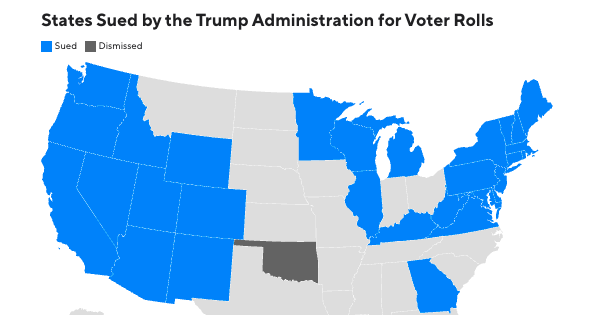
So far, the Trump administration has filed lawsuits against 30 states and the District of Columbia. The legal battles have produced mixed results, with federal judges rejecting the Justice Department’s requests in 21 cases. States that have successfully defended against these lawsuits include Arizona, California, Colorado, Connecticut, Illinois, Kentucky, Maine, Maryland, Massachusetts, Michigan, New Hampshire, New Jersey, New Mexico, New York, Oregon, Pennsylvania, Rhode Island, Virginia, West Virginia, and Wisconsin.
Notably, the Justice Department voluntarily dismissed its lawsuit against Oklahoma after the state agreed to provide its voter registration list. The initial case against Georgia was dismissed because it was filed in the wrong court, but government lawyers have since refiled it. The remaining pending cases involve Delaware, Georgia, Hawaii, Idaho, Minnesota, Nevada, Utah, Vermont, and Washington.
“The administration’s efforts to obtain voter data represent a significant push to strengthen federal oversight of state election systems,” said one legal analyst familiar with the cases.
The Justice Department has appealed most of the decisions dismissing its cases. The U.S. Court of Appeals for the 6th Circuit has already upheld a lower court decision rejecting the administration’s attempt to obtain Michigan’s voter rolls. These appeals could potentially change the outcome of several cases as they move through the appellate system.
Broader Election Reform Efforts
The Trump administration’s pursuit of voter data is part of a larger strategy to exert greater control over federal elections. President Trump has signed two executive orders related to U.S. elections, though both have faced judicial challenges. The first executive order, signed last year, would require documentary proof of citizenship for voter registration. The second, announced in March, tightens mail-in voting rules and mandates that the Department of Homeland Security and U.S. Postal Service compile lists of eligible U.S. citizens.
Additionally, the president is urging Congress to pass the SAVE America Act, a comprehensive voting regulations package that would significantly restrict mail-in voting and introduce new voter identification requirements. President Trump has long criticized mail-in voting, claiming it leads to widespread fraud, although he has not provided substantial evidence to support these assertions. He has also alleged that Democratic states permit noncitizens to vote in U.S. elections—a practice that constitutes a federal crime.
Frequently Asked Questions
Why is the Trump administration seeking unredacted voter rolls? The Justice Department argues that complete voter registration records are necessary to verify state compliance with federal voting laws and ensure voter roll accuracy.
How many states have successfully defended against these lawsuits? Twenty-one states and the District of Columbia have had their cases dismissed by federal judges.
What information is contained in voter registration lists? Voter rolls typically include names, addresses, birth dates, partial Social Security numbers, and driver’s license numbers.
Are any of the dismissed cases being appealed? Yes, the Justice Department has appealed most dismissal decisions, including the 6th Circuit’s ruling on Michigan’s case.
What is the SAVE America Act? It is a proposed federal legislation package that would restrict mail-in voting and impose new voter ID requirements nationwide.