
Perceived Unfairness Reshapes Party Loyalty
Wertynews.com – A majority of Americans still regard the free-market framework as fundamentally sound, and capitalism draws warmer feelings than socialism across the electorate. Yet beneath that broad endorsement sits a sharp sense that the present moment is tougher than the one their parents knew — harder to purchase a home, sustain a household, or simply feel financially steady. Younger cohorts report feeling that genuine opportunity has narrowed.
That squeeze translates directly into judgments about fairness. Most respondents describe today’s American economy as unjust in how it distributes chances to advance. Those perceptions ripple outward into partisan politics, surfacing most visibly in this year’s Democratic primary contests, where the party base rates socialism above capitalism — an inversion of the national mood.
The backdrop is years of persistently poor economic ratings. Many Americans appear to be interrogating the broader system itself, or at minimum searching for remedies that escape conventional ideological boundaries. Perceived fairness tracks both personal financial standing and the sense of available opportunity, with younger generations expressing notably greater anxiety about the latter.
What “Socialism” Means in Everyday Language
System labels carry wildly different connotations depending on who uses them. To capture ordinary understanding, respondents were asked to describe what they believe “socialism” entails in their own words.
The most common answers pointed toward some form of state involvement — government control or government ownership of economic activity. Layered beneath those process-oriented definitions were outcome-oriented framings: equality, fairness, and a general impulse to assist people who are struggling.
Partisan splits emerge in the vocabulary itself. Republicans and independents gravitated toward language about government control. Democrats, by contrast, leaned toward talk of equality, fairness, and public services — emphasizing what the system should produce rather than how it should be administered.
Democrats vs. the Nation on Socialism
Whereas the country at large is net-negative on socialism, Democratic voters skew positive. Within the party, socialism enjoys a more favorable impression than capitalism does — a reversal of the broader public’s ordering.
The gap widens along several demographic lines. College-educated Democrats embrace the label more readily than their less-educated peers. They are also likelier to perceive a widening chasm between the wealthiest and the middle class, and less likely to describe the Democratic Party as “effective.” Younger Democrats outpace older ones in favorability toward socialism, as do White Democrats relative to other racial groups.
On personal stakes, Democrats express the belief that socialism would improve their own household finances while capitalism, on balance, makes them worse off. Those fairness judgments are tightly coupled with how respondents evaluate the economic system’s distribution of outcomes.
The “Democratic Socialist” Label
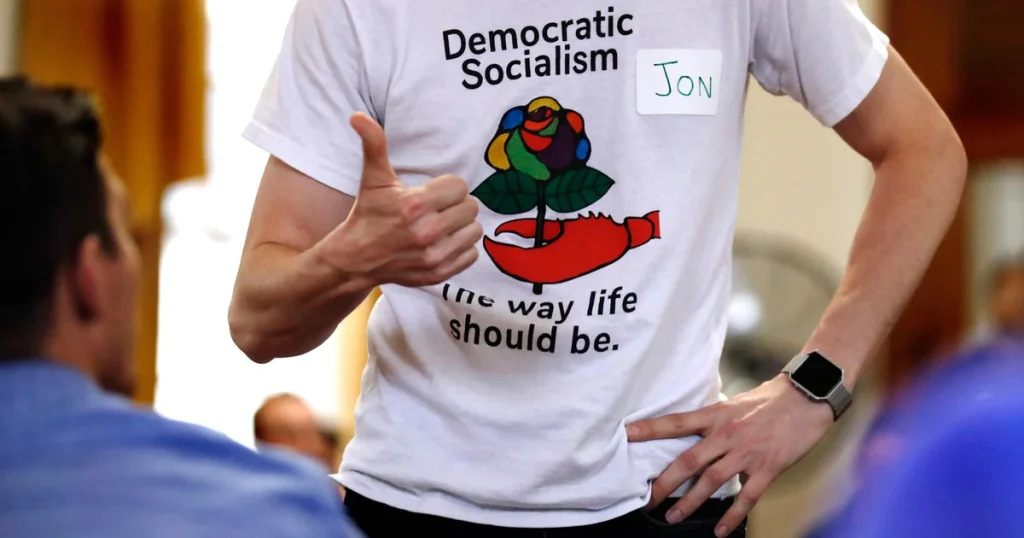
Roughly half the party views the specific term “democratic socialist” positively — a share that climbs among younger and more liberal members. The remainder do not react negatively; for them the phrase lands closer to neutral than hostile.
“Democratic Establishment”
The counter-label “Democratic establishment” provokes little animus inside the party. Most respondents rate it positively or sit at neutral. Those who do respond negatively, however, are less inclined to regard their own party as effective or strong.
How Progressive Is Enough?
A near-even split divides the base on ambition. About half say the party is already as progressive as they desire. The other half judge it insufficiently so — a group that skews more liberal and carries a comparatively warmer impression of socialism.
Those who find the party lacking in progressivism are also less likely to report that the Democratic Party aligns with their views “a lot” on economic questions, signaling a deeper disconnection between platform and personal conviction.
What Democrats Demand Economically
Beyond specific policy content, presentation matters. When Democrats put forward economic proposals, their rank-and-file wants those measures to read as sweeping transformations rather than incremental adjustments — even where the smaller step would be politically easier to enact.
More fundamentally, overall impression outweighs granular policy detail. Voters want to feel the party is actively fighting on their behalf. The affective register of a proposal can matter more than its technical architecture.
How the Public Sees Both Parties
Both major parties face alignment gaps with the electorate on economic and cultural questions alike. On each dimension, Democrats secure at least some voter agreement but fall short of strong consensus. The shortfall is not concentrated in one domain over the other; just over half of respondents register at least minimal agreement with the party’s positions.
On the Republican side, a pronounced voice champions capitalism. A slight majority — joined by most Democrats and independents — nonetheless expresses comfort with government price controls, indicating that even within a market-favoring electorate, appetite for targeted intervention persists.
Related Reading
Frequently Asked Questions
What is CBS News poll on whether Democrats?
CBS News poll on whether Democrats is the main topic of this guide. The article explains the context, practical details, and next steps readers should understand.
Why does CBS News poll on whether Democrats matter?
CBS News poll on whether Democrats matters because readers are looking for a useful answer, not just a short summary. Good content should match search intent and help them decide what to do next.