
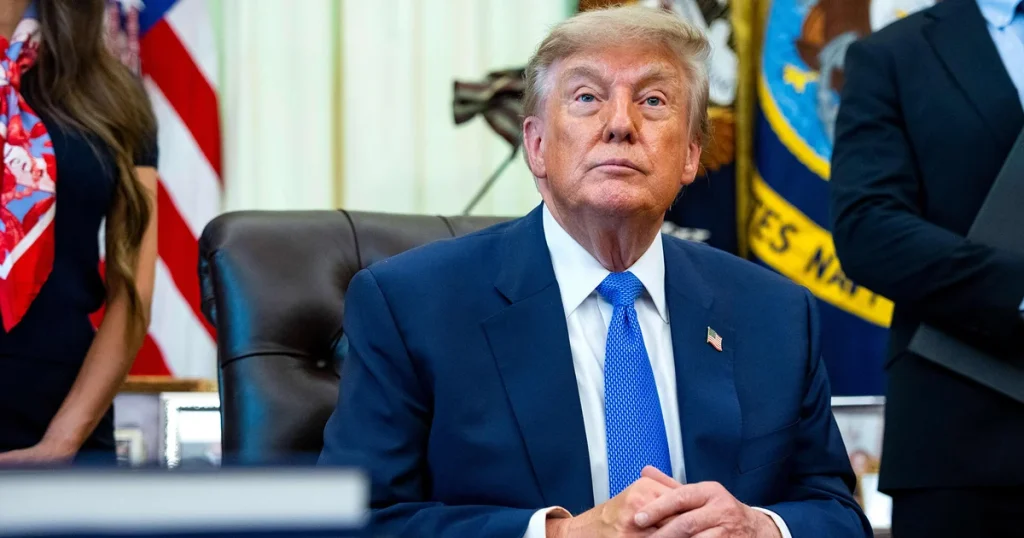
Trump Hits Pause on 50% Canadian Tariffs Amid Last-Minute Deal Push
Wertynews.com – In a Truth Social post Tuesday, President Trump announced a temporary suspension of the 50% tariffs that had been scheduled to take effect Wednesday morning on a broad swath of Canadian imports. The pause, he explained, would last three days while final documents are completed.
“I have paused the 50% Tariffs against Canada, that were scheduled to kick in tomorrow morning for a three day period, based on the fact that Canada and the U.S.A., subject to the finalization of documents, have a DEAL!”
Canadian Prime Minister Mark Carney confirmed the postponement in a statement issued Tuesday evening, noting that the United States had agreed to delay implementation of the Section 338 levies until the close of business on August 21.
“Substantial progress has been made, although there is important work still to be done.”
“While we continue this work, Canada remains focused on building a stronger, more independent, and more competitive economy at home.”
Two Days of Intense Back-Channel Talks
Carney’s office confirmed that the two leaders had spoken by phone twice over the preceding 48 hours, including a call Tuesday afternoon — a signal of how compressed the timeline had become. Earlier in the week, Carney had told reporters, speaking in French, that the talks were underway but not suited to public discussion.
“The negotiations are very intense and delicate. This is not the time to talk about negotiations in public.”
The Economic Stakes
The tariffs targeted roughly $20 billion in Canadian merchandise, spanning an eclectic list that included hockey sticks and tongue depressors. Yet the political fallout was expected to dwarf the economic damage. Ottawa had warned it would answer any new U.S. levies with retaliatory duties of its own, deepening a trade dispute between two economies that exchanged $880 billion in goods and services the previous year.
Nearly 72% of Canada’s merchandise exports flow to the United States, making the tariff threat an existential commercial risk for the northern neighbor. On the American side, imposing a steep new duty — ultimately borne by U.S. importers who would attempt to shift the cost onto consumers through higher shelf prices — carried obvious political risk ahead of the November midterm elections, in which voters already gripe about the cost of living.
“I don’t think either side really wants these tariffs to come into effect,” said Ryan Majerus, a partner at King & Spalding and a former U.S. trade official, before the delay was made public. “There’s a pretty strong push on both sides to find an off-ramp here.”
Why Section 338? A Century-Old Legal Lever
The Trump administration already levies a 10% tariff on Canadian goods — the country being the United States’ second-largest trading partner behind Mexico — though most Canadian imports escape that charge because they qualify under the U.S.-Mexico-Canada Agreement signed during Trump’s first term. To go further, the White House reached into Depression-era statute book, invoking Section 338 of the Tariff Act of 1930 to threaten a 50% rate on products representing roughly 5% of Canadian exports to the U.S.
The 1930 law, known as the Smoot-Hawley Act after its congressional sponsors, imposed sweeping import taxes during a period of global economic collapse. Economists and historians widely regard it as having choked international commerce and deepened the Great Depression. Section 338 specifically empowers the president to impose duties of up to 50% on imports from nations that discriminate against American businesses. No prior investigation is required, and no statutory sunset limits how long the tariffs may remain in force. The provision had never been invoked before this administration.
The turn to Section 338 followed a February Supreme Court ruling that struck down the broad tariffs Trump had imposed last year on nearly every trading partner under a national-emergency declaration, opening the door to refunds for importers. With that legal avenue closed, the White House turned to older authority to keep tariff pressure on Canada.
A Fractured Bilateral Relationship
The tariff standoff sits atop a wider pattern of friction between the two countries, spanning trade policy, NATO burden-sharing, a dispute over a Detroit-area bridge project, and Trump’s repeated threats to absorb Canada as a 51st state. Last month, when the tariffs were first announced, the White House charged Canada with taking “unreasonable, unequal, and discriminatory actions” through tariffs and import restrictions on specific American goods — measures some of which were introduced in response to Trump’s initial round of tariffs on Canada the prior year.
Tariffs remain the centerpiece of the president’s second-term economic agenda, and the Canada episode underscores both the reach of his trade strategy and the limits of the legal tools available to sustain it.
Related Reading
Frequently Asked Questions
What is Trump says he paused 50 tariffs?
Trump says he paused 50 tariffs is the main topic of this guide. The article explains the context, practical details, and next steps readers should understand.
Why does Trump says he paused 50 tariffs matter?
Trump says he paused 50 tariffs matters because readers are looking for a useful answer, not just a short summary. Good content should match search intent and help them decide what to do next.