
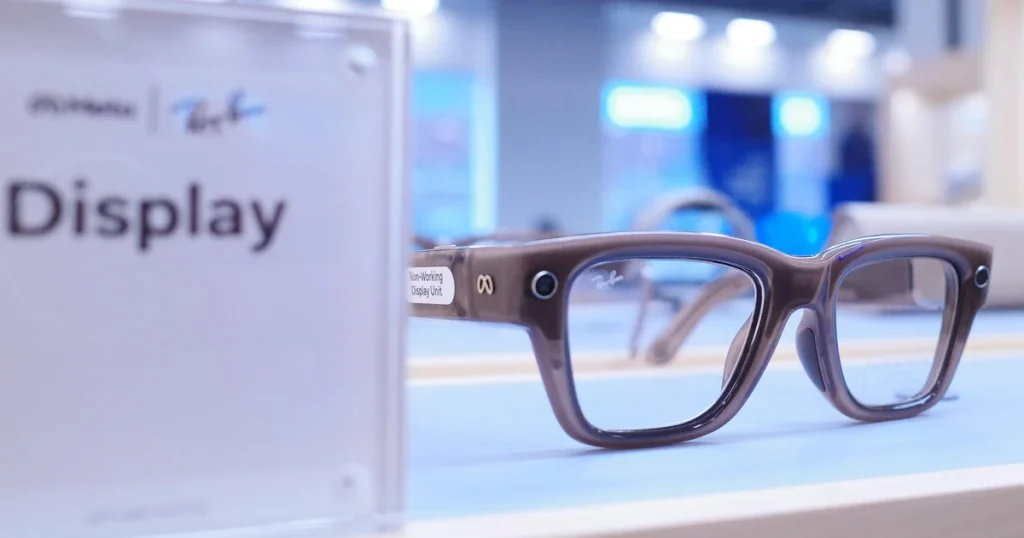
Meta Overhauls Smart Glasses Privacy Controls After Non-Consensual Recording Backlash
Wertynews.com – The rapid spread of wearable cameras has sharpened a question that once belonged mostly to surveillance-camera debates: who decides when a bystander’s face ends up in someone else’s photo roll? Meta has responded to mounting public concern by rolling out revised privacy safeguards for its artificial-intelligence–powered glasses, a move the company framed as both a technical correction and a broader commitment to transparent capture behavior in shared spaces.
The Technical Change: Tamper-Triggered Shutdown
At the heart of the update is a simple but consequential rule. The glasses carry a small LED indicator that illuminates whenever the camera is actively capturing an image or video. Under the earlier design, a user had to physically obstruct that light before recording began in order to lock the function. The revised mechanism goes further: if a wearer starts a recording and then covers or tampers with the LED afterward, the camera now powers down automatically. In other words, the device treats any post-start interference with the indicator as a signal to stop capturing, removing the need for the wearer to remember a specific pre-recording gesture.
Meta characterized the change in an email sent to a major news outlet, describing the update as already producing a measurable deterrent effect on the small ecosystem of online services that had been selling step-by-step instructions for disabling the LED.
“These investments are already having a deterrent effect — companies that were offering LED tampering services have shut down because the camera now deactivates when tampering is detected.”
The Incident That Sparked Scrutiny
The privacy controversy gained public visibility in August when a woman discovered footage of herself posted to social media, shot by a man wearing the glasses. She said she had no awareness that a recording was underway and had never been asked for permission. The episode crystallized a fear many people had voiced informally since the product launched: that a small light on a pair of eyewear could be quietly defeated, turning an ordinary street conversation into uninvited content.
“I had no say,” the woman said.
Her experience was not an isolated anecdote. A senior crime and public safety coordinating producer at a major news organization tested an earlier iteration of the glasses the previous month and found that the original disabling mechanism failed to engage when the indicator was covered after recording had already begun. That finding underscored the gap between the company’s stated design intent and the behavior users actually encountered in the field.
Meta’s Stated Position and Ongoing Updates
In response, Meta confirmed that the enhanced security feature now deactivates the recording function whenever tampering with the capture LED is detected, regardless of whether the interference occurs before or after the recording session begins. Alex Himel, vice president of wearables at Meta, addressed the issue in a social-media post last week, framing the company’s approach as iterative rather than one-and-done.
“We’re going to keep rolling out updates like this to make sure the capture LED can reliably alert bystanders when photos or videos are being captured for someone’s gallery.”
Himel added that only a small minority of users attempt to circumvent the protections, and that the lengths those individuals must go to demonstrate the system is functioning as intended.
“Only a tiny minority of people try to get around these protections, and the fact they have to go to these lengths shows our efforts are working.”
A Broader Awareness and Content-Cleanup Campaign
Beyond the hardware fix, Meta announced a new education and awareness initiative designed to make the LED’s signaling purpose unmistakable to people in the wearer’s vicinity. The company said the light was engineered from the outset to communicate capture status to bystanders, and the campaign aims to ensure that public understanding of that signal keeps pace with the product’s distribution.
The company also disclosed a series of platform-level actions taken to reduce the volume of content that normalizes or instructs non-consensual capture. Those steps include:
Removing online posts that provide step-by-step tampering instructions or advertise services for disabling the indicator. Eliminating thousands of harassing posts tied to “pickup artist” and prank-style content that had circulated around the glasses. Blocking search terms and hashtags associated with violating content, including phrases such as “pickup artist” and “rizz” posts that had become shorthand for unwanted recording scenarios.
Why This Matters Beyond One Product
The episode sits at the intersection of several larger trends. Consumer wearables are increasingly capable of continuous capture, and the line between a personal camera and a public surveillance device grows thinner with each firmware update. Legal frameworks in many jurisdictions still treat ambient recording in public spaces with limited restriction, placing the burden of consent largely on the person being filmed rather than the person holding the device. When a product’s default behavior can be altered by a small physical gesture, the question of who bears responsibility for that alteration becomes both a design problem and a social one.
Meta’s decision to tie camera availability to the integrity of a visible indicator, and to commit to ongoing updates rather than a single launch-day specification, represents an attempt to keep the technology’s behavior aligned with the expectation that bystanders should know when they are being recorded. Whether that expectation can be fully honored in practice—across crowded streets, concerts, and transit systems—will depend on continued engineering iteration, transparent communication to the public, and, ultimately, on whether users treat the indicator as a social contract rather than a feature to be defeated.
For consumers already wearing or considering the glasses, the practical takeaway is straightforward: the indicator light is now the single source of truth for whether capture is active, and any attempt to obscure it mid-session will result in the camera shutting down. For everyone else in the vicinity, the light remains the signal that a recording is underway, and Meta has pledged to keep that signal reliable through successive software updates.
Related Reading
Frequently Asked Questions
What is Meta says AI glasses fix stops?
Meta says AI glasses fix stops is the main topic of this guide. The article explains the context, practical details, and next steps readers should understand.
Why does Meta says AI glasses fix stops matter?
Meta says AI glasses fix stops matters because readers are looking for a useful answer, not just a short summary. Good content should match search intent and help them decide what to do next.