
Border Patrol’s Top Field Commander Retired Mid-Investigation Over Court Testimony and Alleged Antisemitic Remarks
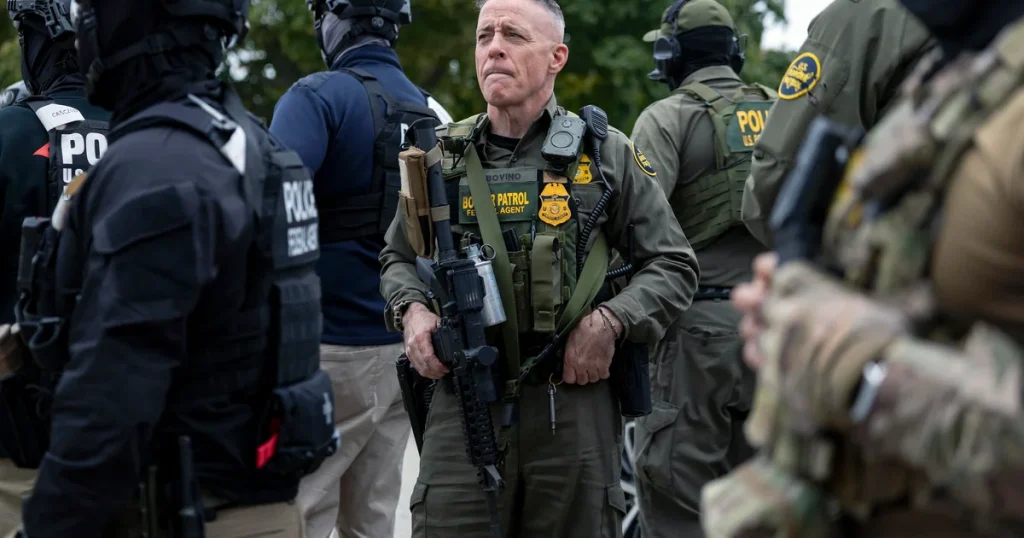
Wertynews.com – Records obtained last week reveal that Gregory Bovino, the former “commander at large” of U.S. Customs and Border Protection who became the most visible face of the Trump administration’s sweeping immigration enforcement operations, was already the subject of an internal agency probe when he filed his retirement paperwork. The timing — an official inquiry notice arriving just two weeks before his departure — has fueled questions about whether the departure was truly voluntary or the product of institutional pressure.
The Sequence of Events
On March 2, CBP sent Bovino an email stating the agency was “conducting an official Inquiry into allegations of misconduct reported to CBP.” Sixteen days after that notice, Bovino submitted an official retirement relocation request. The existence of the investigation was first brought to public attention by the Chicago Tribune, which reviewed the internal correspondence before it was made available more broadly.
Bovino has disputed the characterization of his exit. Speaking to CBS News, he described himself as having been “forced to retire” and pointed to CBP Commissioner Rodney Scott as the driving force behind the probe. In his account, Scott pursued the investigation not for legitimate institutional reasons but because “Bovino was a political rival coupled with the fact Rodney Scott was adamantly opposed to interior enforcement by the US Border Patrol.” Bovino further stated that two separate investigations “popped up within days of the infamous surrender in Minnesota,” tying the timing of the probes to the chaotic aftermath of the Minneapolis enforcement actions.
Who Bovino Was and What He Did
Before his removal from the field, Bovino had spent decades inside Border Patrol and rose to become the public spokesperson for a series of high-profile immigration crackdowns. Beginning in Los Angeles and expanding through Chicago, Charlotte, New Orleans, and ultimately Minneapolis, those operations drew intense scrutiny for their scale and tactics. Bovino’s role as “commander at large” ended in late January, shortly after two U.S. citizens — Renee Good and Alex Pretti — were killed during enforcement activity in Minneapolis. The shootings, combined with Bovino’s immediate public statements, triggered a wave of political backlash that accelerated his removal from the operational command position.
In the hours following Pretti’s death, Bovino asserted — without citing any evidentiary basis — that the deceased had intended to “massacre” federal agents. That claim, and the broader pattern of agency conduct during the crackdowns, became central to subsequent litigation.
The Court Credibility Problem
A lawsuit filed in fall 2025 by the Chicago Headline Club and allied organizations alleged that Border Patrol had carried out an “unnecessarily brutal enforcement of the immigration laws,” deploying tear gas, pepper balls, and rubber bullets against journalists and demonstrators. U.S. District Judge Sara Ellis responded by issuing a preliminary injunction that curtailed the agency’s use of force in the affected area. In her ruling, Ellis went further, accusing Bovino of misrepresenting events in sworn testimony.
“Most tellingly, Bovino admitted in his deposition that he lied multiple times about the events that occurred in Little Village that prompted him to throw tear gas at protesters,” Ellis wrote.
The CBP investigation letter sent to Bovino in March pressed directly on that judicial finding. One question asked: “Do you agree that District Judge Ellis’ findings about your lack of credibility would have to be disclosed if you were called to testify in a trial?” The investigator then asked what should happen when a federal judge determines that a Border Patrol agent’s testimony is not credible, and whether Bovino believed Ellis’s findings rendered him “Giglio impaired” — a term of art referring to prosecutors’ duty to disclose known credibility problems that defense counsel may later use to impeach a law-enforcement witness. The line of questioning suggests the agency was evaluating whether the judicial credibility finding created a lasting operational liability for Bovino well beyond the immediate case.
The Seventh Circuit later vacated Ellis’s preliminary-injunction order, though it did so without ruling on whether her credibility determinations about Bovino were correct. That procedural posture left the underlying credibility question unresolved at the appellate level while the internal probe continued.
Inquiry Into Alleged Antisemitic Comments
Separately from the testimony issue, the CBP investigator put specific alleged remarks directly to Bovino. Rather than asking broadly about his public statements, the letter posed a pointed question: “Did you make a comment to the effect of ‘Do Orthodox criminals also take off Saturday?'” A follow-up asked, “What did you mean by this comment?”
According to The New York Times, Bovino allegedly learned of the investigation after disparaging a Minneapolis judge for taking time off for Shabbat, the Jewish Sabbath. The CBP documents also asked whether he had made a remark about “chosen people,” an apparent reference to Jewish people. Both sets of questions were framed against CBP Standards of Conduct Section 7.7.2, which requires that “employees will be professional in their contact with supervis[ors and others]” — a standard Bovino was asked whether his testimony and remarks violated.
Agency Silence and Broader Implications
A CBP spokesperson told CBS News: “DHS does not comment on matters regarding personnel who are no longer with the agency.” The statement added: “Bovino voluntarily retired from CBP. CBP is not authorized to provide any security for retired personnel.”
While federal privacy rules limit disclosure of certain personnel files, no blanket statute or publicly available Department of Homeland Security policy prohibits comment on former employees. That distinction matters: it means the agency’s silence is a policy choice rather than a legal compulsion, and it leaves open questions about what the investigation ultimately concluded and whether any findings were communicated to Bovino before or after his departure.
The episode underscores a recurring tension in federal law-enforcement agencies: when a senior official’s courtroom credibility is formally questioned by a judge, the institution faces a dilemma. Disclosing the finding protects future litigants but can undermine the agency’s own witnesses; suppressing it risks later impeachment surprises. Bovino’s case — combining a judicial credibility ruling, alleged discriminatory remarks, and a retirement filed two weeks after an investigation notice — places all of those tensions into sharp public view at once.
Related Reading
Frequently Asked Questions
What is Gregory Bovino former Border Patrol commander?
Gregory Bovino former Border Patrol commander is the main topic of this guide. The article explains the context, practical details, and next steps readers should understand.
Why does Gregory Bovino former Border Patrol commander matter?
Gregory Bovino former Border Patrol commander matters because readers are looking for a useful answer, not just a short summary. Good content should match search intent and help them decide what to do next.