
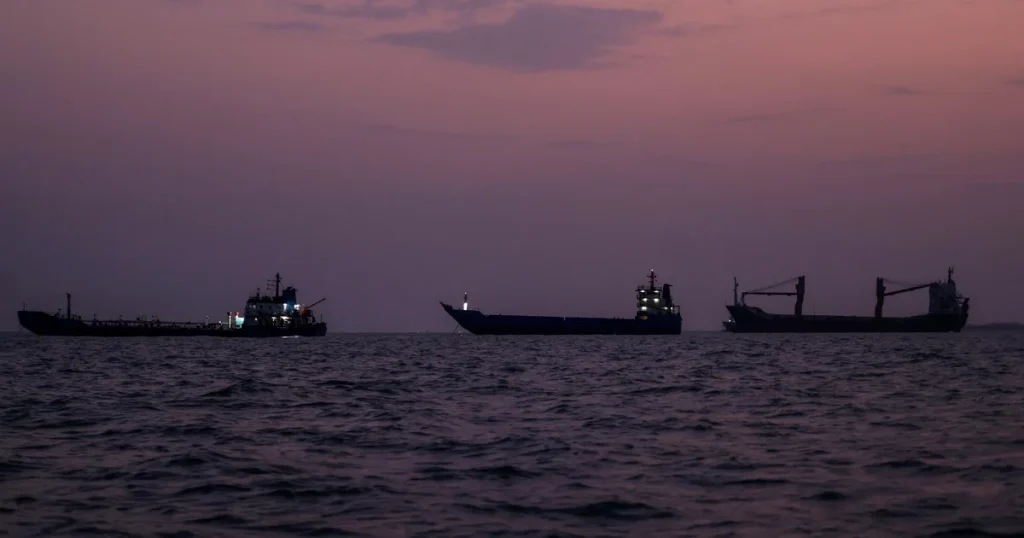
Iran Moves to Formalize a Maritime Exclusion Zone Around the Strait of Hormuz
Wertynews.com – Tehran is preparing to declare a formal “exclusion zone” stretching from the outer edge of the American naval blockade inward through the Strait of Hormuz and onward into the broader Persian Gulf. The announcement, expected within days or weeks, marks a sharp escalation in a conflict that has already driven global crude prices to multi-year highs and left millions of drivers at the pump paying well above seasonal norms.
The zone’s parameters were outlined by Mohsen Rezaei, who recently assumed the role of head of Iran’s Supreme National Security Council. Speaking to state television, Rezaei described the boundary as beginning at the line of the U.S. naval blockade, extending toward the strait itself, and continuing from that point into the Gulf. He offered no further operational specifics, leaving analysts to speculate about enforcement mechanisms, transit exemptions, and the legal framework under which vessels would be turned back or detained.
The declaration comes one day after American forces struck three Iranian oil tankers in the Persian Gulf and the Gulf of Oman. Those strikes were a direct retaliation for Tehran’s launch of ballistic missiles aimed at U.S. warships operating in the same waters. The sequence of events — missile salvo, then kinetic response against commercial shipping — underscores how quickly the confrontation has moved from posturing to sustained exchange of fire.
Seoul Told to Stay Clear
With the exclusion zone on the horizon, Iran’s foreign ministry issued a pointed warning to South Korea on Monday. Spokesperson Esmaeil Baghaei cautioned Seoul against deploying military assets into or around the strait, or otherwise becoming entangled in American operations in the region. He characterized any such step as yielding to “U.S. pressure and intimidation” and warned it would carry “serious consequences.”
“Any military deployment or participation in operations by other countries in the Persian Gulf or the Strait of Hormuz can only be regarded as direct support for the party responsible for that aggression and will have serious consequences.”
The remark was aimed at a statement released by the South Korean government on Friday, in which officials said they would weigh joining naval operations in the area, contingent on preserving their own force-readiness posture. No final decision had been made as of Monday, but Tehran’s intervention signals that it views even the prospect of allied naval presence as a red line.
Energy Markets Absorb the Shock
The economic fallout has been immediate and persistent. Brent crude, the benchmark contract for internationally traded oil, climbed another 67 cents on Monday to close at $96.95 per barrel. The rally traces back to February, when the United States and Israel launched coordinated strikes against Iran. Since then, crude-oil traffic through the Strait of Hormuz — the chokepoint through which roughly one-fifth of the world’s daily oil consumption has historically flowed — has collapsed, and Tehran has declined to reopen the waterway to normal commercial transit.
At the consumer level, the average price of regular unleaded gasoline stood at $4.14 per gallon heading into the Labor Day holiday weekend, according to AAA motor club data. That figure sits nearly a dollar above the same period last year and well above the previous Labor Day weekend record of $3.82 set in 2012. For households already stretched by inflation, the gap translates into hundreds of dollars of additional annual fuel spending.
The sustained price pressure carries implications beyond the pump. Shipping insurers have raised premiums on Gulf transits, petrochemical feedstock costs are climbing, and central banks in oil-importing economies face the prospect of a renewed terms-of-trade deterioration just as they had begun to ease monetary tightening.
Escalation Rhetoric Hardens on Both Sides
Iran’s Parliament speaker, Mohammad Bagher Ghalibaf, used a Sunday address carried by state media to declare that Tehran’s calculus of retaliation has shifted. After ordering ballistic-missile strikes on American warships in response to the tanker attacks, Ghalibaf framed the next round of U.S. action as one that would meet a qualitatively different response.
“The Americans must have understood that the era of proportionate responses has come to an end. Any aggression against Iran’s interests and security will receive a faster, more intense and more painful response.”
On the American side, U.S. Central Command confirmed on Saturday that it had “permanently disabled” the three Iranian oil tankers. Commander Adm. Brad Cooper used the statement to issue what amounted to a standing threat aimed at the Islamic Revolutionary Guard Corps.
“Let the message to the IRGC be clear: If you shoot at two of our ships, we will impose an even higher economic cost — taking out three of yours. We will not hesitate to defend American forces, and if necessary, destroy Iran’s limited and exposed oil fleet.”
The exchange of tit-for-tat arithmetic — two ships met with three — suggests both sides are now operating from a logic of escalating economic punishment rather than calibrated deterrence. Combined with the forthcoming exclusion zone, the Strait of Hormuz is rapidly becoming a managed, militarized corridor in which transit rights are negotiated under the shadow of missile batteries and destroyer gun mounts. For the global energy system, that transition from open waterway to contested chokepoint represents the single largest structural risk to supply continuity since the 1970s oil shocks.
Related Reading
Frequently Asked Questions
What is Live Updates: Iran says it will expand control in Strait of Hormuz as oil and gas prices continue to climb?
Live Updates: Iran says it will expand control in Strait of Hormuz as oil and gas prices continue to climb is the main topic of this guide. The article explains the context, practical details, and next steps readers should understand.
Why does Live Updates: Iran says it will expand control in Strait of Hormuz as oil and gas prices continue to climb matter?
Live Updates: Iran says it will expand control in Strait of Hormuz as oil and gas prices continue to climb matters because readers are looking for a useful answer, not just a short summary. Good content should match search intent and help them decide what to do next.