
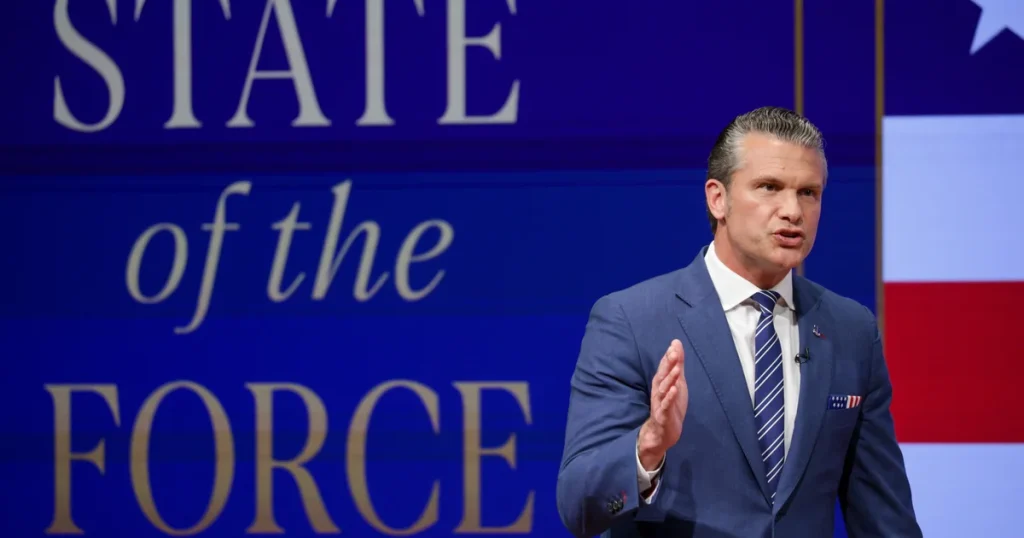
Hegseth says generals who clung to Pentagon culture are gone
Wertynews.com – Hegseth says generals who clung to what he called a “woke department” no longer work at the Pentagon, as the Defense Department reduces its senior military ranks. Defense Secretary Pete Hegseth said the changes are part of a broader effort to alter the department’s culture, command structure and military priorities.
Speaking during a State of the Force Address at Marine Corps Base Quantico in Virginia, Hegseth said the military should be focused on winning conflicts. He described his preferred Pentagon as “unrelenting, unapologetic, and uncompromising” in that mission.
“The number crunchers say we fired 10% of the generals and admirals across the force, and that number sounds about right,” Hegseth said. “And I know because I directed it that we’ve also reduced the overall number of general officer slots by an additional 10%.”
Hegseth characterized the combined moves as a 20% reduction in generals and admirals. While critics have described the changes as a purge, he called them accountability and said they were overdue.
Senior officer reductions follow a 2025 directive
The restructuring follows a May 2025 directive ordering the removal of at least 10% of flag and general officers across the force. The directive also called for a 20% reduction in National Guard general officers.
In the one-page memorandum, Hegseth said the reductions were intended to support innovation and operational performance. He argued that redundant command structures and excess management layers can limit the military’s effectiveness.
As of July, the Army, Navy, Marine Corps, Air Force and Space Force had 851 active-duty generals and admirals. That total was slightly higher than the 848 officers recorded a year earlier and near the statutory ceiling of 857.
Hegseth says generals who clung to the previous Pentagon culture were among leaders no longer serving. He also criticized senior officials who, in his view, did not respect civilian authority over the armed forces. Civilian control remains a central feature of the U.S. defense system, with the defense secretary serving as the top civilian official overseeing the military.
Autonomous Warfare Command announced
Alongside the personnel reductions, Hegseth announced Autonomous Warfare Command, a proposed four-star combatant command intended to speed the deployment of autonomous and robotic capabilities throughout the joint force.
“A new four-star combatant command with service-like authorities, built to scale autonomous and robotic capabilities across the joint force in the fastest peacetime shift in modern military history,” Hegseth said.
The proposal links the leadership overhaul with a push for technological modernization. Autonomous systems and robotics are increasingly important to military planning, and the new command would create a senior-level structure dedicated to those capabilities.
Debate continues over military leadership structure
The appropriate number of generals and admirals has long been debated in Washington. A Congressional Research Service report released in May outlined competing perspectives: supporters of cuts say large senior hierarchies can slow decisions, while opponents say global operations require experienced leaders to manage complex commands and joint missions.
Hegseth’s latest speech echoed themes from a previous Quantico address, where he criticized Pentagon diversity policies and called for stricter appearance and fitness standards. He said the department would no longer be “woke” or weak, continuing his public campaign to reshape its leadership and culture.
FAQ: What do the Pentagon leadership cuts mean?
How large are the planned cuts? Hegseth said dismissals and the elimination of senior officer positions amount to about a 20% reduction in generals and admirals across the force.
Does the reduction affect all service members? The announced changes focus on senior general and flag officer ranks, rather than an overall reduction in the size of the U.S. military.
What is the goal of Autonomous Warfare Command? The proposed command is intended to accelerate the military’s use of autonomous and robotic systems across the joint force.