
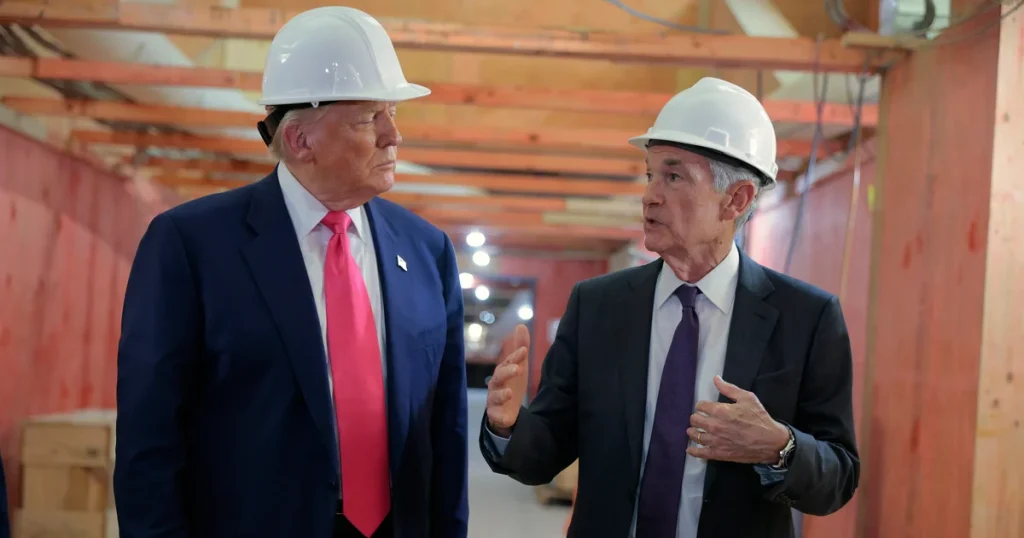
Federal Reserve Watchdog Finds No Criminal Violation in Headquarters Renovation Review
Wertynews.com – A lengthy internal review of the Federal Reserve’s multibillion-dollar headquarters renovation has found no basis for a criminal referral, while sharply criticizing how the project was managed and controlled as costs climbed.
The Federal Reserve inspector general released a 121-page report Wednesday examining the renovation of the central bank’s offices, a project that President Trump had attacked as “disgraceful.” The review concluded that federal law was not broken and found no administrative misconduct, but identified major management shortcomings that helped push the project’s cost to roughly $2.5 billion.
“At no point during our evaluation did we find reasonable grounds to believe that a violation of federal criminal law had occurred requiring a referral to the U.S. Attorney General in accordance with the Inspector General Act.”
Michael Horowitz, the Federal Reserve’s inspector general, wrote that the evaluation uncovered deficiencies in the renovation’s oversight rather than misconduct by officials. The findings followed an investigation lasting more than a year, launched in July 2025 at the request of then-Federal Reserve Chairman Jerome Powell.
Management Problems, Not Criminal Conduct
The review highlighted four central issues behind the rapidly increasing construction costs and made seven recommendations for the Federal Reserve’s Board of Governors. Among the most significant findings, the Board did not obtain a construction-cost estimate from its general contractor before the work moved forward. It also did not communicate a stated spending limitation to that contractor at the beginning of the project.
Project governance inside the Federal Reserve was also judged inadequate for a construction effort of this size and complexity. Large public building projects often require firm cost controls, clear decision-making authority, detailed estimates, and regular monitoring of changes. The inspector general found that the Board’s internal structure did not sufficiently meet those needs during the renovation.
Federal Reserve officials frequently cited inflation when explaining why expenses rose. The report accepted that inflation played a role, especially in construction-related pricing, but determined that the project’s overruns went beyond what inflation alone could explain.
The inspector general sought an analysis from the Board on inflation’s effect on the overall renovation price. Instead of a full project-specific assessment, the Board provided views from two senior economists. They agreed that the Producer Price Index can be useful for measuring broad changes in the cost of new office construction, while also cautioning that a general construction index cannot fully account for cost growth on a unique, multiyear renovation project.
Dispute Over Design Features
The investigation also reviewed complaints from the White House that certain elements of the work were ostentatious or inconsistent with approved plans. The inspector general did not find wrongdoing involving those features. That conclusion removes one of the central allegations surrounding the politically charged criticism of the renovation.
The report does not portray the project as a routine cost increase. Its conclusions instead point to a gap between rising construction prices and the Federal Reserve’s responsibility to manage a major capital project with stronger planning and financial discipline. The recommendations are intended to address those weaknesses and improve how the institution handles comparable work in the future.
Powell Testimony and the Criminal Inquiry
The review also covered Powell’s June 2025 testimony before the Senate Banking Committee, which became part of a separate Justice Department investigation. Bill Pulte, who leads the Federal Housing Finance Agency, had urged Congress in July 2025 to investigate Powell’s statements about the renovations, accusing him of being deceptive without presenting evidence to support that charge.
The inspector general found no criminal wrongdoing in Powell’s testimony. That finding is particularly significant because Powell had disclosed in January that the Federal Reserve received grand jury subpoenas linked to an ongoing criminal inquiry. The subpoenas raised the prospect of an indictment tied to his statements about the years-long renovation project.
The dispute unfolded while Trump was publicly expressing frustration with Powell over interest rates. Trump had criticized Powell for not moving quickly to cut rates. A federal court in Washington, D.C., later quashed subpoenas issued by D.C. U.S. Attorney Jeanine Pirro, ruling that they were a pretext intended to pressure Powell either to support lower interest rates or to leave his position.
In January, Trump nominated Kevin Warsh to replace Powell as Federal Reserve chair. Warsh’s confirmation encountered a major obstacle after Republican Sen. Thom Tillis of North Carolina said he would not support any nominee until the criminal inquiry into Powell had been dropped. In April, Pirro announced that federal prosecutors had ended their investigation, eliminating that barrier to Warsh’s confirmation.
At that time, Pirro said she expected a comprehensive review from the inspector general and believed its conclusions could finally settle the questions that led prosecutors to issue subpoenas. Following Wednesday’s release, Pirro said she would examine the report. Her office was asked whether a criminal investigation might be reopened.
Trump Calls for Further Review
Trump responded to the inspector general’s findings Wednesday in a Truth Social post, saying he had asked Attorney General Todd Blanche to review the report and determine what action, if any, should follow.
The watchdog’s conclusions leave room for continued political debate over the renovation’s price and the Federal Reserve’s stewardship of taxpayer-sensitive institutional resources. Yet the report draws a clear distinction between poor project execution and illegal conduct. It found costly planning and oversight failures, while rejecting claims that the available evidence established a violation of federal criminal law or misconduct by Federal Reserve officials.
Related Reading
Frequently Asked Questions
What is Fed watchdog finds no laws broken?
Fed watchdog finds no laws broken is the main topic of this guide. The article explains the context, practical details, and next steps readers should understand.
Why does Fed watchdog finds no laws broken matter?
Fed watchdog finds no laws broken matters because readers are looking for a useful answer, not just a short summary. Good content should match search intent and help them decide what to do next.