
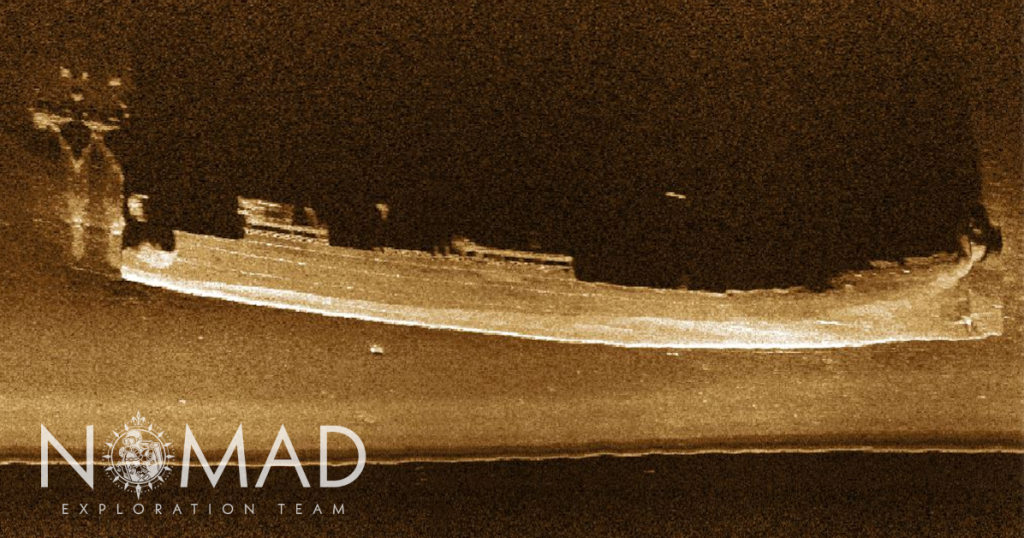
Wreck of SS Cornwallis Found More Than Eight Decades After Maine Coast Sinking
Wertynews.com – More than 80 years after a German U-boat sent a Canadian merchant vessel to the bottom of the Atlantic off Maine, divers have located the wreck of the SS Cornwallis nearly 400 feet beneath the surface.
The discovery closes a long-standing chapter from one of the most unusual wartime episodes along the New England coast. Four days before attacking the Cornwallis on Dec. 3, 1944, the same submarine had secretly put two German agents ashore near Hancock, Maine, during World War II.
The New Hampshire-based Nomad Exploration Team announced that it found the vessel in July. Searchers faced icy water, powerful currents and a remote offshore location before side-scan sonar identified a large wreck. Subsequent dives established that the site was the Cornwallis.
“For the team, finding the wreck was the culmination of years of persistence,” dive team member Danny Allan said. “For the families and communities connected to the ship, it brings renewed attention to a largely forgotten tragedy.”
A Merchant Ship With a Wartime History
The Cornwallis was launched in 1921 in Vancouver, British Columbia. The 5,458-ton steam merchant ship was initially named Canadian Transporter before entering service with Canadian National Steamships and receiving the name Cornwallis.
Its final loss was not its first encounter with a German submarine. On Sept. 11, 1942, while anchored in Barbados, the vessel was hit by German torpedoes and badly damaged. It settled only partly in shallow water, allowing it to be repaired and returned to service.
By November 1944, the ship was again at sea, carrying sugar and molasses from Barbados toward St. John, New Brunswick. Nautical historian Eric Wiberg has described its defensive equipment as including a 4-inch gun, a 12-pound gun and machine guns positioned on the bridge. Those weapons were never used.
As the Cornwallis traveled off the Maine coast on Dec. 3, it was sighted by U-1230, commanded by Hans Hilbig. A torpedo struck near the ship’s bow. The steamship disappeared beneath the waves in under 10 minutes.
There were 48 people aboard. Six reached life rafts, but one of them died from hypothermia. Fishing vessels recovered the remaining five survivors, who were then transferred to a U.S. Navy ship and taken to Rockland, Maine.
The U-Boat’s Secret Mission to Maine
The sinking became especially notable because of what U-1230 had done immediately beforehand. On Nov. 29, 1944, the submarine landed Erich Gimpel and William Colepaugh near Hancock. Their mission was to conduct espionage inside the United States.
Colepaugh was an American who had traveled to Germany in 1944 for espionage training. After leaving the submarine, he and Gimpel made their way from Maine to New York City without being detected.
The loss of the Cornwallis prompted U.S. authorities to investigate whether the attacking submarine might also have brought enemy agents onto American soil. The FBI eventually learned that Hancock residents had noticed unfamiliar men in the area around the time the merchant ship was sunk.
The espionage operation unraveled in New York. Colepaugh confessed to a friend, who alerted the FBI. Gimpel was arrested days later. A military court sentenced both men to death, although the punishments were later changed to life imprisonment.
U-1230 survived the war but was scuttled in 1945. For decades, the Cornwallis itself remained missing, leaving its precise resting place unknown despite the ship’s dramatic place in regional wartime history.
An Underwater Record of a Forgotten Loss
The newly identified wreck offers a physical connection to the ship’s crew, its cargo and the final wartime voyage that ended so quickly off Maine. Its depth and location also illustrate why finding it required sustained effort and specialized exploration.
For coastal communities, the discovery brings renewed visibility to a conflict that was often associated with distant battlefields but also reached waters close to New England. The events surrounding the Cornwallis show how naval warfare, commercial shipping and covert intelligence activity intersected along the U.S. coastline in late 1944.
“Lying at nearly 400 feet, the Cornwallis is no longer the ship that sailed north with sugar and molasses,” the Nomad Exploration Team wrote. “She is an underwater time capsule from one of the most unusual episodes of the war along the Maine coast.”
Related Reading
Frequently Asked Questions
What is An infamous Nazi sub sank a ship?
An infamous Nazi sub sank a ship is the main topic of this guide. The article explains the context, practical details, and next steps readers should understand.
Why does An infamous Nazi sub sank a ship matter?
An infamous Nazi sub sank a ship matters because readers are looking for a useful answer, not just a short summary. Good content should match search intent and help them decide what to do next.