

How Iran Could Be Outmaneuvering the U.S. in the Online Propaganda World
How Iran could be outmaneuvering the U – As the conflict with Iran nears its third month, a less visible but equally intense struggle is unfolding far from the battlefronts. A digital war of influence is intensifying between the United States and Iran, with global audiences increasingly favoring the latter’s tactics. Analysts suggest that Iran is not only matching but surpassing American efforts in shaping public opinion through online content. While traditional military strategies dominate headlines, the power of satire and strategic messaging is reshaping the narrative in the digital realm.
The Rise of Satire as a Weapon
Political satire has long been wielded as a tool of influence in conflicts. Decades ago, during World War II, the German army’s relentless expansion across Europe required more than comedic relief to shift the balance. Charlie Chaplin’s iconic portrayal of Adolf Hitler, however, demonstrated the profound impact of ridicule. “The core of political satire is to undermine authority by mocking it,” explained Bret Schafer, a senior director at the Institute for Strategic Dialogue, who studies foreign propaganda. “Leaders are accustomed to criticism, but they resist being reduced to caricatures.”
“People in power are okay with being criticized. What they’re not okay with is being ridiculed and cut down to size,” Schafer added, highlighting the psychological edge of satire.
Throughout history, the U.S. has been a leader in crafting messages, whether for product branding, political campaigns, or military objectives. Hollywood and the American advertising industry set the standard for persuasive communication, but no figure has exemplified this skill as vividly as President Trump. His mastery of social media, particularly Twitter, showcased how modern leaders could dominate public discourse with immediacy and flair. Yet, despite these advantages, Iran is gaining ground in the digital propaganda arena.
A Shift in the Propaganda Landscape
Recent analysis reveals Iran’s online strategy is gaining traction. Schafer’s team at the Institute for Strategic Dialogue found that Iranian accounts on the platform formerly known as X saw a 30-fold surge in engagement within 50 days of the war’s onset. This includes a viral video where a seemingly Christ-like image of Trump was mocked by the Iranian Embassy in Tajikistan, amassing over 24 million views. “Diplomatic accounts rarely reach such levels of interaction,” Schafer noted. “The content they produce isn’t subtle, but it’s resonating with millions.”
The videos often combine stark visuals with simple, impactful messages. For example, one clip focused on the financial burden of war, a theme that resonates deeply with American audiences. “Targeting the cost of war is a potent strategy,” Schafer said. “It requires minimal resources—just a few AI tools—and is highly effective at eroding public support.” This shift marks a new era of propaganda, where technology democratizes influence, allowing content creators to outmaneuver traditional state media.
Legos and AI: Iran’s Unconventional Tools
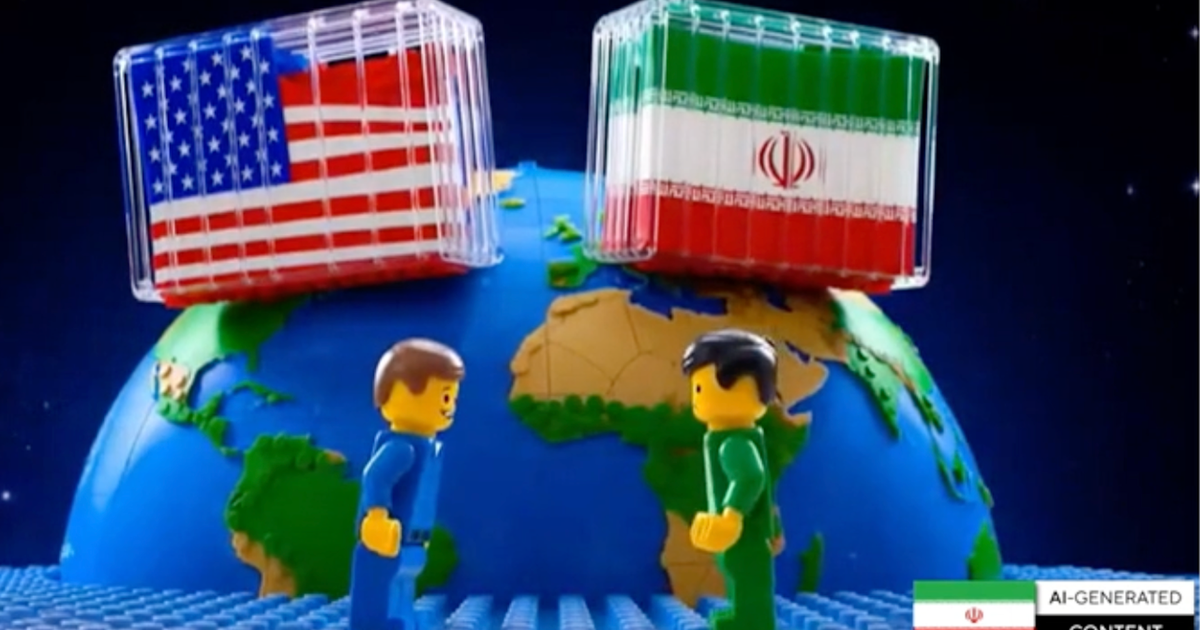
Among the most striking examples is an account called Explosive Media, which uses Lego bricks to convey Iran’s messaging. The creative approach has sparked global curiosity, with some viewers interpreting it as a universal symbol of accessibility. When asked about their choice, a representative from Tehran explained, “Lego is a universal language. Everyone can understand it without needing to speak.”
“Every person around the world can grasp its meaning without words,” the spokesperson said, emphasizing the simplicity and appeal of the medium.
Schafer believes these videos are likely generated by artificial intelligence, underscoring how technology is transforming the propaganda battlefield. “AI creates content that is easily shareable and engaging,” he observed. “People are drawn to it, not the formal statements from diplomats.” This trend highlights a broader challenge: as audiences grow accustomed to quick, digestible content, traditional messaging struggles to compete.
A Cracks in U.S. Propaganda Strategy
Former State Department officials have raised concerns about the U.S. approach to the conflict. Jamie Rubin, who once led the Global Engagement Center—a division shut down after Congress cut its funding in 2024—shared his perspective. “We had an information warfare unit designed to counter Russian, Chinese, and Iranian disinformation,” Rubin recalled. “But it’s been eliminated, leaving us without a strong defense.”
“This is a painful subject, and it’s painful because we haven’t adhered to the basics of building public support for military action,” Rubin said. “You need a compelling cause, urgent stakes, and trusted messengers.”
Rubin pointed to the Trump administration’s approach as a key factor in this decline. “Our policy is now entirely dictated by the White House,” he stated. “If every response requires approval from the executive branch, we’ve lost control of the narrative.” This centralized control, he argued, limits the agility needed to counter Iran’s digital campaigns effectively.
The Cost of a Lost Narrative
The consequences of this propaganda shift are significant. With the U.S. struggling to maintain a coherent message, Iran’s ability to craft relatable content gives it an edge in shaping public perception. “The financial cost of war is a message that sticks,” Schafer reiterated. “It’s a powerful way to challenge the legitimacy of military actions without requiring a massive budget.”
Meanwhile, the use of AI tools by Iranian creators exemplifies the evolving nature of influence. These tools enable rapid content production, allowing Iran to respond swiftly to U.S. narratives and amplify its own. “Technology is leveling the playing field,” Schafer said. “It’s no longer just about the size of your budget—it’s about the creativity of your message.”
As the conflict continues, the question remains: can the U.S. reclaim its position in the digital propaganda war? With Iran’s strategy gaining momentum and the U.S. grappling with internal challenges, the answer may hinge on whether American leaders can adapt their messaging to the new, decentralized landscape. The battle for hearts and minds is no longer confined to traditional media—it’s a race for attention in the vast, interconnected world of social platforms and AI-generated content. The outcome of this contest could shape the future of global influence itself.
The digital battlefield is a dynamic space, where the rules of engagement are constantly changing. While the U.S. has historically led in strategic communication, Iran’s ability to blend satire, simplicity, and technology has turned the tide. This new era of propaganda underscores the importance of not just content, but context. As Schafer noted, “The power of a message lies in its ability to connect with people’s values and emotions.” If the U.S. fails to do so, it risks losing the war not just on the ground, but in the hearts of its own citizens and the wider world.