
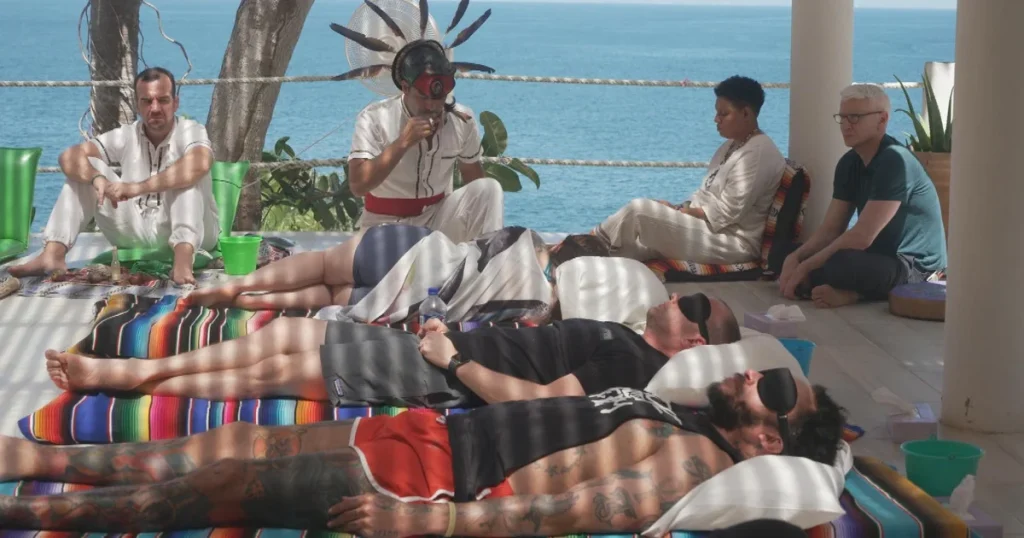
Nine Veterans Sought Relief From PTSD in a Mexican Psychedelic Retreat — Here’s What They Reported Nearly a Year Later
Wertynews.com – This account was originally published on February 2, 2025, and has since been updated with follow-up reporting.
A Federal Shift That Hasn’t Reached Patients Yet
In 2024, the Department of Veterans Affairs made a historic announcement: for the first time, it would bankroll its own clinical trials examining two psychedelic compounds — psilocybin and MDMA — as treatments for post-traumatic stress disorder, depression, and addiction. Even assuming those trials yield positive results, veterans will likely wait years before either substance becomes available through VA channels.
That timeline, however, has not stopped thousands of service members from seeking help now. Many are traveling to countries where these substances are legally administered, often within indigenous ceremonial frameworks, simply because the suffering cannot wait for bureaucratic timelines.
Nine Veterans, One Week, One Remote Village
In March 2024, a group of nine veterans flew from various points across the United States to a secluded village on Mexico’s west coast, near Puerto Vallarta, for a week-long psychedelic journey. Each carried what they described as invisible wounds — injuries no uniform or medal could account for.
The retreat was organized and funded by the Heroic Hearts Project, a nonprofit organization that has helped more than 1,000 American veterans with combat-related PTSD gain access to psychedelic-assisted experiences. To qualify, participants had to coordinate with their physicians to taper off any antidepressant or anxiety medication, given potential interactions with the psychedelics, and complete a full medical screening.
TJ Duff: A Sailor Who Barely Survived
TJ Duff enlisted in the Navy at age 18. Months into his first deployment aboard the USS Cole, two suicide bombers struck the ship in Yemen, killing 17 sailors. Duff says he narrowly escaped death that day.
“Everyone around me was killed. There’s bodies, alive and dead, being piled up in the midships. And– I think that’s really where I just started holding everything in.”
Asked by Anderson Cooper whether he felt optimistic about the retreat ahead, Duff responded:
“Being optimistic is hard for me. Because I’ve been through a lot of therapy, a lot of different treatments. And not a lotta success.”
Randy Weaver: Twenty Years of Carrying a Friend’s Name
Randy Weaver, now a police officer in New York, served as a staff sergeant in the Army before being diagnosed with PTSD in 2007, following deployments to Bosnia, Iraq, and Afghanistan. He describes his condition as a self-destructive pattern — jumping into ditches at loud noises, replaying scenarios endlessly.
“It’s the constant, you know, what if I had done this? What if we did that, you know?”
When Cooper asked whether he wanted to revisit specific memories under psilocybin, Weaver pointed to a single date: March 18, 2004. His platoon had been caught in a firefight in an Afghan village. Two soldiers were killed, one of them his close friend, Staff Sergeant Anthony Lagman. Weaver has worn a bracelet engraved with Lagman’s name every single day since returning home — two decades now.
“Yeah. Every day.”
Weaver has attempted virtually every treatment the VA offers: talk therapy, exposure therapy, meditation, antidepressants. He described reaching a point of such mental exhaustion that internal voices told him his family would be better off without him.
“You get to a point where you’re– you’re so mentally exhausted and you’ve created so much destruction that you– your demons tell yourself that these– your family would be better off without you and when those demons tell you those things every day, it’s somethin’ hard to ignore.”
Asked if the retreat might ease that burden, he answered simply:
“I hope so.”
Ed Glover: Anger That Followed Him Home
Ed Glover served with the Marines in Afghanistan and has worked as a firefighter for 22 years. He returned from deployment carrying what he described as super-angry, super-anxious, hyper-vigilant states that ultimately contributed to a painful divorce.
“I feel like one or two traumatic events you may be able to recover from, but– kind of seeing it day in, day out– really takes its toll.”
Michael Giardina: Wounds That Predate the Uniform
For some in the group, the roots of their suffering stretched well before military service. Navy veteran Michael Giardina grew up under an emotionally abusive father who took his own life 17 years ago. His sister died by suicide just five months before he arrived at the retreat.
“My family life was just always this constant conflict.”
He recalled his daughter asking his ex-wife whether he was going to kill himself.
“I’m not. I just want to get better.”
A Risk Worth Taking
For each of the nine, the journey into the unknown represented a calculated gamble — one made not out of curiosity but out of exhaustion with conventional options that had failed to deliver lasting relief. They crossed an ocean, stepped into a ceremony, and opened themselves to substances and experiences that, for most of their adult lives, had been unavailable or unthinkable.
Related Reading
Frequently Asked Questions
What is Nine veterans with PTSD went to Mexico?
Nine veterans with PTSD went to Mexico is the main topic of this guide. The article explains the context, practical details, and next steps readers should understand.
Why does Nine veterans with PTSD went to Mexico matter?
Nine veterans with PTSD went to Mexico matters because readers are looking for a useful answer, not just a short summary. Good content should match search intent and help them decide what to do next.