
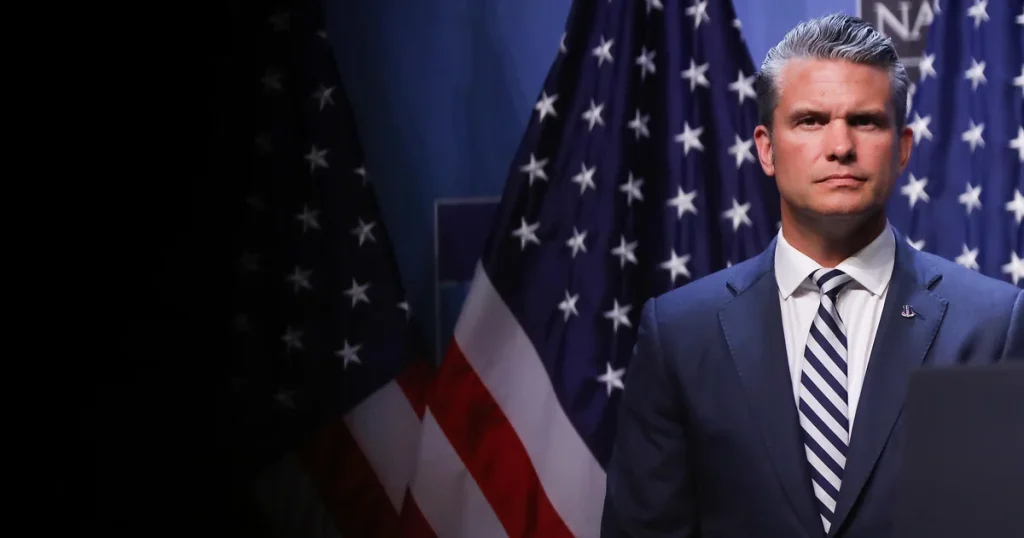
Appeals Court Upholds Pentagon’s Reporter Escort Regulation
Wertynews.com – Washington — A federal appellate panel ruled Thursday to retain the Pentagon’s mandate requiring journalists to be accompanied by military personnel while on its premises. The three-judge panel, part of the U.S. Court of Appeals for the District of Columbia Circuit, reached a split decision, with two justices aligning with the Trump administration to reinstate a previously suspended rule.
Majority Opinion Supports Pentagon’s Stance
Justice Karen Henderson and Patricia Millett, appointed by George H.W. Bush and Barack Obama respectively, concluded that the escort policy does not infringe upon First Amendment rights. In an unsigned ruling, they stated that the New York Times and reporter Julian Barnes had not demonstrated that the policy was uniquely targeting them or unfairly restricting their ability to report.
“The New York Times and Julian Barnes have not argued that the escort requirement is not generally applicable or evenly enforced across all reporters. They also failed to show that the policy has a distinct impact on their work compared to other journalists,” the judges noted.
Dissenting View Highlights Concerns
Judge Bradley Garcia, appointed by Joe Biden, disagreed, emphasizing that broad application of a policy does not negate its potential to suppress speech. He argued, “A government policy meant to retaliate against journalists should not be shielded simply because it is applied uniformly to all.”
“If imposing an escort requirement on one journalist sufficiently deters their reporting, as the district court found, it becomes illogical to claim the same rule applied to all has no chilling effect. In fact, the impact on a speaker who values their peers might be intensified,” Garcia wrote.
The Pentagon’s revised policy, introduced during Secretary Pete Hegseth’s leadership, imposed stricter conditions on media access. News organizations like CBS News, the Washington Post, CNN, and the New York Times opted out of the new guidelines, citing concerns over restricted freedoms. The Times and Barnes initiated a legal challenge, asserting the policy violated constitutional protections for free speech.
Following a March ruling that invalidated some provisions, the Pentagon adjusted its approach by relocating press workspaces outside the building and enforcing the escort rule. The Times then filed a second lawsuit in May, targeting the escort policy. U.S. District Judge Paul Friedman initially blocked the requirement, but the Trump administration contested the decision, arguing the policy applied equally to all reporters without hindering their access.
Legal representatives for the Justice Department dismissed the Times’ claims of retaliation as “nonsensical,” supporting the Pentagon’s position that the policy maintains consistent enforcement across the board.