
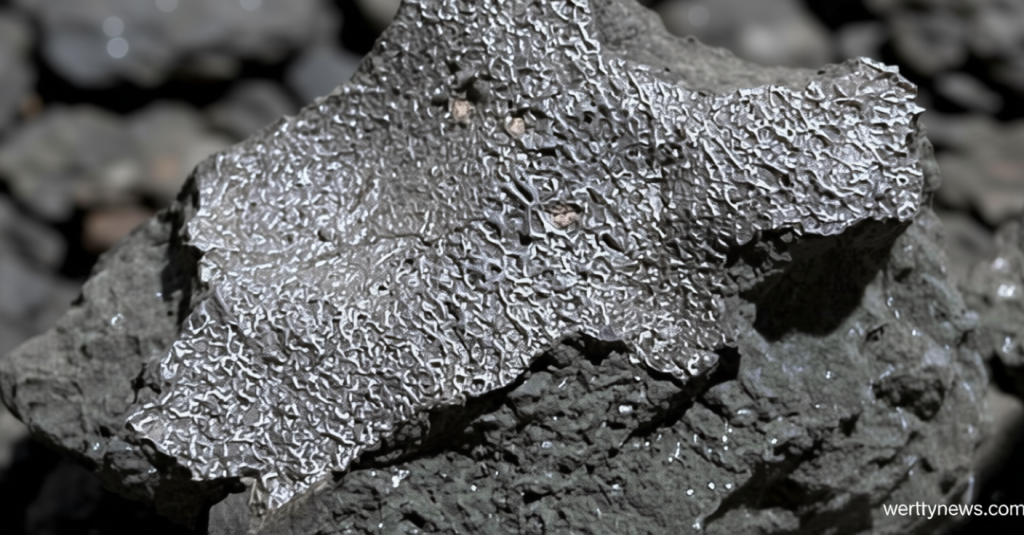
Scientists Identify ‘Alien World Chemistry’ in New Jersey Meteorite
Wertynews.com – The meteorite that crashed into a New Jersey home has captured global attention for its unique composition, revealing prebiotic molecules and compounds that could hold clues to the origins of life. This discovery, made in July 2024, marks the second time a CM1/2 carbonaceous chondrite meteorite has been documented to impact Earth, according to researchers. The sample, preserved in fragments, offers a rare glimpse into extraterrestrial chemistry and its potential role in shaping early Earth’s biosphere.
Preservation and Expert Study
The homeowner’s prompt action in safeguarding the meteorite’s remnants with glass containers, gloves, and aluminum foil was pivotal. This care enabled international scientists to conduct detailed analyses, uncovering the meteorite’s extraordinary makeup. The findings, published in the journal *Science Advances*, highlight its significance as a pristine extraterrestrial sample. The SETI Institute emphasizes that such discoveries are critical for bridging the gap between cosmic phenomena and terrestrial biology.
Brine and Life’s Building Blocks
A major revelation from the forensic examination was the presence of concentrated salty fluids on the meteorite’s surface, as noted by study co-author Peter Jenniskens. This brine, previously unobserved on similar objects, suggests that the parent asteroid may have once contained liquid water that evaporated. The high salt concentration could have played a key role in stabilizing phosphate compounds and enabling amino acids—fundamental to life—to form under extraterrestrial conditions.
“The salty brine likely acted as a medium for chemical interactions, preserving molecules that might have been crucial for the development of life on Earth,” explained Queenie Chan, a cosmochemist involved in the research. “Such environments could mimic the early conditions of our planet, offering insights into how life began.”
Organic Compounds and Evolutionary Insights
Alongside the brine, the meteorite contains a range of soluble organic compounds, some of which may have originated from its parent asteroid or formed through collisions in space. Among these are magnesium-based molecules, found in blood and photosynthesis, as well as amino acids. These findings support the hypothesis that carbonaceous chondrites like this one could have transported organic materials to Earth, contributing to the emergence of complex life forms.
Unique Composition and Scientific Implications
What sets this meteorite apart is its rich chemical diversity, which includes both simple and complex organic molecules. The presence of such compounds in a meteorite from New Jersey underscores the importance of studying these cosmic objects for understanding the chemical processes that may have occurred in the early solar system. Scientists believe that the meteorite’s chemical profile could mirror the conditions of ancient Earth, where life’s building blocks first formed.
Legacy for Future Research
Following the study, several key fragments will be housed at the American Museum of Natural History in New York City. The meteorite’s trajectory included a close pass over the city before landing in New Jersey, making it a notable sample for both local and global scientific communities. “This meteorite from New Jersey is a treasure trove of information,” said museum curator Denton Ebel. “It will serve as a vital resource for future research into the chemical foundations of life.” The sample’s preservation and accessibility now offer new opportunities to explore the connections between space and the development of Earth’s ecosystems.