
A Mother’s Near-Miss: HELLP Syndrome and Liver Bleeding Threaten New Life
When Warning Signs Escalate
Wertynews.com – Candice Davis never anticipated that her first pregnancy would become a medical emergency. The experience had been remarkably smooth up until mid-June 2025, when just eleven days remained before her expected delivery date. On that particular morning, everything appeared routine. However, as time progressed, nausea settled over her while she rested near her swimming pool. The discomfort eventually migrated to her upper abdomen.
Her spouse strongly recommended heading to medical care immediately. Davis initially hesitated, confident in her professional knowledge. Working as a recruiter for an obstetric practice, she believed she could recognize serious complications. Still, when her close friend and physician, Dr. Susan Passarella, also encouraged an emergency room visit, Davis finally agreed to go.
A Rapid Medical Crisis
At Baptist Hospital’s obstetric emergency department in Pensacola, Florida, medical staff discovered elevated blood pressure readings. The decision was made to monitor her through the night. Complications emerged swiftly thereafter.
Davis experienced intensifying pain alongside continuously rising blood pressure levels. Her liver enzymes surged dramatically. Medical professionals recommended inducing labor within two hours of her arrival. Although she had envisioned a natural delivery, circumstances demanded otherwise.
“Everything kept getting worse,” she explained. The medical team ultimately chose to perform a cesarean section to deliver her baby.
Reflecting on that moment, Davis expressed profound gratitude. She recalled being in severe discomfort, noting that even an epidural failed to alleviate her upper abdominal pain. Fear overwhelmed her as she realized she could not deliver naturally. Sitting upright proved impossible, yet she remained aware of the gravity of the situation.
HELLP Syndrome and Critical Complications
Medical staff diagnosed Davis with HELLP syndrome, a rare pregnancy-related condition connected to preeclampsia. This disorder impacts liver function and can trigger sudden hemorrhaging. According to Dr. Passarella, preeclampsia develops in approximately five to eight percent of pregnancies, while HELLP syndrome manifests in only 0.01 to 0.06 percent of cases. Most patients recover following delivery.
Although Davis’ son was delivered safely through surgery, his body had been pressing against a seventeen-centimeter wound in her liver. Once the baby was removed, her organ began bleeding uncontrollably.
“When they were getting my son out, they said, ‘Oh, there’s not blood. This is good,'” Davis recounted. “And within seconds, it was, ‘Oh, there’s blood, there’s a lot of blood.'”
The anesthesiologist quickly placed a mask over her face, announcing that she needed to be sedated immediately. Her medical team had anticipated this possibility due to her elevated liver enzymes. A surgeon stood ready, and the cesarean procedure had been designed to allow access to her liver if needed.
Despite these preparations, the hemorrhage persisted. Davis became too unstable for additional surgical intervention, compelling doctors to pack her body with sterile materials and wait until morning for her condition to stabilize. Unable to breathe independently, she faced an uncertain future. Dr. Passarella, receiving updates through Davis’ husband, worried her friend might never regain consciousness.
“It was just one thing after another,” Passarella described. “He asked me, ‘Is she going to survive this?’ I didn’t know what was going to happen.”
Recovery and Resilience
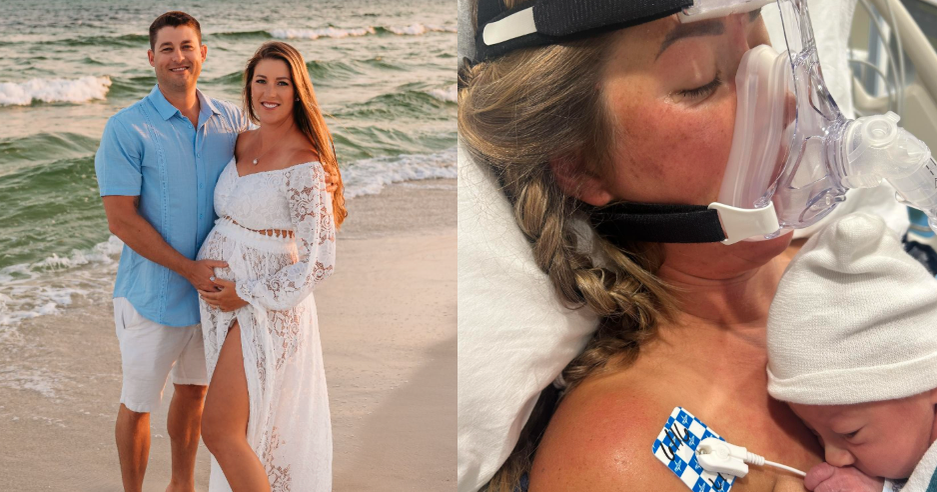
After approximately twenty-four hours, physicians successfully halted the bleeding. Davis regained the ability to breathe on her own the following day and gradually regained awareness. However, her earliest recollection of the ordeal occurred two days later, when her four-day-old son, Camden, was placed against her chest in the intensive care unit.
“My blood pressure was still elevated, and Camden, my son, he was crying,” Davis remembered. “I heard my sister say, ‘Oh look, he stopped crying when he got on her chest, and her blood pressure immediately started decreasing.’ That’s something I’ll never forget.”
Her recovery remained incomplete. Blood clots developed in her left hand, but she could not receive blood thinners due to the risk of renewed liver bleeding. Physicians attempted topical treatments and a hyperbaric oxygen chamber, yet Davis ultimately lost her thumb and portions of her other four fingers on her left hand.
Over subsequent weeks, she underwent six surgical procedures to excise damaged tissue. Intensive therapy followed to help her relearn hand movements.
Adjusting to amputations while caring for an infant proved exhausting, despite having her husband and extended family nearby. She reflected on how completely her expectations had shifted.
“Everything I had planned just went out the window,” she stated. “It was a whole process in terms of what changed from what I thought was going to happen. I couldn’t change his diaper by myself. I had to get help feeding him.”
Related Reading
Frequently Asked Questions
What is A pregnant woman had 2 signs?
A pregnant woman had 2 signs is the main topic of this guide. The article explains the context, practical details, and next steps readers should understand.
Why does A pregnant woman had 2 signs matter?
A pregnant woman had 2 signs matters because readers are looking for a useful answer, not just a short summary. Good content should match search intent and help them decide what to do next.