
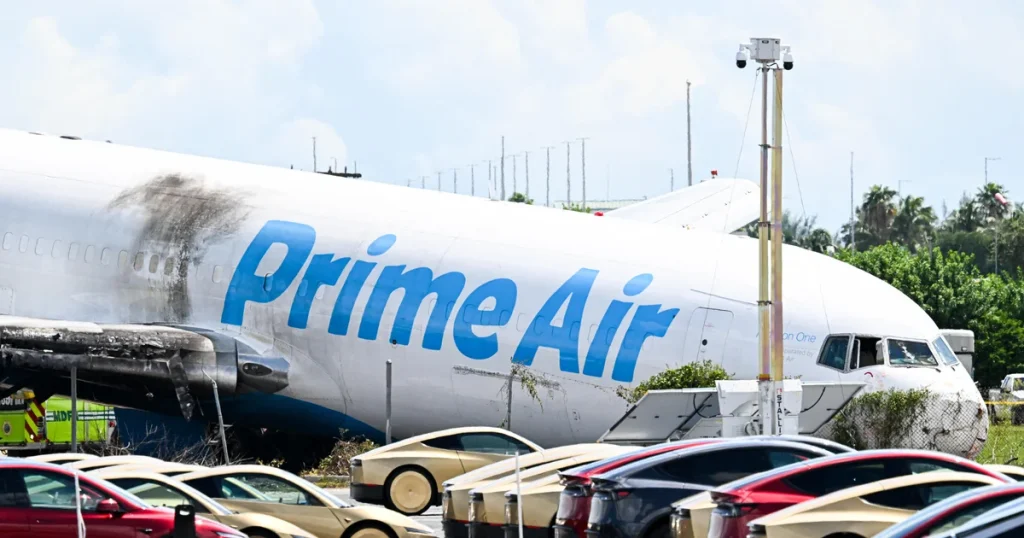
NTSB Confirms All Five Fatalities in Miami Cargo Plane Crash Were Passengers in Struck Vehicles
Wertynews.com – Investigators confirmed Monday that every person killed when an Amazon cargo jet overshot its landing and plowed into traffic near Miami International Airport was riding inside one of two ground vehicles the aircraft struck. The revelation, delivered by NTSB Chair Jennifer Homendy at a midday press briefing, narrowed the scope of the tragedy while underscoring just how far the Boeing 767-33 Alpha traveled beyond the end of the runway before finally stopping and erupting in flames on Sunday.
Five people died. At least five more were wounded. Homendy made clear that none of the fatalities occurred aboard the aircraft itself. All five victims were occupants of the two vehicles caught in the plane’s path after it left the paved surface of Runway 30.
The Flight and the Runway Excursion
The aircraft, identified as Amazon Air Flight 7598 and operated by 21 Air LLC, had just completed its third leg of the day. Its route that afternoon ran from Cincinnati to Miami, then Miami to San Juan, Puerto Rico, and back to Miami. On final approach into the Florida airport, the jet overshot the runway, clipped navigational aids, and kept rolling forward.
Homendy detailed the sequence: the plane first struck a 2012 white Ford Econoline van belonging to Professional Ocean Service Corporation, a contract cleaning outfit that services airlines at the airport. Seven people were aboard the van at the moment of impact. The aircraft then tore through a perimeter fence and hit a Toyota Corolla Cross LE traveling along Northwest 67 Avenue. It continued into a grassy area where a second fence line stood near a staging zone for Tesla robotaxis before finally halting roughly 1,300 feet beyond the paved runway surface.
The van sat inside the airport boundary; the Toyota was on the public roadway outside. That distinction, Homendy noted, meant the crash crossed from controlled airport property into ordinary neighborhood traffic.
Injuries and First-Responder Response
Two of the wounded were transported to Jackson Memorial Hospital, where their conditions have not been publicly disclosed. Three others were rushed to the Ryder Trauma Center at Jackson in critical condition. Cell-phone footage captured by bystanders shows first responders pulling a survivor from the wreckage of the crushed Toyota while firefighters worked to extinguish the burning airframe.
Local officials have lauded the speed of the emergency response. Commissioner Natalie Milan Orbis, who represents District 6 in Miami-Dade County, highlighted the near-instantaneous arrival of crews.
“We are so, so very proud of our Miami-Dade Fire Rescue; they had a record response time of 30 seconds, and our sheriff’s office did an incredible job out there investigating.”
Witnesses who drove past the airport in the minutes after the crash described scenes that felt surreal. Grace Mercado, who was in traffic nearby, recalled the sight of thick smoke rolling over the airfield.
“You look, and you just see black smoke everywhere. It was just absolutely insane. It looked like something from a movie.”
What the NTSB Has Recovered and What Comes Next
The board announced it has retrieved both the flight data recorder and the cockpit voice recorder from the wreckage. Both units are en route to NTSB headquarters, where engineers will download and analyze their contents. Homendy cautioned that preliminary speed figures exist from secondary sources but that the agency intends to verify every number against the flight data recorder before releasing any findings to the public.
A team of 32 investigators is stationed at the crash site. Full access to the airframe has not yet been possible because recovery operations remain underway and fuel is still being drained from the fuselage. No formal interviews with witnesses or personnel have taken place; the transportation disaster assistance team is in the process of scheduling them, though Homendy said she could not yet confirm which individuals had been contacted.
Beginning Tuesday, the investigation will split into specialized working groups covering human performance, airplane systems, power plants, air traffic control, aircraft performance, structures, meteorology, and airport survival factors. Each group will pursue its own line of inquiry before findings converge.
The EMAS Question
One area of particular scrutiny will be whether an Engineered Materials Arresting System should have been in place at the end of Runway 30. EMAS is a crushable, lightweight material laid beneath the final stretch of a runway. When an aircraft overruns the pavement, the plane sinks into the mat, which deforms and absorbs kinetic energy, slowing the aircraft to a stop without the violent deceleration forces of a hard stop. The system is designed to reduce the likelihood of fire, structural breakup, and collision with objects beyond the runway end. Investigators will assess whether the absence of such a system at this particular runway contributed to the severity of the crash and whether its installation could have altered the outcome.
Professional Ocean Service Corporation, the cleaning company that owned the Econoline van, declined to comment when reached for this story. The company’s role as a contract vendor servicing airlines at the airport places its vehicles in the operational perimeter of the airfield, a detail that may factor into later questions about vehicle placement and airport ground-traffic protocols.
Homendy closed the briefing with a description of the wreckage that left little to the imagination.
“I would describe it in one word: devastating, utter devastation. The Econoline van is torn apart. You can see airbags, the surrounding airbags. You can see components from vehicles, both passenger vehicles and the aircraft itself. Certainly navigation components, some debris from the airport, and then certainly fencing everywhere. It’s pretty extensive.”
The investigation is expected to run for months. Until the recorders are decoded and witness interviews completed, the board has said it will not speculate on cause. For now, the confirmed fact remains: every fatality was a person in a vehicle on the ground, caught in the path of a jet that had already left the runway.
Related Reading
Frequently Asked Questions
What is Amazon cargo plane crash victims were?
Amazon cargo plane crash victims were is the main topic of this guide. The article explains the context, practical details, and next steps readers should understand.
Why does Amazon cargo plane crash victims were matter?
Amazon cargo plane crash victims were matters because readers are looking for a useful answer, not just a short summary. Good content should match search intent and help them decide what to do next.