
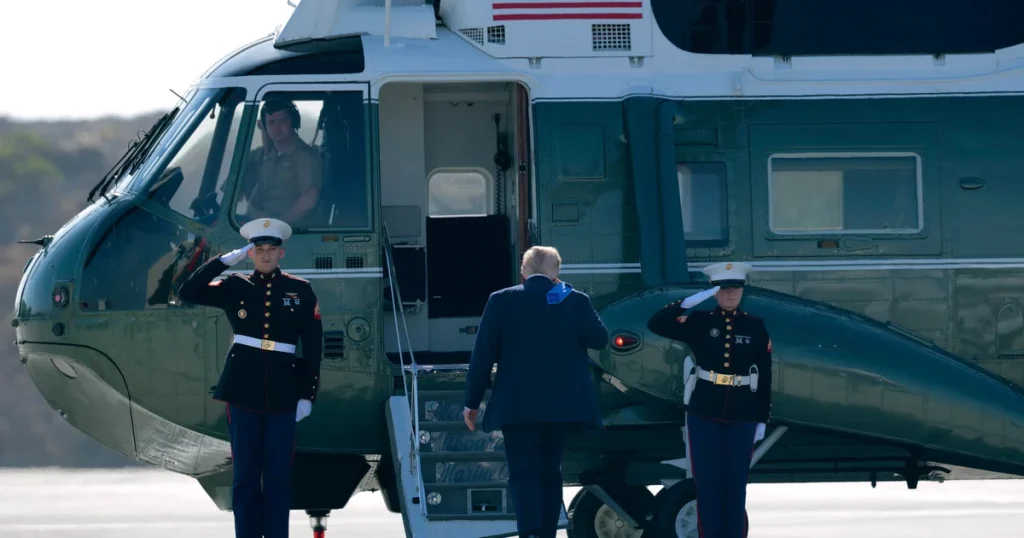
FAA Reviews Marine One Incident at Reagan National Airport
Presidential Helicopter Departure Sparks Investigation
Wertynews.com – The Federal Aviation Administration is currently reviewing an incident involving Trump’s Marine One helicopter during a departure from the White House on Tuesday. The FAA reviewing incident involving Trump flight has prompted questions about air traffic coordination at Reagan National Airport, where controllers were managing normal operations when the presidential helicopter lifted off. President Trump was aboard Marine One as it prepared to transport him to the West Coast for upcoming engagements.
This incident comes in the wake of a significant aviation safety change at Washington’s Reagan National Airport. Following a tragic midair collision in January 2025 between an American Airlines commercial jet and an Army Black Hawk helicopter, the Transportation Department implemented new restrictions on helicopter movements in the area. These rules specifically barred non-essential helicopter operations in the airspace surrounding the airport. However, emergency flights and Marine One remain exempt from these limitations. When either type of aircraft crosses the Potomac River, a ground stop at the airport is required to ensure safety.
Communication Challenges During Departure
On Tuesday, as the president prepared to travel to the West Coast, the Marine One pilot attempted to reach the DCA tower three separate times to warn controllers that liftoff was imminent. At one moment, the tower responded but requested the pilot repeat the transmission because the signal “was broken and unreadable.” This communication difficulty added complexity to an already busy air traffic situation at the airport.
Marine One then lifted off, seemingly catching air traffic controllers by surprise. The tower quickly informed the presidential helicopter that airport operations were still active and that another aircraft remained airborne. A controller relayed the message:
“Marine One, you’ve got traffic rotating off runway one.”
The presidential helicopter acknowledged the warning and maintained its position, then communicated back to the tower:
“National Tower, Marine One — we’re going to be doing a delay.”
Official Response and Safety Assessment
The Wall Street Journal was the first publication to report on this incident. According to the FAA, President Trump faced no danger during the episode. Speaking with CBS News, the FAA explained that “there was momentary loss of separation after which the aircraft continued to move away from one another.” The agency stated it would maintain its review of the situation to ensure all protocols were followed correctly.
The Marine Corps characterized the flight as “routine” and noted that air traffic controllers “approved the requested route and provided timely and appropriate traffic information.” This official response suggests that while the incident was notable, it did not represent a serious safety concern. The FAA reviewing incident involving Trump continues as officials gather additional information about the timeline and communication gaps that occurred.
Aviation experts have noted that incidents like this, while uncommon, can occur during busy periods at major airports. The fact that Marine One was exempt from the helicopter restrictions implemented after the January 2025 collision means it could operate even when other helicopters were grounded. This exemption is designed to ensure the president can travel without unnecessary delays, even during periods of heightened air traffic restrictions.
What This Means for Future Flights
The ongoing investigation by the FAA reviewing incident involving Trump will likely result in recommendations for improved communication protocols between Marine One and air traffic controllers. While no changes are expected immediately, officials may implement additional measures to prevent similar situations in the future.
For travelers using Reagan National Airport, the incident serves as a reminder of the complex coordination required to manage both commercial and presidential flights. The airport continues to operate normally, with the new helicopter restrictions remaining in place for non-essential operations.
Frequently Asked Questions
What exactly happened with Marine One at Reagan National Airport?
Marine One departed from the White House while air traffic controllers at Reagan National Airport were managing normal operations. The pilot attempted to contact the tower three times before liftoff, but communication issues occurred. Once airborne, controllers informed Marine One that another aircraft was still operating on the runway.
Was President Trump in any danger during the incident?
No. According to the FAA, President Trump faced no danger during the episode. There was a momentary loss of separation between Marine One and another aircraft, but they continued to move away from one another safely.
Why was Marine One allowed to fly when other helicopters were restricted?
Following the January 2025 midair collision at Reagan National Airport, the Transportation Department implemented restrictions on helicopter movements. However, emergency flights and Marine One remain exempt from these limitations to ensure the president can travel without unnecessary delays.
When will the FAA complete its review of this incident?
The FAA has not provided a specific timeline for completing its review. The agency stated it would maintain its review of the situation to ensure all protocols were followed correctly and to identify any areas for improvement.
Are there any changes expected to air traffic procedures at Reagan National Airport?
While no immediate changes are expected, the ongoing investigation may result in recommendations for improved communication protocols between Marine One and air traffic controllers. Officials may implement additional measures to prevent similar situations in the future.