
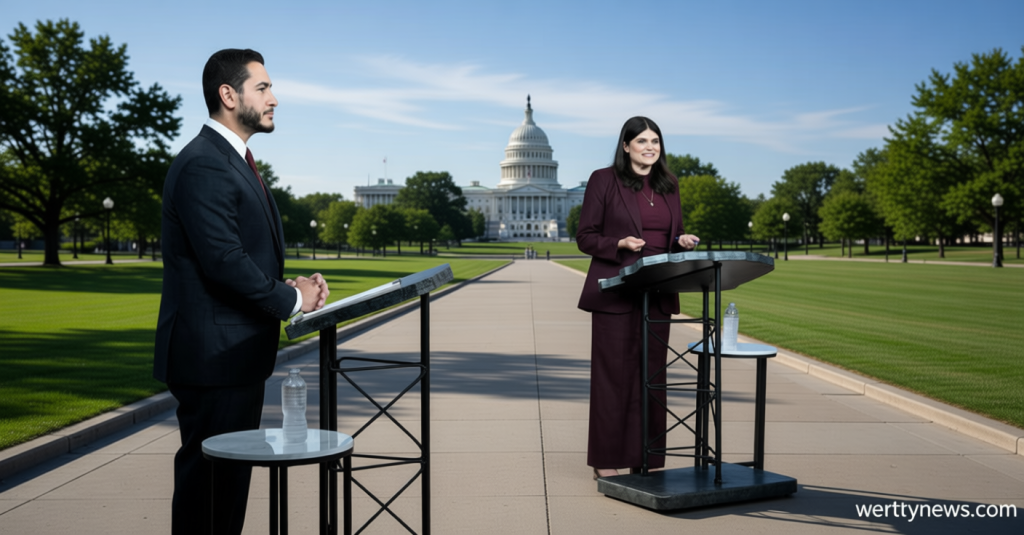
Final Michigan Senate Democratic Debate Highlights Key Differences
Wertynews.com – In final Michigan Senate Democratic debate held in Southfield, Michigan, candidates Haley Stevens and Abdul El-Sayed clashed over campaign spending, foreign policy positions, and personal attacks. The contest sets up a critical matchup before Tuesday’s primary election, with voters deciding who will challenge Republican Mike Rogers in November.
The race to replace outgoing Senator Gary Peters has become a broader party conversation about progressive versus moderate approaches. Both candidates have strong credentials, but their positions on Medicare for All, immigration enforcement, and U.S. support for Israel reveal distinct ideological differences that could define the Democratic primary.
Campaign Finance Becomes Central Issue
Outside spending has emerged as a defining theme in this race. El-Sayed has repeatedly questioned the millions flowing into Stevens’ campaign from organizations tied to AIPAC. During Monday’s debate, he highlighted Stevens’ July vote against an amendment reducing military aid to Israel by $3.3 billion, calling it poor use of taxpayer money.
Stevens defended her record, noting that outside contributions would not change her views on Israel. She supports a two-state solution and has publicly criticized Israeli Prime Minister Benjamin Netanyahu, drawing a response from him during a CNN interview.
Stevens also pointed to a super PAC supporting El-Sayed, the “Fighting for Michigan PAC,” that has received $300,000 from his father-in-law, Jukaku Tayeb. “I don’t think there’s much difference between super PACs going in for Abdul or super PACs going in for me. We have a problem with campaign finance reform in this country,” Stevens said.
Financial records show the Fighting for Michigan organization has invested more than $2.3 million in El-Sayed’s campaign. Meanwhile, AIPAC’s super PAC, the United Democracy Project, has contributed over $19.9 million to Stevens through July 20. Another group called “A Stronger Michigan” has allocated $16.8 million for Stevens while keeping donors private.
“My father-in-law does not want to send your tax dollars to the Israeli military to do genocide, I’ll tell you that much,” Tayeb told reporters after the debate.
El-Sayed has regularly accused Israel of committing genocide in the Gaza Strip, an allegation that Israel firmly rejects. Advertisement tracking company AdImpact reports that Stevens’ campaign alongside six supporting super PACs have invested more than $61 million in primary advertisements. FEC records indicate that El-Sayed’s campaign combined with outside groups has spent over $15.3 million.
Electability Debate Intensifies
The August 4 Democratic primary winner faces Republican former Representative Mike Rogers in November. Rogers spent Monday alongside President Trump during the president’s comments at a General Motors facility in Milford, Michigan.
“The president is doing his part. You look around the country. They’re scoring some big wins in manufacturing … We got to send President Trump some help,” Rogers said on stage with the president, who won Michigan in 2024 by 1.4 points.
A Republican has not held Michigan’s Senate seat for 25 years. However, as the national Democratic Party examines whether progressive candidates can win nationally, Stevens and her supporters argue that El-Sayed presents a political vulnerability. El-Sayed does not classify himself as a socialist.
“I’m just a capitalist who understands how capitalism works,” El-Sayed said Monday night. “The biggest threat to capitalism was never the idea of government regulation. It was always monopol[ies].”
Progressive leaders including independent Senator Bernie Sanders of Vermont and Democratic Senator Elizabeth Warren of Massachusetts have endorsed El-Sayed. Stevens receives support from the party’s moderate wing, including Peters and Michigan Governor Gretchen Whitmer.
Stevens contended that one element that progressive politicians backing El-Sayed are “missing” is “an understanding of what makes Michigan voters electable.” In final Michigan Senate Democratic debate discussions, electability concerns continue to shape voter perceptions of both candidates as the primary approaches.