
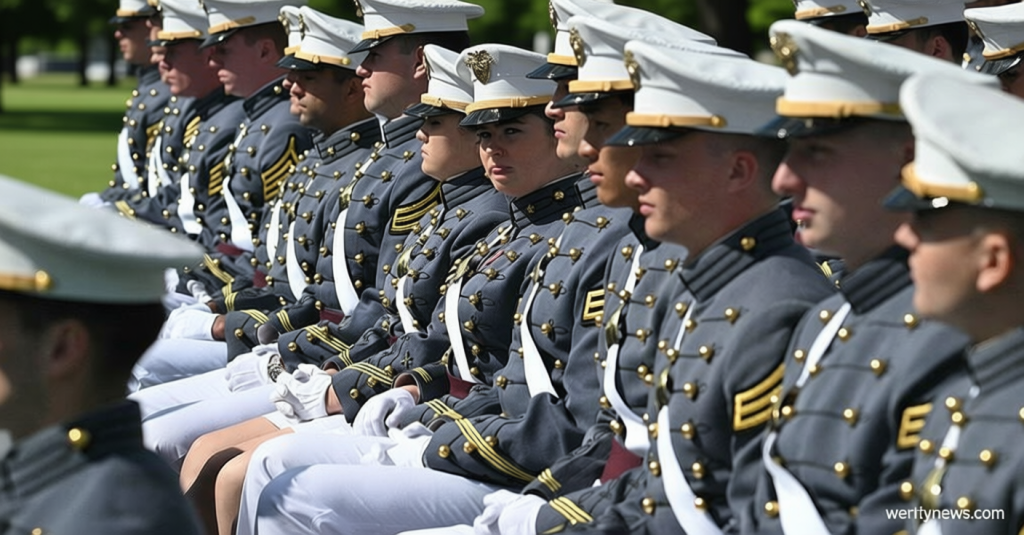
Pentagon Draft Memo Proposes Sweeping Changes to Military Academy Education
Wertynews.com – An unreleased draft memorandum has surfaced that could fundamentally transform how the United States educates its future military leaders. According to the document obtained by CBS News, the Defense Department is contemplating the most extensive restructuring of military higher education in recent history. The proposal would eliminate tenure for civilian professors and completely overhaul the academic programs at military service academies alongside senior war colleges.
Scope of the Proposed Reforms
Titled “Refocusing the Military Service Academies and Senior Service College on Warfighter Education,” the memorandum outlines significant changes for several key institutions. These include the U.S. Military Academy at West Point, the U.S. Naval Academy located in Annapolis, and the U.S. Air Force Academy situated in Colorado. Additionally, the Naval War College in Rhode Island and the Army War College in Pennsylvania would fall under these new directives. Together, these establishments currently enroll more than 10,000 students and officers.
The memo has not yet received final approval from senior Pentagon leadership. Consequently, the timeline for completion and distribution remains uncertain, as does the method of implementation once approved.
Challenging the Tenure System
One of the most notable provisions targets the tenure system itself. The document argues that tenure, while originally intended to safeguard academic freedom, has become counterproductive in practice.
“Tenure is a construct designed to protect academic freedom within universities. In practice, it more often leads to stagnation, complacency, and inflexibility,” the memorandum states. “It contributes to curriculum that drifts from the mission of educating our warfighters to the research priorities of the tenured academics.”
While the memo declares that tenure would be abolished “effective immediately,” it grants Anthony Tata, the under secretary of defense for personnel and readiness, a 60-day window to issue implementation guidance and begin the curriculum review process.
Comprehensive Curriculum Overhaul
Beyond employment structures, the proposal extends directly into classroom content. Defense Department officials would be instructed to perform a meticulous, “line-by-line” examination of every course offered at military academies and senior service colleges. Each class would be evaluated against one primary criterion: does it directly advance “tactical operational or strategic warfighting” capabilities?
Courses identified as non-essential or “ideologically driven” would face elimination. However, the memo does not specify the exact criteria the Pentagon will employ to classify academic instructions as either non-essential or ideologically motivated.
Key Figures Behind the Initiative
U.S. military officials, speaking on condition of anonymity due to authorization restrictions, indicated that Tim Dill is spearheading this policy proposal. Dill serves as the assistant defense secretary for manpower and reserve affairs. A former Army Green Beret officer, he previously held the position of national security adviser to Republican Senator Ted Cruz of Texas.
The memorandum still requires approval from two additional officials. Anthony Tata, a West Point graduate, must endorse the changes. Defense Secretary Pete Hegseth, a former Fox News host and National Guard veteran, also needs to provide his sign-off.
Part of a Broader Military Education Transformation
This proposal represents the newest phase in Hegseth’s ongoing effort to reshape military education. Since assuming his position, the Pentagon has ordered service academies to remove diversity, equity, and inclusion instruction, rescind certain faculty appointments, and examine library collections for titles addressing race and gender topics.
Furthermore, the Pentagon has severed connections with several civilian university graduate programs, including those at Harvard, Princeton, Columbia, and Yale. Hegseth has characterized these institutions as “factories of anti-American resentment.”
During a gathering of generals and admirals in Quantico, Virginia, last year, Hegseth announced that the Pentagon would evaluate standards across “every service, every unit, every schoolhouse and every form of professional military education.” A subsequent memo mandated a 60-day assessment of military education and training standards, though no results have been published publicly.
Historical Context and Current Structure
Unlike previous initiatives focused primarily on curriculum, this new proposal addresses the fundamental employment framework of military higher education. At West Point, the Army’s premier academy, active-duty officers constitute the majority of faculty, with civilians forming a smaller portion of the teaching staff.
This dynamic traces back to 1992, when Congress passed federal legislation requiring service academies and senior war colleges to increase their civilian academic representation. The current draft memo now challenges that trajectory by potentially removing tenure protections for civilian faculty members at these institutions.
The Pentagon declined to provide comment when CBS News reached out regarding this developing story.