
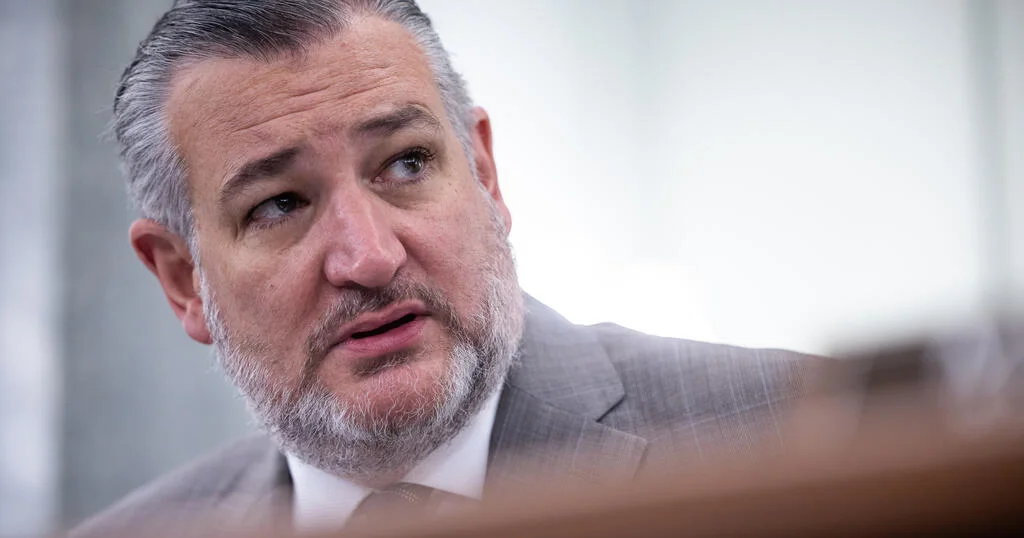
Cruz Urges Trump to Support Iranian Opposition Amid Ongoing Conflict
Wertynews.com – As hostilities between Washington and Tehran enter their sixth month, President Trump’s administration is working toward a diplomatic resolution. However, Texas Republican Senator Ted Cruz contends that additional pressure must be applied to the Iranian leadership, specifically through military support for domestic opposition groups.
Speaking with CBS News national security analyst Aaron MacLean during the “School of War” podcast, Cruz outlined his vision for American policy. “I think our objective should be regime collapse,” the senator declared.
Background on the Conflict and Cruz’s Position
Cruz initially advocated for arming Iranian demonstrators in late January, following a severe government crackdown on the nation’s most significant protests in recent years. According to sources speaking with CBS News, the violence resulted in at least 12,000 deaths.
By February, American and Israeli forces commenced aerial operations against Iran. While the official mission focused on weakening Tehran’s conventional armed forces and nuclear capabilities, President Trump also directly addressed Iranian citizens, encouraging them to “take over your government” and remove the hardline clerical leadership that has governed since 1979.
Since those initial strikes, relations have fluctuated between military action and diplomatic engagement. A June memorandum of understanding temporarily paused hostilities, reopened maritime commerce, initiated nuclear discussions, and promised eventual sanctions reductions. That accord fell apart recently, though Tehran is now negotiating with Oman to restore shipping through the Strait of Hormuz—a development that might enable renewed U.S.-Iranian dialogue.
Cruz’s Criticism of the Diplomatic Approach
The senator has been vocal in his opposition to Washington’s diplomatic initiatives. He characterized the June agreement as both a “disaster” and a “terrible deal,” cautioning that it would enable Iran to receive billions in sanctions relief alongside $300 billion in economic development resources. He further warned that the arrangement could grant Tehran “a permanent role with the Strait of Hormuz.”
“You’ll forgive me if I’m not terribly eager to give them $300 billion to facilitate their carrying out their stated intent of murdering us,” Cruz explained. “Giving them $300 billion is an exceptionally bad idea. It was a bad idea two months ago, it’s a bad idea today and it would be a bad idea two months from now. So I hope we don’t go down that road.”
The Trump administration clarified in June that the $300 billion reconstruction package would be voluntary, funded by Gulf states and private investors rather than the U.S. government.
Advocating for Continued Pressure and Armed Opposition
Rather than pursuing diplomacy, Cruz maintains that the United States should persist in targeting Iranian military installations while intensifying economic constraints. This includes maintaining a naval blockade intended to prevent Iran from exporting its oil.
Additionally, the senator has repeatedly called for direct military assistance to Iranian citizens. “What I believe we should do, what I have urged President Trump repeatedly, what I’ve urged Israel to do repeatedly, is arm the protesters, give them the guns, to let them overthrow their own government so that it’s not American boots on the ground, it’s Iranians fighting for their own country,” he stated.
Regime Change and Potential Successors
Over recent months, President Trump has moderated his earlier demands for the Iranian government’s removal. Cruz recognized that advocating for “regime change” carries historical baggage, particularly comparisons to the instability that followed the U.S. overthrow of Iraq’s Saddam Hussein.
Nevertheless, Cruz emphasized that he does “not particularly care who comes next” if the current regime falls, provided the successor is not an Islamist hostile to American interests. “I don’t have a dog whether it’s the son of the Shah, whether it is the [Mojahedin-e-Khalq opposition group], whether it is someone local, as long as they are not an Islamist who hates America and is actively trying to kill Americans,” he said, referencing exiled crown prince Reza Pahlavi—whose father was deposed as Iran’s monarch in 1979—or members of the Mojahedin-e-Khalq.
President Trump indicated in March that he desired input on selecting Iran’s future leader. While he described Pahlavi as “very nice,” he expressed uncertainty about the prince’s viability domestically, noting: “I don’t know how he’d play within his own country.”
Broader Republican Skepticism
Cruz is not alone among Republicans in questioning the wisdom of a deal with Tehran. Following the mid-June announcement of the memorandum of understanding, Louisiana Senator Bill Cassidy labeled it “the worst foreign policy blunder in decades,” while Arkansas Senator Tom Cotton cautioned that certain provisions represented a “step in the wrong direction.”
President Trump dismissed these detractors as “fools” and characterized them as “either jealous, bad people, or stupid.”
Meanwhile, several Republican lawmakers—including Kentucky Senator Rand Paul—have challenged the president’s comprehensive approach to Iran, arguing that the current strategy requires fundamental revision.
Related Reading
Frequently Asked Questions
What is Sen Ted Cruz calls for Trump?
Sen Ted Cruz calls for Trump is the main topic of this guide. The article explains the context, practical details, and next steps readers should understand.
Why does Sen Ted Cruz calls for Trump matter?
Sen Ted Cruz calls for Trump matters because readers are looking for a useful answer, not just a short summary. Good content should match search intent and help them decide what to do next.