
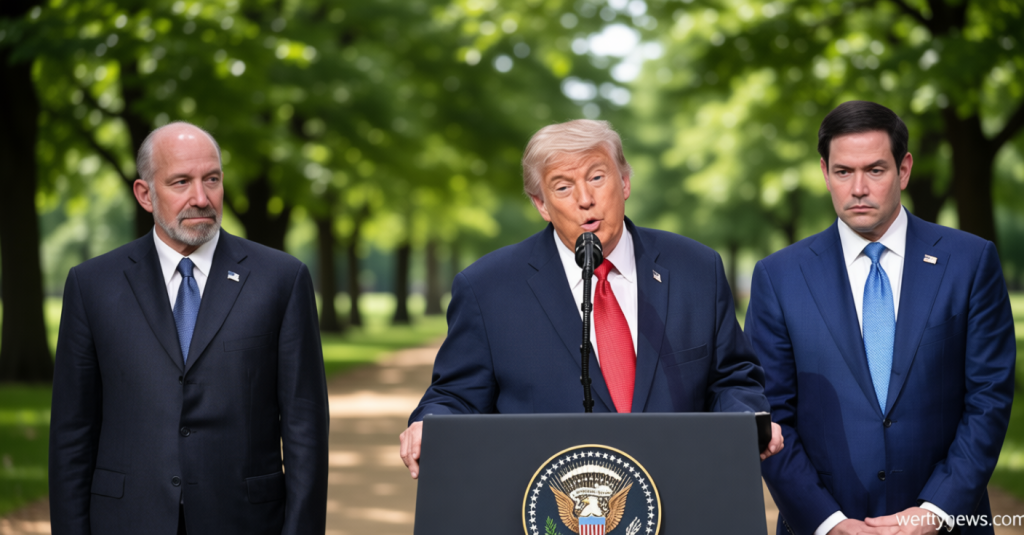
Trump Touts Iran Agreement to Wrap Up G7 Summit in France
Wertynews.com – During the closing press conference of the Group of Seven (G7) summit in Évian-les-Bains, France, President Donald Trump highlighted the U.S.-Iran memorandum of understanding as a pivotal achievement to finalize the summit’s agenda. The agreement, which he emphasized as a key focus, aimed to establish a framework for resolving tensions with Iran and setting the stage for potential future negotiations. Trump’s comments underscored his commitment to securing a deal that would address critical issues while ensuring the United States’ strategic interests remained protected.
A Framework for Diplomatic Resolution
Senior U.S. officials outlined the 14-point agreement during the press conference, which included provisions for “immediately and permanently halting military operations on all fronts.” The deal also stipulated that the U.S. would lift its embargo on Iran and work toward “eliminating all sanctions,” while Tehran committed to “not acquiring or building nuclear weapons.” Trump’s administration framed the agreement as a flexible tool, allowing for adjustments if Iran failed to meet its obligations. “If they don’t honor the agreement or some things aren’t even mentioned, we have an understanding without writing it,” he said, hinting at the possibility of a broader deal or a more targeted approach.
“Just in case you have any doubt, we’ll be releasing the agreement for you to review. It’s a memorandum of understanding. Should it not be completed in 60 days, we will return to bombing them. I don’t want to do that, but we may have to, as we cannot allow Iran to acquire a nuclear weapon,”
Trump touts Iran agreement to wrap up the G7 summit, reinforcing his belief that the document would serve as a cornerstone for international cooperation. The summit, which brought together leaders from the United States, France, Germany, Italy, Japan, Canada, and the United Kingdom, provided a platform for Trump to showcase his administration’s diplomatic progress. While the agreement was not a comprehensive treaty, it was designed to create momentum for deeper discussions and signal a shift from military confrontation to economic collaboration.
Reactions and Strategic Implications
Reactions to the agreement varied among G7 leaders, with some expressing cautious optimism. French President Emmanuel Macron, who hosted the summit, praised Trump’s efforts to bridge the gap with Iran, though he noted that the deal was just the first step in a longer process. Meanwhile, Chinese President Xi Jinping and Russian President Vladimir Putin were acknowledged for their neutrality in the U.S.-Iran dispute, which Trump said helped facilitate the agreement. “We’ve made progress that would not have been possible without their support,” he added, highlighting the importance of multilateral partnerships in global diplomacy.
Earlier in the week, Trump met with G7 leaders and allied figures, including UAE President Sheikh Mohammed bin Zayed Al Nahyan, to discuss the agreement’s details. “The last two days allowed us to talk through the agreement’s specifics with our closest partners, and they’re all excited about the deal,” he said. This sentiment was echoed in his remarks about the summit’s conclusion, where he stated that no one had asked the U.S. to continue bombing Iran. The agreement, therefore, was positioned as a diplomatic win that could ease regional tensions and open new avenues for cooperation.
Trump also reiterated his 2020 decision to assassinate Iranian general Qasem Soleimani, contrasting it with the 2015 Iran nuclear deal under former President Barack Obama. He criticized the previous agreement for its perceived shortcomings, particularly Iran’s later expansion of uranium enrichment activities. “Bibi, your greatest risk was that Iran would drop a nuclear weapon into Israel. They’d only need one,” he warned, emphasizing the urgency of securing a new accord to prevent a potential threat to Israel’s security.
As the summit concluded, Trump planned to dine with Macron at Versailles before returning to Washington. He hinted at potentially staying abroad for the agreement’s signing ceremony, underscoring its significance as a diplomatic milestone. The U.S. president’s focus on the Iran agreement to wrap up the G7 summit reflected his broader strategy of using multilateral events to advance bilateral objectives. While the agreement did not resolve all conflicts, it marked a critical juncture in the ongoing U.S.-Iran relationship and demonstrated the potential for renewed cooperation in the region.