
Japan Begins Long-Duration Mission to Explore Mars’ Mysterious Moons
Wertynews.com – Japan has sent a robotic spacecraft toward Mars on a mission designed to answer one of the solar system’s enduring questions: where did the planet’s two small moons come from?
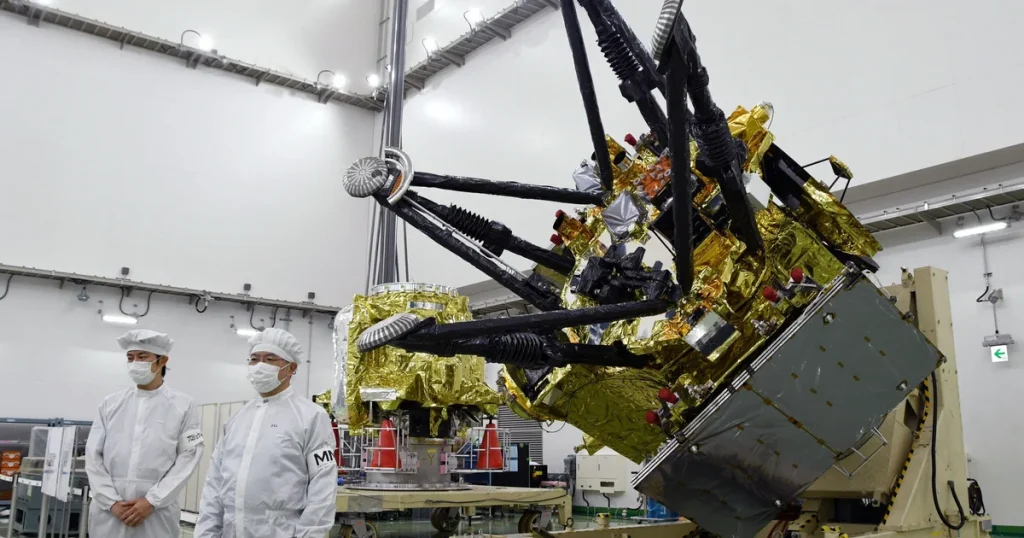
The Martian Moons Exploration mission, known as MMX, lifted off aboard a Japanese H3 rocket from the Japan Aerospace Exploration Agency’s Tanegashima Space Center. The spacecraft will conduct an extended investigation of Phobos and Deimos, deploy a compact rover on Phobos, gather material from its surface and ultimately return those samples to Earth.
At roughly $350 million, the project is an ambitious attempt to bring back the first material ever collected from the Mars system. If the mission proceeds as planned, the return capsule is expected to reach Earth in 2031.
A question about the origin of Phobos and Deimos
Phobos, the larger of Mars’ two moons, is about 17 miles wide at its broadest point. Deimos is less than half as large. Both have uneven, asteroid-like forms, but appearance alone has not resolved whether they are captured asteroids or fragments left behind by a massive collision involving Mars early in the history of the solar system.
That distinction matters because the moons could preserve evidence about Mars’ past. A captured asteroid would have originated elsewhere in the solar system, while impact debris could contain material associated with ancient Mars itself. Laboratory examination of returned samples could provide a more definitive answer than remote observations alone.
“One of the most intriguing questions about Phobos and Deimos is simply why these two little moons are there in the first place,” said Thomas Statler, who helped oversee development of two NASA instruments on MMX.
Statler noted that the moons share characteristics with objects from the outer asteroid belt, while other evidence supports the possibility that they are remnants of a giant impact in Mars’ early past.
“By going to the Martian moons, studying them up close and bringing samples back to Earth, we’ll be able to determine whether Phobos material is more consistent with an asteroid composition or with debris created by a collision involving Mars,” Statler said.
Launch and journey to Mars
The H3 rocket departed at 3:41 p.m. EDT, corresponding to 4:41 a.m. in Japan. Four solid-fuel boosters and two hydrogen-powered first-stage engines carried the vehicle through the lower atmosphere. Its upper stage then continued the climb into space.
One hour and 11 minutes after launch, following two upper-stage engine burns, the approximately 9,900-pound MMX probe separated to begin its independent flight.
The spacecraft is expected to enter orbit around Mars in September 2027. Its planned trajectory will allow it to travel around the planet in step with Phobos. MMX is scheduled to spend about three years studying the moon and the nearby Martian environment before beginning the most demanding phases of the mission.
During that time, its scientific instruments will investigate the chemical and mineral makeup of Phobos. The spacecraft will also assess conditions relevant to the possible use of the moon as a future staging location for human explorers. While such an outpost remains a future concept, learning more about the surface and surrounding environment could help guide later planning.
A rover built to bounce
In early 2029, MMX is expected to release a 55-pound rover developed with support from the German and French space agencies. Unlike landers headed for Earth, Mars or the moon, the rover will not need a complex powered descent system.
Phobos has extremely weak gravity, only about one-thousandth of Earth’s. Rather than slowing itself with rockets, the rover is intended to bounce across the surface and tumble gently until it comes to rest. Its design allows it to right itself regardless of its final orientation.
Once upright, the rover will begin moving across Phobos. Cameras will help it navigate and examine the surface material. A laser-based instrument will probe the ground for clues about minerals, and another system will measure temperatures in the soil.
The rover’s observations will complement the larger spacecraft’s orbital survey, offering a close view of a surface that has never been explored this way.
Collecting material for return to Earth
About a year after the rover’s arrival, during 2030, MMX is expected to land on Phobos itself. The spacecraft may touch down once or twice to acquire samples using two collection systems: one supplied by JAXA and another provided by NASA.
The formal requirement is to retrieve at least 10 grams of material, less than half an ounce. The actual amount could be greater if the surface material allows for a larger collection.
After leaving Phobos, MMX will complete remote observations of Deimos before beginning its journey home. The samples will be sealed inside an aerodynamic, heat-resistant return capsule. That capsule is planned to re-enter Earth’s atmosphere over Australia, where a recovery team will be prepared to retrieve it.
An international group of scientists will then study the returned material. Such work could reveal whether Phobos is primarily asteroid material, impact debris, or a more complex mixture that reshapes current ideas about the formation of Mars and its moons.
“MMX will be the first spacecraft ever to return to Earth from the Mars system,” Statler said. “That says a lot.”
For researchers, the decisive moment will come when the return capsule is opened and the material from Phobos can be examined directly. The mission’s results may turn two small, irregular moons into important records of the early solar system and Mars’ own distant past.
Related Reading
Frequently Asked Questions
What is Japan launches ambitious robotic mission to land?
Japan launches ambitious robotic mission to land is the main topic of this guide. The article explains the context, practical details, and next steps readers should understand.
Why does Japan launches ambitious robotic mission to land matter?
Japan launches ambitious robotic mission to land matters because readers are looking for a useful answer, not just a short summary. Good content should match search intent and help them decide what to do next.