
How white supremacists staged the only successful coup in U.S. history
Wertynews.com – Nestled in downtown Wilmington, North Carolina, a quiet memorial stands as a reminder of a pivotal moment in American history. Six bronze paddles, arranged to reach toward the sky, are accompanied by a plaque that proves difficult to decipher—not due to wear, but because the message itself is unsettling. The historical narrative they convey is both profound and unsettling, yet few tours delve into its significance. Cedric Harrison, a local advocate, is committed to changing that. “Education is the first step toward addressing this issue,” he asserts. “If you knew better, you do better,” he adds, recalling a lesson from his elders.
A Forgotten History
At Wilmington’s First Presbyterian Church, echoes of that past linger. Lauren Collins, now a journalist at The New Yorker, grew up in this congregation and was baptized here. She directed attention to a stained-glass window honoring Col. Walker Taylor, a figure once celebrated as a white supremacist. “As a child, I didn’t grasp the stories behind men like him,” Collins recalls. “But there were other mysteries about my hometown, too.” She later uncovered the truth: the church’s pastor, Rev. Peyton Harrison Hoge, was also a white supremacist. “Learning this was shocking and personal,” she says. “Loving a place doesn’t mean lying about it or defending it.”
While the church seeks reconciliation with its past, the city has been slower to address the legacy of the 1898 coup. In her upcoming book, “They Stole a City,” Collins recounts Wilmington’s darkest chapter—a singular instance of a successful overthrow in U.S. history. For many, this episode remains obscure, though it reshaped the city’s future.
The Coup That Shook Wilmington
In 1898, Wilmington was a thriving, integrated city where Black and white residents shared political power. It served as a model for the New South. Yet, tensions brewed among the former slave-owning class, predominantly Southern Democrats, who viewed this progress as a threat. “Their campaign was explicitly centered on white supremacy,” Collins explains. Tom Keith, a historian, notes that local politicians had a clear guide for advancing such a movement. “It wasn’t secret, as it would be today,” Keith says, referencing his grandfather, B.F. Keith, a rare white elite who resisted.
As the conflict escalated, a “white Declaration of Independence” emerged, drafted in part by businessman Hugh MacRae. When asked about his great-grandfather’s role, MacRae III acknowledges, “By definition, yes. What’s terrifying is that these people believed they were doing the right thing.” Their goal was to remove Black influence from the city, a mission that culminated on November 10, 1898, with the destruction of The Daily Record, Wilmington’s Black newspaper.
“This is not gonna end well,”
Tom Keith’s grandfather had warned of the impending violence. “He wrote to the governor and senators, saying someone would be killed,” Keith recalls. The mob’s attack began with torching the newspaper, followed by a chilling display of victory—a photograph of the assailants posing beside the smoldering ruins. “Every time I see it, it sends chills down my spine,” Collins says. “They have this look of flushed satisfaction. It’s a trophy.”
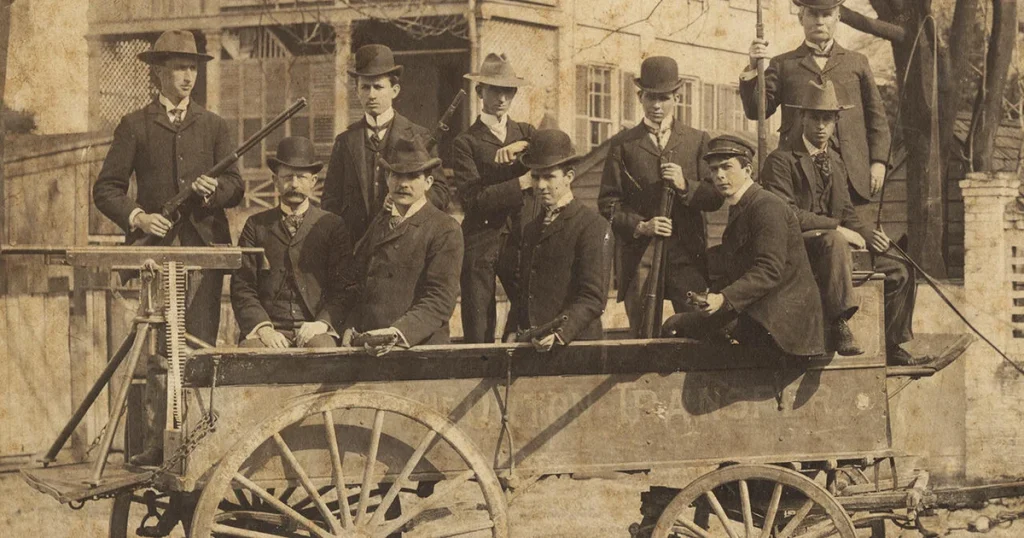
The violence soon spread. At the intersection of Fourth and Harnett Streets, a shot rang out, marking the start of a brutal purge. A cart equipped with a rapid-fire machine gun rolled through the streets, targeting unarmed Black residents. The death toll remains uncertain, but historians estimate dozens to hundreds perished. Among the victims was Joshua Halsey, a Black laborer and father of four. His great-granddaughter, Elaine Brown, recounts how he was singled out during the conspiracy meetings. “It’s in the minutes: ‘When you see that n—– Josh, get that n—– Josh,'” she says. Halsey had sued the city after his wife, Sallie, injured herself on a poorly maintained bridge. His legal action made him a target, as he and his family represented the resilience of Black citizens in a city determined to erase it.