
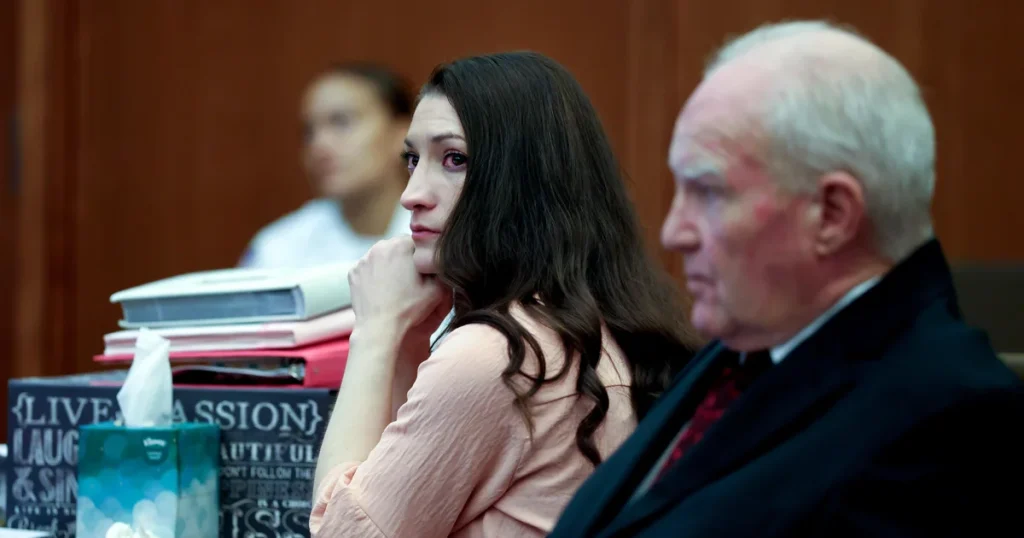
Mistrial Declared in Lindsay Clancy Case After Jury Deadlock on Seventh Day
Wertynews.com – After seven days of deliberation and repeated reports of being unable to agree, a twelve-member jury in the Lindsay Clancy murder case returned to the courtroom on Friday unable to reach a unanimous verdict. Judge William Sullivan, who had sent the panel back into the deliberation room multiple times throughout the week, ultimately declared a mistrial when the jurors confirmed they remained deadlocked. The case centered on whether Clancy was criminally responsible for the deaths of her three young children at their Massachusetts home in January 2023.
The jury’s foreperson had submitted a note indicating that a single juror was holding out against the rest. Sullivan, visibly frustrated by the impasse, urged the group to continue working through their disagreement. Weeks of emotionally charged testimony had preceded the deliberations, and days of tense waiting had followed as the jurors argued behind closed doors. In the end, no consensus emerged, and the trial concluded without a verdict.
Clancy Remains in Custody at Tewksbury State Hospital
Under the rules governing mistrials, a defendant’s conditions revert to those in place before trial began. That means Clancy will continue to be held at Tewksbury State Hospital, a psychiatric facility where she has been confined since 2023. She will remain there under custodial conditions until the next procedural step is determined.
The stakes of the original charge made the outcome particularly consequential. Had the jury returned a verdict of not guilty by reason of insanity, Clancy would have stayed in a mental-health facility indefinitely, never facing prison. Had they found her criminally responsible for the killings, she would have been sentenced to incarceration. The mistrial leaves both those futures unresolved.
Prosecutor Faces Decision on Retrial
Plymouth County District Attorney Timothy Cruz now holds the authority to determine what comes next. Options include retrying the case before a fresh jury on first-degree murder, reducing the charge to a lesser offense, negotiating a plea agreement, or declining to pursue the case altogether. At a news conference held outside the courthouse following the mistrial, Cruz declined to announce his intentions immediately.
“I’m going to be meeting with our team, and we will address this case further at the appropriate time in the context of an official court proceeding,” Cruz said.
The decision carries significant weight. Charging Clancy with first-degree murder mandates a jury trial, a point her defense attorney has repeatedly criticized. A lesser charge would have opened the door to a bench trial before a judge or made a plea negotiation more feasible. Cruz’s choice of charge in the original prosecution has thus shaped the procedural landscape of any potential second proceeding.
Defense Says Client Will Be Ready if Retrial Proceeds
Kevin Reddington, Clancy’s defense counsel, had told reporters earlier in the week that while he would be prepared to litigate again if necessary, he believed his client was not emotionally equipped to endure a second trial. Pressed on that remark at Friday’s news conference, Reddington softened his position slightly.
“She’ll be ready,” Reddington said, referring to a potential retrial this fall.
Reddington has long argued that the first-degree murder charge was excessive and that a lesser count would have allowed for a more manageable resolution. His criticism of Cruz’s charging decision underscores the tension between prosecutorial discretion and defense strategy in high-stakes criminal cases.
Legal Analysts Weigh the Likelihood of a Second Trial
Caroline Polisi, a legal analyst, described the mistrial as “a gut-wrenching outcome” but expressed confidence that the prosecution would pursue a retrial. She pointed to precedent: after Karen Read’s first trial ended in a hung jury in 2024, prosecutors immediately moved to try the case again, and Read was ultimately acquitted in that second proceeding.
“I think they’ll likely come back a second time,” Polisi said.
Jessica Levinson, a professor at Loyola Law School, concurred that a retrial was entirely plausible, citing two factors. First, jury composition can shift dramatically from one trial to the next, producing very different verdicts. Second, the prosecution could structure a second case in a fundamentally different way.
“I think it’s entirely possible that they would move forward with a retrial for a couple of reasons,” Levinson said. “One, sometimes you see a really big swing in juries from one trial to another. Two, you could charge this in a very different way.”
Levinson elaborated that rather than asking a jury to choose among first-degree murder, second-degree murder, manslaughter, or acquittal by reason of mental disease or defect, the state might present a far narrower case. She also noted the possibility of a plea bargain emerging from the mistrial’s uncertainty.
“You could see the prosecution bring a much more slimmed-down case. In addition, you could potentially see a plea bargain,” Levinson said.
Strategic Revisions for a Potential Second Trial
Polisi argued that a retrial would give prosecutors the chance to refine or overhaul their theory of the case. One area she identified for reconsideration was the prosecution’s original argument that Clancy had faked a suicide attempt. In a second trial, she suggested, the state might instead acknowledge the severity of Clancy’s depression while still arguing she retained the capacity to distinguish right from wrong.
“I would think they would really hone down their case to present it not as, you know, diminishing her mental health state, but acknowledging that she was severely depressed,” Polisi said. She added that the prosecution could refocus on “whether or not she knew the difference between right and wrong, not trying to say it was a fake suicide attempt.”
Polisi also noted that both sides would likely seek to interview the jurors who deadlocked, since their reasoning could inform future arguments and charging decisions.
“We might see a completely different theory of this case if it gets tried a second time,” Polisi said.
Jennifer Roman, a legal analyst for WBZ-TV, observed that attorneys on both sides would inevitably be reviewing their own performance and considering adjustments.
“It’s hard not to look back at a trial and, even on the day of, think, ‘That cross-examination went well’ or ‘I wish I had done’ something differently,” Roman said.
For now, the question hanging over the Plymouth County courthouse is simple and consequential: will Timothy Cruz bring this case back before a jury, and if so, under what charge and with what theory? Until he answers, Lindsay Clancy remains in custody at Tewksbury, and the fate of her three children’s deaths stays unresolved in the eyes of the law.
Related Reading
Frequently Asked Questions
What is Lindsay Clancy trial ends in mistrial?
Lindsay Clancy trial ends in mistrial is the main topic of this guide. The article explains the context, practical details, and next steps readers should understand.
Why does Lindsay Clancy trial ends in mistrial matter?
Lindsay Clancy trial ends in mistrial matters because readers are looking for a useful answer, not just a short summary. Good content should match search intent and help them decide what to do next.