
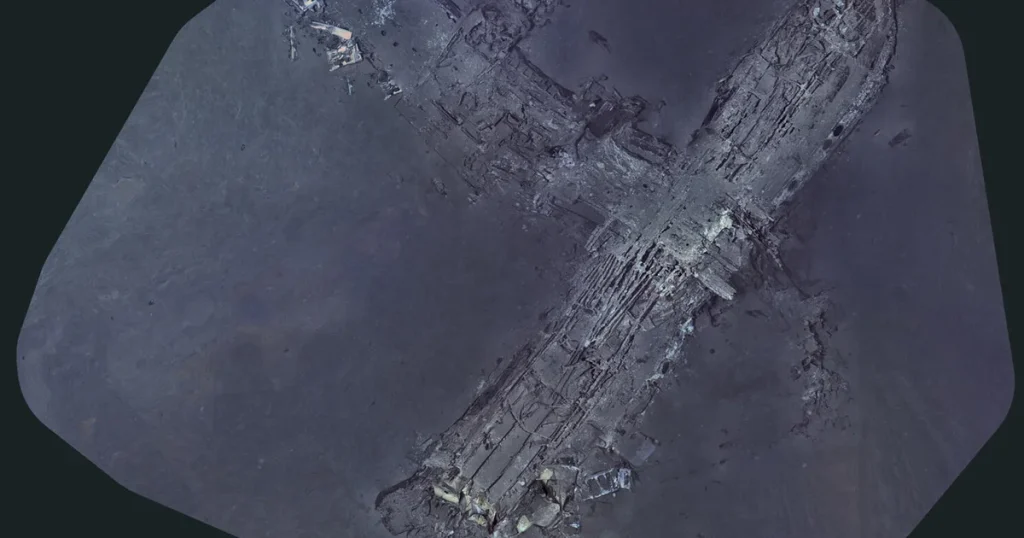
Wreckage of Pan Am Plane Discovered Off Puerto Rico After 74 Years
Wertynews.com – Searchers have located the wreckage of Pan Am plane that crashed into the Caribbean Sea in 1952, an aviation tragedy that killed 52 people and permanently changed how we fly today. The New York-bound Clipper Endeavor experienced engine failure shortly after takeoff, forcing a difficult landing. While 17 passengers and crew members survived the initial impact, chaos erupted as passengers scrambled for life vests and crew members struggled to deploy life rafts.
According to the Pan Am Historical Foundation, cabin crew worked tirelessly to reassure the 64 passengers aboard. “Although the Clipper was equipped with life rafts and personal floatation for all aboard, most of the passengers remained glued to their seats, more afraid of facing the reality of their situation than the momentary mirage of safety offered by remaining in the plane’s cabin,” the foundation explained. “It would prove a fatal mistake for 52 of them.” Within minutes, the aircraft sank beneath the waves.
Modern Technology Solves a Decades-Old Mystery
Explorers finally found the wreckage of Pan Am plane last month using an autonomous sonar drone that located the fuselage and tail section in 2,000 feet of water. The Discovery Channel’s Josh Gates shared his excitement about the discovery: “This accident changed aviation forever. It led to sweeping changes, including the introduction of the now mandatory safety briefing every time you fly.”
Before every flight today, flight attendants demonstrate exit locations and show passengers where life vests are stored and how to properly inflate them. Aviation safety expert John Cox, a pilot and founder of Safety Operating Systems, noted: “This one became a catalyst, and it helped drive safety steps forward of better flotation equipment and the preflight briefings. So this is one steppingstone along the path to what we today enjoy as aviation safety.”
The discovery has reignited hope for families of victims from other ocean crashes, including Malaysia Airlines Flight 370, which vanished 12 years ago with 269 people aboard. Russ Matthews first became interested in this case in 2019 after seeing a luggage tag from the flight wash ashore in Florida. The historical significance of the Clipper Endeavor prompted him to begin extensive research.
Years of archival work through Pan Am Airlines and Coast Guard records, along with reports from the Civil Aeronautics Board, helped narrow down the search area. The breakthrough came from Puerto Rico hearing records and a map created by Air Force pilots who happened to be conducting a training flight in the area when the crash occurred. Bad weather had previously disrupted a 2024 attempt using a towed sonar array.
“There we were, and everything kind of came together at the moment: good weather, the right team, and the right equipment and ship. So we took a shot at it,” said Tony Romeo, CEO of Deep Sea Vision.
Romeo’s company had been discussing the possibility of helping locate the wreckage of Pan Am plane for some time. In April, one of his ships happened to be passing near Puerto Rico between other missions, carrying an advanced underwater drone equipped with the necessary sensors. Deep Sea Vision had previously led an unsuccessful six-month search for Amelia Earhart’s aircraft, but Romeo felt a personal connection—his father had been a Pan Am mechanic and pilot. The drone even bore a Pan Am sticker on its side.
“This discovery offered a rare opportunity to connect with a pivotal moment in history while demonstrating how the proper application of research and cutting-edge technology can unlock even the most elusive undersea mysteries,” Romeo reflected. Matthews’ team combined their research with historical weather data to create a search area covering 10 square nautical miles, ultimately leading to the successful recovery of this important piece of aviation history.