
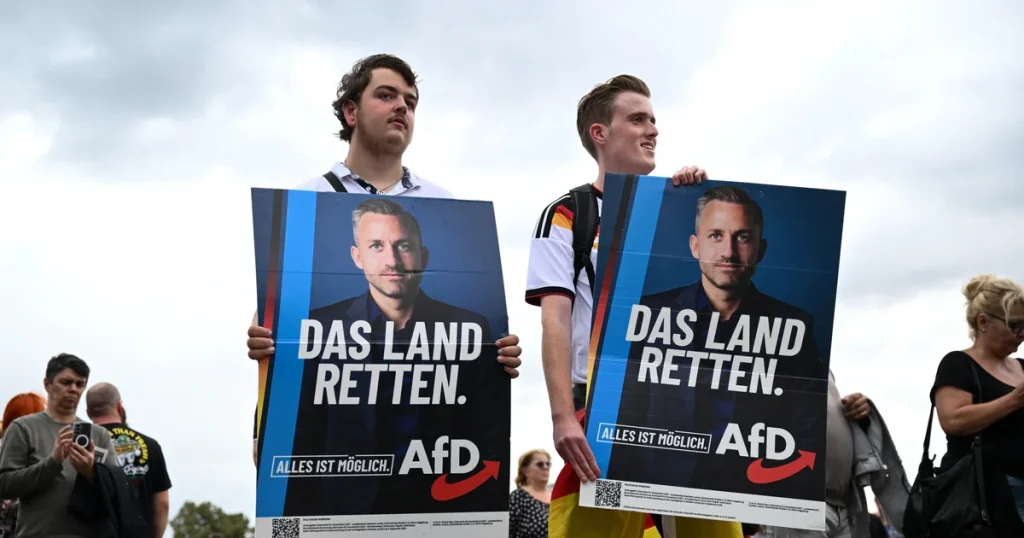
Could the AfD Lead a German State?
Wertynews.com – Could the AfD become Germany’s first far-right state government since the end of World War II? That question hangs over Magdeburg, the capital of Saxony-Anhalt, a city of roughly 244,000 residents where polls have opened for what many analysts call the most consequential regional contest in postwar German history. Opinion surveys give the Alternative for Germany a commanding lead, and if that lead converts into a governing majority on Sunday, the milestone would draw intense scrutiny from political watchers across the continent and beyond.
The polling gap is stark. Recent surveys place the AfD near 41 percent of the vote, while Chancellor Friedrich Merz’s Christian Democratic Union (CDU) trails at roughly 23 percent. Should those figures hold through election day, the AfD would command not merely the largest bloc but a realistic path to forming a state cabinet — a scenario no far-right formation has achieved in a German state since 1945.
From Protest Bloc to Governing Agenda
Founded in 2013 around opposition to EU integration and eurozone austerity, the AfD has drifted sharply toward nationalist and exclusionary positions over more than a decade. Its Saxony-Anhalt chapter now champions what it calls a “deportation and remigration offensive” — a program calling for expanded detention infrastructure to process individuals slated for expulsion, paired with new statutory ceilings on annual immigration. At present, no numerical cap governs how many people may enter Germany each year; the state AfD has publicly dismissed proposals to set that ceiling at around 200,000 as far too generous.
The “remigration” concept gained visibility at a 2023 gathering in Potsdam attended by German and international far-right figures. Austrian anti-immigration activist Martin Sellner presented what he called a “master plan” envisioning the expulsion of asylum seekers, legally resident non-Germans, and German nationals of immigrant background deemed insufficiently “assimilated” — all to be relocated to an unspecified African nation. A variant of that blueprint now anchors the AfD’s Saxony-Anhalt platform. For readers familiar with debates over ICE detention operations and the Trump administration’s aggressive removal agenda, the parallel is striking, though the remigration framing extends the logic to citizens holding passports.
The Candidate and His Circle
The party’s lead candidate is 35-year-old Ulrich Siegmund, a figure who projects composure and charisma in public appearances. The August cover of Der Spiegel labeled him “Germany’s most dangerous man,” citing the convergence of his polished demeanor, a credible prospect of seizing state power, and a radical policy agenda.
Journalistic scrutiny has also highlighted Siegmund’s inner circle. Close associates within the party include former officials of the Heimattreuen Deutschen Jugend, a neo-Nazi youth organization placed under a legal ban in 2009. That association has fueled criticism that the AfD’s organizational depth reaches into networks long considered incompatible with the republic’s democratic foundations.
Under the Intelligence Service’s Lens
Since 2023, the Saxony-Anhalt Office for the Protection of the Constitution — the state-level branch of Germany’s domestic intelligence apparatus — has formally designated the AfD’s regional chapter as a “confirmed far-right extremist” organization. The agency’s assessment holds that the chapter’s core positions contravene fundamental constitutional principles and are “substantially permeated by the racist ideology of ethnopluralism.”
“Numerous anti-Muslim, racist and antisemitic statements by officials and elected representatives of the state association demonstrate that the AfD in Saxony-Anhalt seeks precisely such an ethnoculturally homogeneous national population and calls for the exclusion of people on the basis of their origin or religion.”
Siegmund has pushed back forcefully. In an August interview he accused the intelligence office of being politically weaponized against his party: “It monitors the opposition. It is being used as a political instrument.” He added that, should his party take power, it would consider either abolishing the state intelligence agency outright or subjecting it to a fundamental restructuring.
Memory, Guilt, and Political Identity
The AfD’s Saxony-Anhalt leadership has also drawn fire over its treatment of Germany’s Nazi past. Hans-Thomas Tillschneider, a senior state-level AfD politician, has spoken dismissively of the weight Germans place on collective guilt, arguing that an overemphasis on historical responsibility distorts present-day policy choices and weakens the country’s willingness to act decisively on immigration and security questions. Critics counter that such framing risks normalizing the very narratives the republic spent decades dismantling.
Frequently Asked Questions
When is the Saxony-Anhalt state election? Polls open on Sunday, making it the latest major regional contest in Germany’s postwar electoral calendar. The result will determine whether the AfD can form a state government for the first time since 1945.
What does “remigration” mean in the AfD’s platform? It refers to a program of expanded detention and expulsion of non-citizens and, in some formulations, German nationals of immigrant background. The concept was popularized at a 2023 Potsdam gathering and now features prominently in the party’s Saxony-Anhalt campaign materials.
Why is the state intelligence office watching the AfD? Since 2023, the Saxony-Anhalt Office for the Protection of the Constitution has classified the party’s regional chapter as a “confirmed far-right extremist” organization, citing statements it deems anti-Muslim, racist, and antisemitic. Siegmund disputes the designation and has called for the agency’s abolition or restructuring if his party governs.
How does this vote fit into Germany’s broader political landscape? A victory would make the AfD the first far-right party to lead a German state government since World War II, reshaping the CDU/CSU–SPD–Greens–FDP alignment and intensifying debates over immigration caps, constitutional oversight, and the limits of democratic participation.