
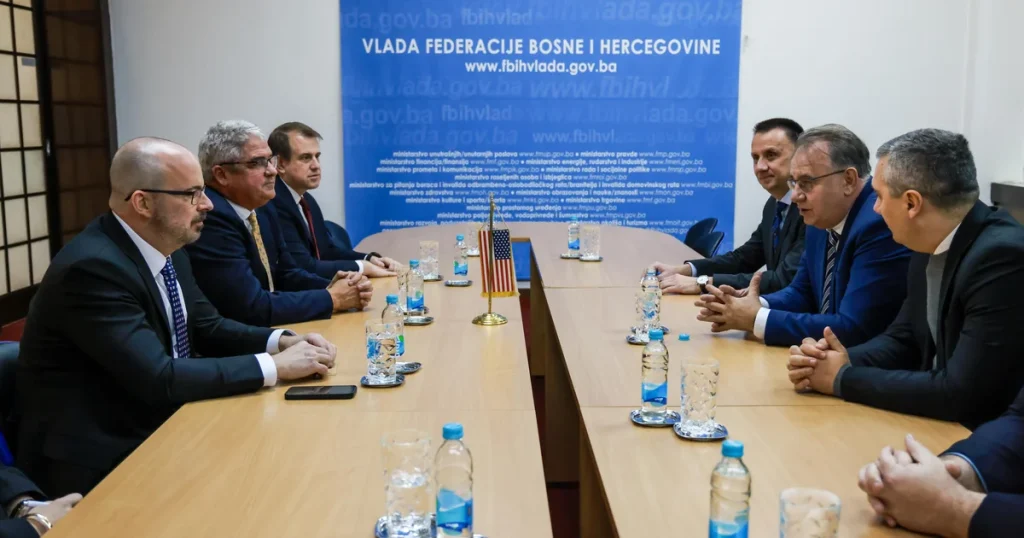
U.S. Sanctions Reversal and Major Gas Deal Stir Debate in Bosnia and Herzegovina
Wertynews.com – A proposed gas link valued at roughly $1.7 billion has become a flashpoint in Bosnia and Herzegovina, where critics question whether a reversal of U.S. sanctions against Bosnian Serb leader Milorad Dodik helped clear the way for a company connected to prominent Trump associates.
The Southern Interconnection Gas Pipeline would connect Bosnia and Herzegovina with Croatia’s gas network, giving the country a route to import liquefied natural gas from neighboring infrastructure. Supporters see the project as a potential means of reducing dependence on Russian gas supplies. Its political and commercial path, however, has drawn sharp scrutiny in Washington and the Balkans.
American Firm Nears Pipeline Role
AAFS Infrastructure & Energy, incorporated in the United States in 2025, is close to securing the contract to develop the Southern Interconnection pipeline. The company is led by Jesse Binnall, a former personal attorney for President Trump, and Joseph Flynn, brother of former national security adviser Michael Flynn.
AAFS presents itself as a business specializing in energy security, project structuring, capital alignment and long-term infrastructure development. The firm does not appear to have a publicly demonstrated record of delivering comparable energy projects.
For years, Bosnian officials have discussed the proposed route through the country. The project faced an important political obstacle in Dodik, whose party holds veto power in Bosnia and Herzegovina’s parliament. Dodik had opposed the plan, but said he would not block it after AAFS became involved in April.
Dodik’s Political Importance
Dodik has long been one of the Balkans’ most divisive political figures. Until recently, he served as president of Republika Srpska, the self-governing Serb-majority entity within Bosnia and Herzegovina. He has been accused of pursuing separatist policies that weaken the country’s institutions and threaten the framework created by the Dayton Accords.
The U.S.-brokered Dayton agreement ended the devastating 1990s conflict involving Bosnia, Croatia and Serbia. Bosnia and Herzegovina’s present political system remains rooted in that settlement, dividing major offices among Bosniaks, Serbs and Croats. The arrangement is designed to balance ethnic representation, but it has also made national decision-making vulnerable to political vetoes and prolonged disputes.
On Sunday, Dodik’s Serb nationalist party won one of the country’s three presidency seats. Addressing supporters, he credited Trump’s electoral victory with changing his political fortunes and also expressed gratitude to Russian President Vladimir Putin.
If it had not been for Donald Trump’s magnificent victory … we would probably be political corpses today.
The comments underscored Dodik’s close political identification with Moscow and his belief that shifting U.S. policy has strengthened his position.
Questions Over Sanctions and Timing
Washington first imposed sanctions on Dodik in 2017 during the Obama administration. The measures included visa restrictions and asset freezes. In 2022, the Biden administration added further sanctions, accusing him of corruption and alleging that government contracts in Republika Srpska had been directed to close business associates.
The Trump administration lifted sanctions against Dodik in October 2025. House Democrats have argued that the decision deserves closer examination because it came only months before Dodik abandoned his opposition to the pipeline’s advancement with AAFS involved.
A House Democratic report released last month, titled Pay for Play in the Balkans, alleges a direct relationship between the sanctions reversal, U.S. diplomatic influence and the prospective pipeline concession for AAFS Infrastructure & Energy.
The Trump administration has used its diplomatic influence and connections with shady characters like Michael Flynn … to facilitate the concession contract for the SIC [Southern Interconnection Gas pipeline] to AAFS Infrastructure and Energy LLC, a company owned and operated by Michael Flynn’s brother Joseph Flynn and Trump-affiliated lawyer and political activist Jesse Binnall.
AAFS did not respond to a request for comment on the allegations.
Michael Flynn’s Lobbying Work
Foreign agent registration filings cited in the congressional report show that Michael Flynn last worked as a paid lobbyist for Republika Srpska in October 2025, the same month the restrictions against Dodik were removed.
The filings indicate that Flynn received $100,000 for the work through RRB Strategies, a lobbying firm operated by Rod Blagojevich. Blagojevich, a former Illinois governor, was convicted in 2011 on 18 corruption counts and spent nearly eight years in federal prison before Trump pardoned him in 2025.
Flynn’s work included strategic advice, counsel, information analysis and research, as well as introductions connected to Republika Srpska. The overlap between his lobbying activity, the change in sanctions policy and the pipeline proposal has fueled Democratic claims that private connections may have shaped decisions with significant geopolitical consequences.
Why the Pipeline Matters
Energy infrastructure has outsized political importance in the Western Balkans. A connection to Croatia’s gas network could offer Bosnia and Herzegovina an additional supply route and reduce its exposure to Russian gas. That prospect aligns with a longstanding Western objective of broadening energy options in southeastern Europe.
Yet the project’s strategic rationale has not muted concerns about transparency. Critics argue that any contract involving public infrastructure of this scale should be subjected to rigorous scrutiny, particularly when the proposed developer has limited visible experience in similar projects and its leadership has close ties to influential figures in U.S. politics.
The controversy also illustrates the fragile balance inside Bosnia and Herzegovina. Decisions involving energy, foreign investment and national infrastructure can become entangled with ethnic representation, regional power competition and unresolved disputes over the country’s constitutional order.
As the Southern Interconnection proposal moves forward, attention will remain focused on the contract process, Dodik’s evolving role and whether the project ultimately delivers the energy diversification its supporters promise without deepening mistrust in Bosnia and Herzegovina’s already strained political system.
Related Reading
Frequently Asked Questions
What is Democrats cry foul as U S lifts?
Democrats cry foul as U S lifts is the main topic of this guide. The article explains the context, practical details, and next steps readers should understand.
Why does Democrats cry foul as U S lifts matter?
Democrats cry foul as U S lifts matters because readers are looking for a useful answer, not just a short summary. Good content should match search intent and help them decide what to do next.