
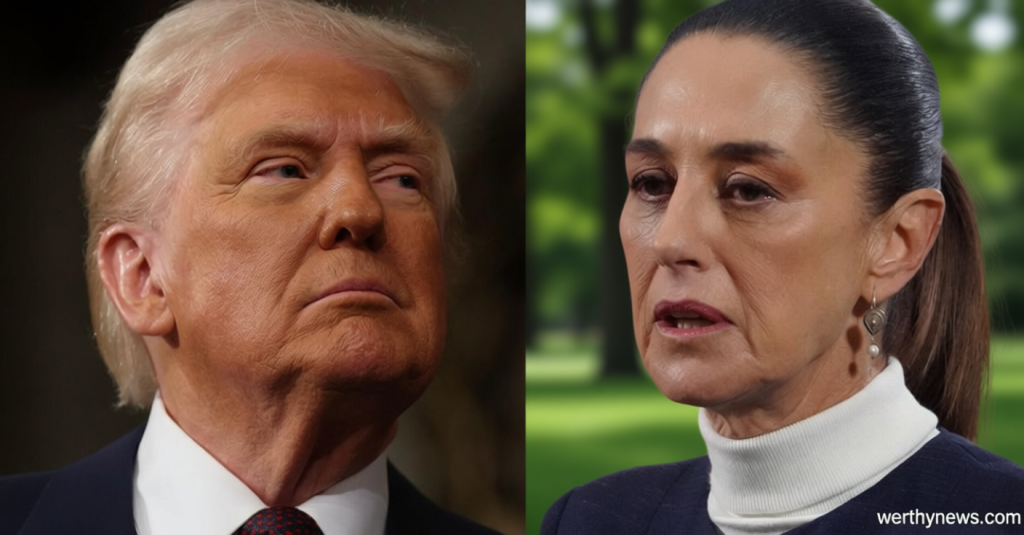
Mexican President Sheinbaum Attends World Cup Final Amid Trade Tensions with Trump
Sheinbaum’s Participation Marks a Strategic Move Amid Diplomatic Strains
Wertynews.com – Mexican President Claudia Sheinbaum has confirmed her attendance at the World Cup final, a decision influenced by an invitation from U.S. President Donald Trump. This event, set to take place on Sunday, represents a notable gesture of engagement between the two leaders, despite lingering trade disputes. The World Cup, a global spectacle, has become an unexpected stage for diplomatic maneuvering, with Sheinbaum’s presence highlighting the complex relationship between Mexico and the United States.
The invitation from Trump is seen as a calculated effort to mend relations between the two nations. Sheinbaum, who has been a vocal critic of U.S. policies, including the controversial USMCA trade agreement, accepted the invitation to demonstrate willingness to collaborate. This move comes as both leaders prepare for renewed trade discussions, with the World Cup final serving as a backdrop for their ongoing negotiations. The decision to attend the match also underscores the cultural significance of the event in fostering international unity.
“I chose to attend the World Cup final because of the invitation from the U.S. president,” Sheinbaum stated in an interview with Mexican media. “This is an opportunity to showcase our shared interests and the potential for continued cooperation.” She added, “Canadian Prime Minister Mark Carney will also be present, and I plan to share further details in a message tomorrow.”
The Mexican president’s attendance has sparked mixed reactions, with some viewing it as a sign of diplomatic progress and others as a political compromise.
Trade Disputes and the World Cup as a Diplomatic Platform
The strained relationship between Sheinbaum and Trump has been fueled by disagreements over trade agreements, border policies, and economic dependencies. The USMCA, which replaced NAFTA, has been a focal point of these tensions, with Trump criticizing its provisions and Sheinbaum defending its benefits for Mexico’s economy. Despite these differences, both leaders have expressed a desire to move forward with collaboration, and the World Cup final has provided a symbolic venue for this.
Sheinbaum’s participation in the World Cup final is particularly significant given the high-profile trade dispute that has persisted since the agreement was signed. The U.S. State Department had recently launched a review of 53 Mexican consulates, citing concerns over security and corruption, which further complicated bilateral relations. However, the invitation from Trump suggests a shift in tone, with both sides seeking to leverage the event to ease tensions and foster dialogue.
While the World Cup final is a moment of celebration for football fans, it also serves as a reminder of the broader geopolitical stakes. The match, featuring Argentina against Spain, is not only a showcase of talent but also a symbol of unity between the three North American nations. The decision to co-host the tournament by the U.S., Mexico, and Canada has been praised as a way to strengthen regional ties, even in the face of economic rivalry.
Cultural and Economic Implications of the Co-Hosting Agreement
The co-hosting of the World Cup by all three North American nations has generated significant interest, with the final set to take place in New Jersey. This choice highlights the United States’ growing role in hosting major international events, while also emphasizing the collaborative spirit of the tournament. Spain’s King Felipe VI is expected to attend the final, adding a layer of cultural exchange and diplomatic presence.
For Sheinbaum, attending the event offers a chance to highlight Mexico’s contributions to the tournament and its economic ties with the U.S. and Canada. The high cost of tickets, nearly $10,000 for the most affordable seats, has drawn attention to the event’s financial implications, but the president’s attendance is likely to focus on its symbolic value. By participating, Sheinbaum aims to reinforce her government’s commitment to international engagement and economic partnerships.
The World Cup final has become a focal point for discussions about the future of U.S.-Mexico relations. With the USMCA set to expire in 2042, both countries are eager to secure favorable terms. The Mexican president’s presence at the event is expected to signal openness to dialogue, even as she continues to advocate for Mexico’s interests. This dual role of the tournament as both a sporting and diplomatic event underscores its importance in shaping international perceptions and fostering cooperation.