
Spain Sends Over 48 000 Migrants Back to Morocco After Deadly Rush
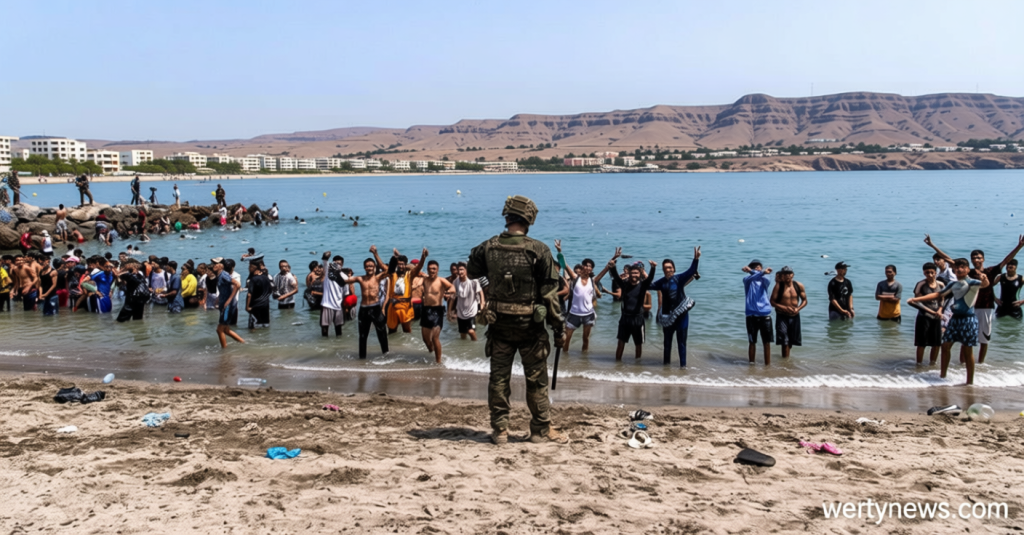
Wertynews.com – Spain sends over 48 000 migrants back to Morocco following one of the largest border crossings in recent history. The Interior Ministry announced that approximately 48,300 people have been repatriated to Moroccan territory from Ceuta by Friday evening. Officials estimate that around 50,000 individuals initially crossed into the Mediterranean enclave starting Thursday morning.
Tragedy and Mass Movement
Ceuta’s president Juan Jesús Vivas originally estimated that 60,000 migrants entered the territory during the chaotic event. He confirmed at least 34 deaths, with several victims drowning while trying to swim to safety. Most of those attempting the crossing are Moroccan nationals seeking entry into European territory.
The small Spanish enclave sits on Morocco’s Mediterranean coast, separated by seawalls and fences. Together with Melilla, located further east, these two territories form the European Union’s only land borders with Africa.
Political Fallout and Government Action
Local officials blame a recent Supreme Court decision for encouraging the massive border crossing. The court ruling made it harder for authorities to turn away migrants arriving by sea from Morocco. Vivas called the situation “absolutely unsustainable” and criticized how officials responded.
Action was taken too late and insufficiently.
Prime Minister Pedro Sánchez told reporters that “all of Spain stands” with Ceuta during this crisis. He described the influx as both an attack and a violation of Spain’s territorial integrity. The prime minister planned to visit the city on Friday to assess conditions firsthand.
Ceuta is a Spanish city, and what happened yesterday deserves our full reproach, our condemnation at the strongest possible level of rejection, condemnation and consideration as deplorable.
Humanitarian Challenges Mount
Images and video showed thousands of predominantly Moroccan people moving through breakwaters at an urban beach near the border checkpoint. While most were young men, women and children were also among the crowd heading onto local streets.
Rachid Sbihi, who leads a local workers association, called the situation a “serious humanitarian crisis.” He reported that thousands of migrants, including unaccompanied children, spent nights sleeping in parks and on sidewalks. Sbihi, whose group represents Spanish Civil Guard officers, described scenes of chaos and noted that some victims were crushed while climbing over a fence.
Legal Changes and International Cooperation
Sánchez announced that buoys would create a physical barrier and that military troop levels have increased. The Spanish government dispatched army units along with diver teams and Maritime Service vessels to help manage the situation.
The prime minister explained that lawmakers are finalizing a system to “facilitate the repatriation of migrants who entered our country irregularly.” He suggested the government might “modify certain aspects of the laws to guarantee those border repatriations as efficiently as possible.” Morocco’s government has confirmed it is cooperating with Spain’s efforts.
This demands one of the strongest condemnations, particularly of the human trafficking mafias that deceive many young people, many of whom find death, whether in the ocean or at this border.
Sánchez placed blame on “human trafficking mafias” for exploiting the Supreme Court’s decision. These criminal organizations allegedly take advantage of vulnerable individuals, some of whom die in the sea or at the border crossing.
Personal Stories Behind the Numbers
While politicians link the border surge to the court ruling, it is unclear if this was the main cause. Moroccan resident Fatima Zahra told AFP she joined the crowd after hearing about successful crossings. She wanted to reach Europe because her job in Morocco involves “under appalling conditions.”
Zahra was ultimately turned back at the Moroccan border town of Fnideq and could not enter Ceuta. She shared her experience with AFP: “I was in Tangier, where I was working. I woke up in the morning and heard that Ceuta had opened. At that point, I told the people with me, ‘Let’s go there for work… let’s try our luck too.'”
Ceuta is often seen as a gateway for people attempting to reach Spain from Africa. However, crossing from Morocco into Ceuta does not automatically grant access to the rest of Europe.