
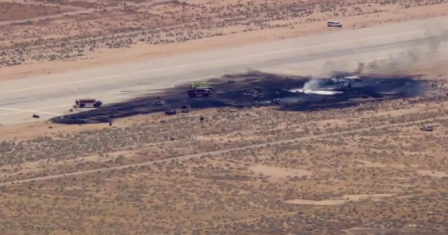
8 Dead in B-52 Bomber Crash at Edwards Air Force Base
Wertynews.com – At least eight people were killed when a B-52 bomber crashed at Edwards Air Force Base in California, marking a tragic event in the military’s long history of strategic aviation. The incident, which occurred on Monday morning, has sent shockwaves through the community and raised questions about the safety of routine test flights. Officials confirmed the fatalities during an afternoon press briefing, as the crash site continued to be assessed for evidence and potential causes.
Details of the Crash and Immediate Response
The B-52 Stratofortress, a long-range, heavy, jet-powered aircraft, came down shortly after takeoff, bursting into flames upon impact. Aerial footage captured the moment of the crash, showing a massive fireball and a large burn mark on the ground. The plane was conducting a routine test flight from the Edwards airfield, situated in the western Mojave Desert, approximately 100 miles northeast of Los Angeles. Emergency crews swiftly responded to the scene, working tirelessly to recover victims and secure the area.
“Today, Edwards Air Force Base experienced a terrible tragedy and we lost eight great Americans,” said Col. James Hayes, representing the base. “The crash was deemed unrecoverable after reviewing footage, and next of kin notifications are in progress.”
Initial reports indicated that the crash involved a mix of military personnel, government civilians, and contractors. Among the casualties were two Boeing employees, the company’s statement revealed, adding a layer of complexity to the incident. The aircraft was part of a radar modernization project, which had been ongoing for several months and aimed to enhance the base’s operational capabilities. The combination of personnel types highlights the collaborative nature of such missions, as well as the risks associated with integrating new technologies into existing systems.
Investigation into the Crash
As of now, investigators have not identified the cause of the crash, though preliminary assessments suggest mechanical failure or pilot error could be potential factors. The B-52 Stratofortress, which has been in service since the 1950s, is known for its reliability and durability, yet this incident underscores the inherent risks of even the most advanced military aircraft. The probe, expected to take several months, will examine flight data, maintenance records, and pilot training to determine the exact sequence of events leading to the crash.
“We are in contact with their families and are offering support,” Boeing stated in a release. “This crash serves as a reminder of the importance of rigorous safety protocols and continuous system evaluations.”
The Edwards Air Force Base, a critical hub for testing military aircraft, has been temporarily closed to allow for thorough investigations and safety reviews. All incoming flights have been diverted, and visitor passes for non-commercial purposes are suspended to ensure resources are focused on the response. The crash has also prompted a reassessment of training procedures and emergency protocols, as the base works to prevent similar incidents in the future.
Authorities have emphasized that the crash was a “terrible tragedy,” with the loss of eight lives sending ripples of grief through the military community. The B-52 bomber, a cornerstone of the U.S. Air Force’s strategic capabilities, has played a vital role in numerous operations, from Cold War deterrence to modern-day missions. This incident, however, has highlighted the need for ongoing vigilance and improvements in aviation safety, particularly for older aircraft models that remain in active service.