
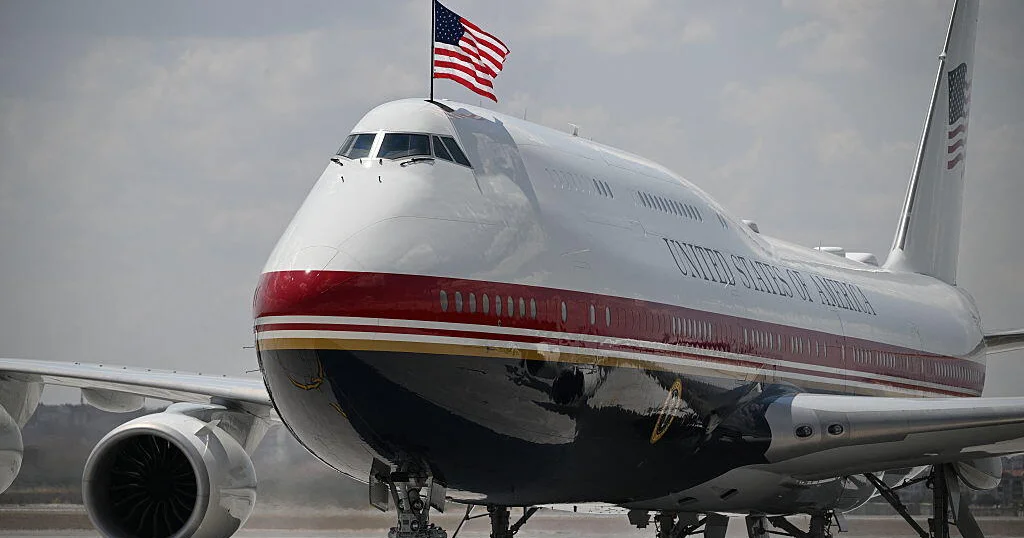
Qatar Donated Air Force One Raises Questions After Secret Service Advises Trump to Use Older Plane
Wertynews.com – When President Donald Trump chose to fly aboard an older Air Force One rather than the newly donated Qatari plane during a recent NATO summit in Turkey, it sparked a wave of questions about the aircraft’s security readiness. The decision, reported by CBS News, has raised concerns among officials and analysts about the potential vulnerabilities of the updated plane, which was gifted by Qatar last year. While the White House asserts that the newer model includes state-of-the-art security features, the Secret Service’s preference for the older model has fueled speculation about its reliability in high-stakes situations.
The Qatari-gifted Air Force One, a Boeing 747-8 retrofitted for presidential use, was designed with modern advancements in defense technology. However, its deployment for Trump’s Turkey trip has been met with scrutiny, particularly as the aircraft was rushed into service without fully meeting all security requirements. Sources indicate that the plane’s retrofitting process left critical systems incomplete, prompting the Secret Service to recommend the older model for the mission. This shift highlights the delicate balance between cutting-edge innovation and proven operational security in presidential travel.
Security Concerns Amid Escalating Tensions
The decision to use the older Air Force One was reportedly driven by the heightened risks of the Iran conflict, which has seen increased military activity and diplomatic friction. Officials emphasized that the Secret Service’s recommendation was not based on a specific threat but rather as a precautionary measure to ensure the President’s safety. Despite this, the move has drawn attention to the aircraft’s defensive capabilities, with some experts questioning whether the new plane is adequately equipped to handle potential missile or cyber threats.
“The Qatari plane was meant to enhance our fleet, but its security features were not fully tested under real-world conditions,” said a former government official who requested anonymity. “The Secret Service’s caution is understandable, especially given the current geopolitical climate.”
This sentiment aligns with broader concerns about the rapid integration of the aircraft into active service. While the White House maintains that all essential security protocols are in place, the lack of transparency regarding the plane’s defensive systems has left room for doubt.
The older Air Force One, a Boeing 747-400, has a long history of service and has been repeatedly upgraded to meet modern security standards. However, its use for the Turkey trip included a notable deviation from standard protocol, as reporters were instructed to keep their windows closed—a measure aimed at reducing potential threats. This detail, combined with Trump’s comments about the plane’s design, has amplified the debate over whether the newer aircraft is truly ready for critical missions.
The Retrofitting Process and Its Implications
Details about the retrofitting of the Qatari plane remain sparse, but sources suggest that the process prioritized aesthetic and technological upgrades over full operational readiness. The aircraft, which features advanced communication systems and reinforced hulls, was intended to replace the aging fleet of presidential jets. However, some security experts argue that the time and resources allocated to the project were insufficient to address all vulnerabilities, particularly in countermeasures against laser-guided missile threats.
“The retrofit was impressive, but it left gaps in the plane’s defensive systems that could be exploited,” noted a defense analyst. “The Secret Service’s choice reflects a preference for proven reliability over untested modernization.”
This perspective underscores the importance of testing and real-world validation in high-security environments. While the Qatari plane may offer improved comfort and amenities, its effectiveness in mitigating threats remains a topic of discussion among military and political observers.
As the debate continues, the incident has also drawn attention to the broader issue of presidential aircraft management. The White House has defended its decision, stating that the new plane is still being integrated into the fleet and has been used for non-critical missions, including a stop in the United Kingdom. Trump’s emphasis on the plane’s design during the trip suggests that the issue extends beyond immediate security concerns, touching on the administration’s approach to modernizing its transportation assets.
The Qatari donation, which was part of a larger effort to strengthen U.S.-Qatar relations, has now become a focal point of scrutiny. With tensions on the rise in the Middle East and global hotspots, the choice of aircraft for presidential travel carries significant weight. The incident has prompted calls for a more transparent evaluation of the plane’s capabilities, as well as a review of the Secret Service’s protocols for assessing security risks in such high-profile scenarios.