
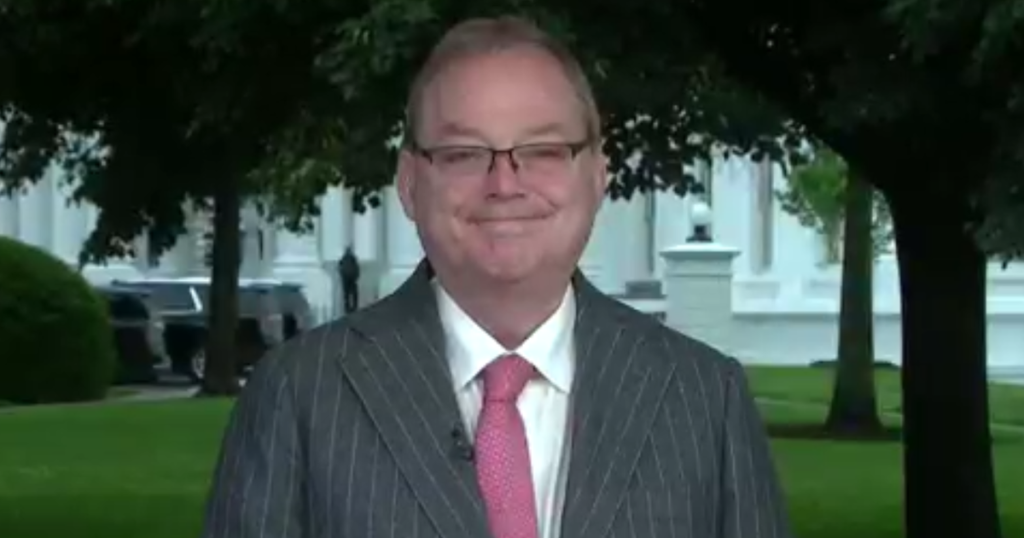
Transcript: Kevin Hassett on “Face the Nation with Margaret Brennan,” May 24, 2026
Wertynews.com – The interview transcript features Kevin Hassett, director of the White House National Economic Council, speaking with Nancy Cordes on the “Face the Nation with Margaret Brennan” program, broadcast on May 24, 2026. Hassett addresses economic trends, political influences, and the effects of geopolitical events on market stability.
Consumer Sentiment and Political Affiliation
Nancy Cordes begins by asking Hassett about the economy’s current state, noting the apparent contradiction between rising stock markets and declining consumer confidence. She highlights the recent performance of the Dow Jones and the drop in consumer sentiment, prompting Hassett to offer his perspective.
“I don’t believe there are any significant storm clouds on the horizon,” Hassett responds. “Let’s start with the consumer sentiment data, which was striking. When we examined the breakdown by political affiliation, it became clear that the numbers aren’t purely economic—they’re deeply tied to political dynamics. For instance, the index plummeted into the low 30s for Democrats, while Republicans saw little change. This suggests the data might be more reflective of political preferences than actual economic conditions.”
He adds that the Conference Board’s consumer confidence survey aligns better with the broader economic picture, emphasizing that the decline in sentiment could be influenced by partisan perspectives rather than genuine economic concerns. Hassett also notes the correlation between independent and Democratic voters, which he interprets as a sign of the sample’s political bias.
Geopolitical Impact and Market Resilience
Cordes presses further, questioning whether the ongoing conflict has negatively affected economic indicators. Hassett counters by citing the Atlanta Fed’s second-quarter GDP estimate, which exceeds 4%, and the historic low in unemployment insurance claims.
“Consumer confidence is actually at its highest level since the start of the year,” he explains. “This indicates that the war’s disruption isn’t as severe as some believe. The data doesn’t support the notion that Middle Eastern tensions are crippling the economy, except for the consumer sentiment metric, which may not be the best measure of economic health.”
He argues that the term “consumer sentiment” should be reevaluated, suggesting it might better be called “political sentiment” given its apparent partisan alignment. The conversation shifts to the logistics of oil supply, with Hassett noting that tanker refueling and refinery operations could restore equilibrium within a month or two once the straits reopen.
Gas Prices and the Path to Recovery
Cordes acknowledges the high gas prices during Memorial Day weekend, which reached a four-year peak. She references AAA’s warning that prices will remain elevated through the summer and asks whether the White House underestimated the war’s impact.
“The four- to six-week timeframe was accurate for the immediate kinetic events of the conflict,” Hassett replies. “The president and other stakeholders will determine when the deal is ready, but the key takeaway is that oil distribution is highly responsive. Tankers travel roughly 300 nautical miles daily, so countries near the straits—like India and Pakistan—will replenish their supplies quickly. Even regions farther away, such as New Zealand, should see improved availability within two months.”
He highlights the interconnectedness of global supply chains, stressing that the market’s ability to adapt will mitigate long-term effects. Cordes then shifts focus to the timeline for the straits’ reopening, prompting Hassett to assign the responsibility to the administration and diplomatic efforts.
Economic Forecast and Policy Priorities
Discussing the broader economic outlook, Hassett underscores the resilience of key metrics. He points to rising earnings at major retailers, such as Walmart, as evidence of continued consumer demand despite inflationary pressures. The mention of mortgage rates hitting a nine-month high adds nuance to the discussion, showing how different factors influence economic behavior.
“The data shows a clear picture of economic strength,” he says. “While inflation is up, and rates are climbing, these are not signs of systemic weakness. Instead, they reflect a shift in priorities, with consumers seeking value amid rising costs. The market’s response to these challenges—such as the Dow Jones hitting a record high—suggests confidence in the economy’s ability to withstand shocks.”
He also addresses the role of the White House in shaping economic narratives, suggesting that the administration’s focus on temporary disruptions has been justified. Cordes questions whether the emphasis on a short-term timeline overlooked longer-term risks, but Hassett maintains that the economy’s fundamentals remain robust.
Conclusion and Policy Implications
As the interview concludes, Cordes summarizes the key points, asking if the White House’s assessment of the war’s economic impact is overly optimistic. Hassett agrees that the situation was initially perceived as more dire than the data supports, but he acknowledges the need for vigilance.
“The real test will be how quickly the supply chains stabilize,” he states. “While we can’t predict the exact timing, the underlying trends are positive. The president and his team are working closely with allies to ensure the straits remain open and that oil flows resume without interruption. This collaboration will be critical in maintaining economic momentum.”
He concludes by reinforcing the administration’s confidence in the economy’s ability to recover, even amid global uncertainties. The discussion ends on a note of cautious optimism, with Hassett emphasizing the importance of continued monitoring and adaptive policy measures.
Throughout the interview, Hassett’s emphasis on political influences in economic data and the resilience of markets provides a framework for understanding the current economic landscape. His insights highlight the complex interplay between global events, consumer behavior, and policy decisions, offering a balanced view of challenges and opportunities.