
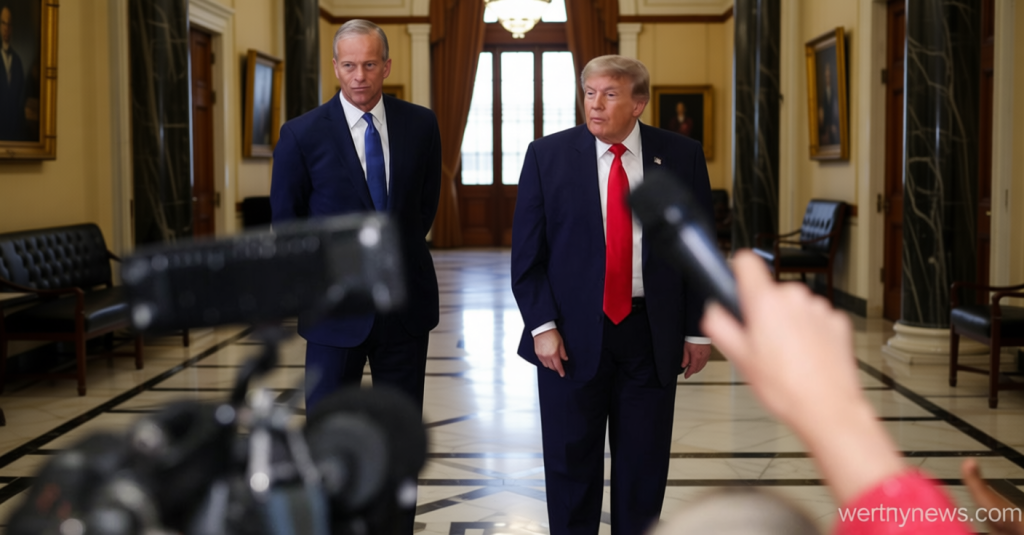
Trump Cancels Bipartisan Housing Bill Signing, Demands SAVE America Act
Wertynews.com – President Donald Trump has rescinded the scheduled signing of the bipartisan housing bill, which passed both chambers of Congress with significant support, in favor of advancing his proposed SAVE America Act. The decision, announced via a social media post, marks a strategic shift in the White House’s priorities, as the SAVE Act is now positioned as a prerequisite for finalizing the housing legislation. This move has sparked debate among lawmakers and analysts about the implications for housing affordability and the broader political landscape.
Legislative Process and Context
The housing bill, known as the 21st Century ROAD to Housing Act, was designed to address rising costs and supply shortages by streamlining development processes and increasing federal support. Under the Constitution, a bill becomes law 10 days after it is presented to the president, provided no action is taken. This rule, which applies when Congress is in session, gives the president a limited window to either sign or veto the legislation. House Speaker Mike Johnson confirmed that Trump is using this period to push for the SAVE America Act, a legislative priority linked to his broader electoral goals.
“Today’s Housing News Conference and Signing is hereby cancelled until such time as we pass the desperately needed SAVE AMERICA ACT,” Trump tweeted, signaling his intent to leverage the delay as leverage in negotiations. The SAVE Act, which aims to address voting irregularities and expand election access, has been a consistent focus for the administration, even as the housing bill garners bipartisan backing.
Provisions of the Housing Bill
The 21st Century ROAD to Housing Act includes a range of measures intended to alleviate housing crises across the United States. Among its key provisions are efforts to reduce regulatory barriers for affordable housing projects, accelerate environmental reviews, and increase funding for modular home construction. The bill also seeks to address supply chain challenges by allowing the repurposing of vacant commercial spaces into residential units, a move that could create thousands of new housing opportunities in underserved areas.
Additionally, the legislation removes the requirement for homes to be built on a chassis, potentially lowering construction costs and making housing more accessible. Critics argue that these changes could lead to increased competition among developers, while supporters claim they will stabilize prices and encourage investment in the housing sector. The bill’s bipartisan nature underscores its perceived importance, yet Trump’s cancellation has raised questions about its future viability without his endorsement.
Reactions and Political Dynamics
Senate Majority Leader John Thune described the housing bill as a “great piece of legislation” and acknowledged Trump’s authority to delay its signing. However, he expressed hope that the president would eventually support the measure, emphasizing its potential to benefit both voters and the economy. Meanwhile, House Republicans like Don Bacon have pointed out the inconsistency in Trump’s stance, noting that he had previously championed the housing bill before shifting focus to the SAVE Act.
“He’s fixated on the SAVE Act that we passed three times out of the House,” said Nebraska Representative Don Bacon. “He endorsed the housing bill a month ago, so the criticisms now are strange. We made the Senate bill better than when he endorsed it.” This sentiment reflects growing frustration among lawmakers who see the delay as a political maneuver rather than a genuine obstacle to the housing bill’s passage.
SAVE America Act and Electoral Priorities
The SAVE America Act, which Trump has framed as a “National Emergency,” seeks to modify voting procedures to ensure fair representation in upcoming elections. Proponents argue the bill will prevent voter fraud, while opponents claim it could disenfranchise minority communities. Despite its electoral focus, the SAVE Act is also seen as a way to align with Trump’s broader agenda of reducing regulatory burdens and expanding the influence of Republican policies.
Trump’s allies have insisted that the SAVE Act is critical to maintaining the integrity of the voting process, even as the housing bill addresses immediate economic concerns. The delay of the housing bill signing highlights the administration’s prioritization of electoral strategy over legislative compromise, a trend that has been evident in recent months. This approach has drawn mixed reactions, with some Republicans supporting the SAVE Act and others questioning its necessity in the context of the housing crisis.
Impact on Housing Affordability
Experts warn that the delay could stall progress on critical housing reforms, potentially exacerbating the affordability crisis for millions of Americans. The 21st Century ROAD to Housing Act was designed to lower costs by reducing red tape and increasing supply, but its postponement may lead to uncertainty for developers and homeowners. Advocates for the bill argue that its provisions are essential for addressing the growing need for affordable housing, particularly in urban and rural areas facing shortages.
With the housing bill’s signing delayed, the fate of its provisions now hinges on the SAVE America Act’s passage. This situation underscores the delicate balance between Trump’s electoral ambitions and the urgent need for housing solutions. While the SAVE Act is expected to receive further attention, the bipartisan support for the housing bill suggests a desire for compromise that may be overshadowed by the president’s demands.
Political Strategy and Legislative Leverage
Analysts suggest that Trump’s decision to cancel the housing bill signing is part of a calculated effort to exert pressure on Congress. By making the SAVE America Act a prerequisite for the housing bill, the president is effectively holding the legislation hostage, a tactic that has been used in previous legislative battles. This strategy not only aligns with his electoral goals but also reflects a broader pattern of prioritizing policies that resonate with his base over those with broad appeal.
As the deadline for the 10-day window approaches, lawmakers face a critical decision: whether to push for the housing bill’s enactment without Trump’s signature or wait for the SAVE America Act to move forward. The outcome of this dilemma will have significant implications for housing policy and the political landscape, as it tests the resilience of bipartisan cooperation in an increasingly polarized environment.