Utah Declares Emergency, Limits Fireworks Amid Largest U.S. Wildfire
Wertynews.com – Utah has declared a state of emergency and imposed temporary restrictions on fireworks as the Cottonwood Fire, now the largest wildfire in U.S. history, threatens communities. The decision comes ahead of July Fourth celebrations, when fireworks displays typically surge in popularity, creating a heightened risk of new blazes. Officials emphasize that the emergency measures are critical to preventing further spread of the fire, which has rapidly consumed vast areas of southern Utah’s dry forests.
Emergency Declaration and Fire Risk Alert
The National Weather Service has issued a rare “Particularly Dangerous Situation” alert, signaling extreme fire risks due to dry, windy conditions across the western U.S. This warning, usually reserved for tornado threats, highlights the severity of the current situation. The Cottonwood Fire, which began on Monday, has grown to over 112 square miles by Friday, challenging crews with its rapid expansion and unpredictable behavior. Strong winds have intensified the fire’s spread, making containment efforts more complex.
With more than 144,700 acres currently burning in Utah, the Cottonwood Fire is one of six major wildfires active in the state. It has caused significant damage to the Eagle Point ski resort in Beaver County, leading to mandatory evacuations. As of Friday evening, the fire had consumed nearly 72,000 acres and remained at 0% containment, according to the state’s wildfire tracking system. The emergency declaration ensures state foresters can enforce stricter fire prevention rules, including limiting fireworks, which are a common cause of wildfires.
“We have the 35 miles-per-hour sustained winds they predicted, and we definitely have the 45 miles-per-hour gusts,” said Alyssa Mason, a spokesperson for the fire. “Extreme fire behavior is occurring, including crown fires and spotting, which makes containment extremely difficult.”
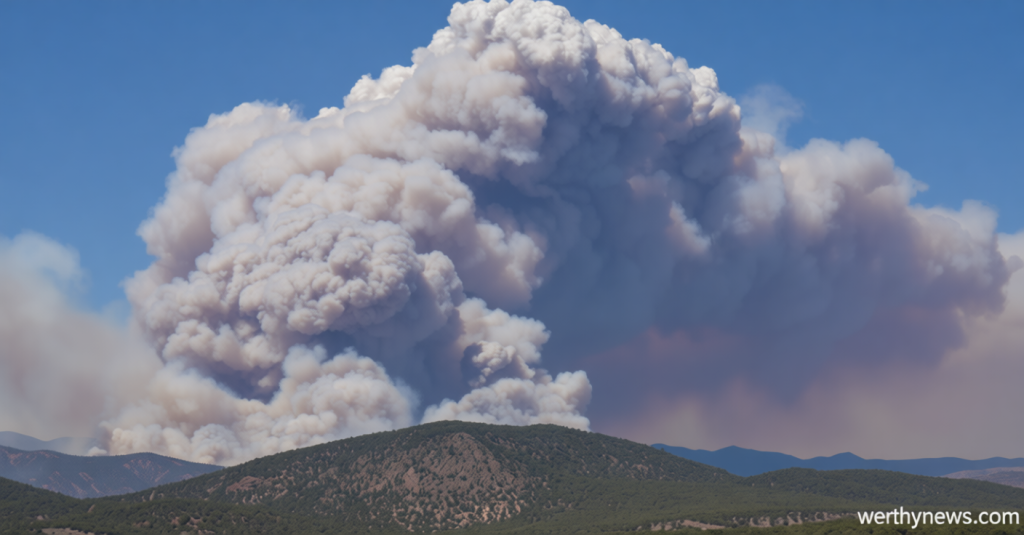
Smoke from the Cottonwood Fire has been spreading east and northeast, impacting air quality in regions like Bryce Canyon National Park. While the parks remain far from the flames, visitors in Bryce reported distant plumes of smoke, creating a visible haze. Social media has captured the massive smoke cloud, raising awareness of the fire’s reach and the urgency of the state’s actions. Officials warn that the smoke could travel hundreds of miles, affecting areas as far as Colorado.
Residents in Marysvale, Junction, and Circleville have been urged to prepare for potential evacuations as the fire continues to advance. State forester Jamie Barnes noted that current conditions are unlike anything seen in recent years, with flames spreading faster than historical patterns suggest. The emergency measures, including fireworks restrictions, aim to mitigate the risk of human-started fires during the holiday season. Gov. Spencer Cox emphasized that this year’s circumstances are unique, given the nation’s 250th anniversary celebrations.
Meanwhile, the Iron Fire southwest of Salt Lake City has also forced the evacuation of the small town of Eureka, home to 1,000 residents. Red flag warnings, indicating heightened wildfire risk due to low humidity, warm temperatures, and strong winds, are active across much of Utah and extend into neighboring states like Idaho and Arizona. Forecasters predict winds of 25 to 35 miles per hour and minimal humidity levels through Saturday, further complicating firefighting efforts.
Although the cause of the Cottonwood Fire remains under investigation, officials have stated that human activity has sparked most of Utah’s 376 wildfires this year, with 273 traced to human sources. The recent mistrial in the arson case of Jonathan Rinderknecht, linked to the 2025 Palisades Fire in Los Angeles, underscores the broader challenge of preventing human-started blazes. As the state works to contain the fire, the focus on fireworks restrictions in Utah reflects a proactive approach to minimizing risks during a high-fire-danger period.