
Unearthing the Past Beneath Notre Dame’s Stones
Wertynews.com – As the summer sun casts a warm glow over the iconic Notre Dame cathedral, a steady stream of visitors gathers to ascend its towering spires and admire its medieval gargoyles. Unbeknownst to them, just four meters below the sacred stone, a team of archaeologists is engaged in a groundbreaking effort to peel back layers of history, revealing the ancient foundations of Roman Paris. This ongoing excavation, hailed by French media as the “dig of the century,” is not only a testament to the city’s layered past but also a pivotal step in preserving its cultural legacy.
The Fire That Uncovered a New Chapter
In 2019, a devastating fire tore through the heart of Notre Dame, sending its central spire crashing to the ground in a dramatic moment that captured global attention. The cathedral, a symbol of centuries of French heritage, was painstakingly rebuilt and officially reopened in late 2024. However, the renovation of the surrounding square—once a bustling area of activity—has presented a unique challenge. To avoid disturbing ancient artifacts during the construction of new green spaces, engineers and historians have turned to archaeology, transforming part of the cathedral’s forecourt into a temporary excavation site.
Now, an open pit surrounded by barriers and traversed by a wooden walkway serves as the gateway to Paris’s buried history. This site, located mere steps from the tourist line, is where the past is being meticulously uncovered. As the ground is carefully sifted, artifacts from Roman, Merovingian, and Carolingian eras emerge, offering glimpses into a city that has evolved over two millennia.
Secrets in the Soil: A Modern Da Vinci Code
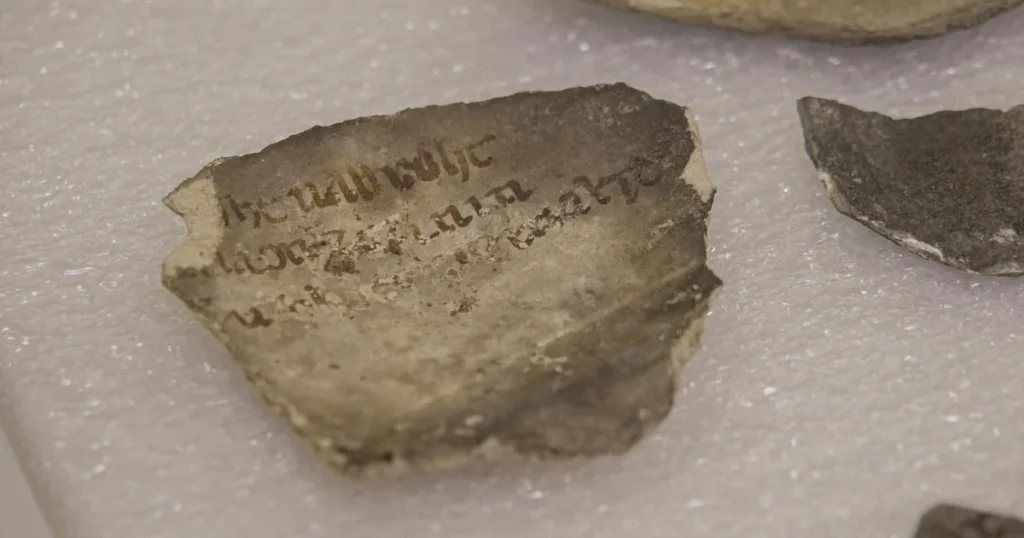
Among the treasures unearthed so far is a fourth-century coin bearing the visage of Emperor Constantine, a rare find that highlights the Roman roots of the city. Equally intriguing are shards of medieval pottery, their interiors adorned with faint, enigmatic markings that have left experts puzzled. These inscriptions, likened by some to a “modern Da Vinci Code,” hint at a mystery yet to be solved, deepening the intrigue of the excavation.
“It’s a rare opportunity for us to work on something that’s tangibly going to make a difference to the history of Paris,” said Lucie Altenburg, a conservator with the Paris archaeology unit, reflecting on the significance of the project.
The excavation has become a focal point for both scholars and the public. Emily Carter, a 34-year-old tourist from Manchester, shared her awe at the site: “You come to see the cathedral, then realize there’s another city under your feet. That’s almost more moving.” Her sentiment underscores the emotional impact of discovering the hidden layers of Paris, which now feel like a living tapestry of forgotten stories.
Layers of Time: From Roman to Medieval
The project’s scope extends far beyond the immediate site. Camille Colonna, the lead archaeologist, explained that the entire square was once a vibrant medieval neighborhood, divided by a single street during the cathedral’s construction in the 12th century. As the team digs deeper, they uncover remnants of earlier civilizations, including the cellars of medieval homes and the remnants of a Roman quarter dating back to the fourth and fifth centuries AD.
What lies beneath the surface is a 4-meter (13-foot) vertical timeline, compressing 2,000 years of history into a single space. This depth is equivalent to the height of two-and-a-half Napoleon Bonapartes stacked atop one another, a striking visual metaphor for the city’s layered existence. The excavation has already yielded Merovingian grain pits, Carolingian artifacts, and Roman structures, each representing a distinct chapter in Paris’s evolution.
“Here you can see the layers—medieval Paris, Roman Paris, maybe even before that,” noted Yasmine Benali, a 22-year-old archaeology student. “It makes the city feel less like a postcard and more like something still being discovered.”
The site’s strategic location on the Ile de la Cite, the original island of Paris, adds to its historical value. This land, once a Roman settlement, has borne witness to the rise and fall of empires, with each era building upon the rubble of the last. In Rome, for instance, the ground has risen nearly 9 meters (30 feet) since the empire’s collapse in the fifth century AD, a pattern that mirrors Paris’s own transformation.
Archive of the Ancient: Coins, Ceramics, and Enigmas
Among the most remarkable discoveries are the coins recovered from the Roman period. Though initially appearing as dark, rusted discs, these artifacts reveal their former glory under X-ray imaging, displaying the unmistakable face of Constantine. Such coins are invaluable for dating the layers of the site, providing a tangible link to the city’s earliest days.
Valentine Breloux, an archaeologist from the unit, emphasized the significance of the ceramics found in the area. “It’s rare to find complete ceramics,” she remarked, as the team carefully extracted intact jugs and cups from deep pits that once served as latrines and rubbish dumps. The soft soil, a natural preservative, has shielded these objects from decay, allowing them to surface centuries later in remarkable condition.
Yet, not all findings are straightforward. The pottery shards, while seemingly ordinary at first glance, have revealed faint reddish markings that baffle experts. These inscriptions, found across multiple artifacts, suggest a connection between the medieval inhabitants and their ancient predecessors, potentially reshaping understanding of the city’s cultural continuity. Breloux described these markings as the “most astonishing” elements of the dig, a clue to a deeper historical narrative.
The excavation’s broader implications extend to how cities preserve their heritage. As ancient structures are built upon, their remains are buried beneath modern layers, a phenomenon seen in Rome and Athens alike. In 2004, the construction of Athens’ metro system triggered the largest archaeological project in Greek history, unearthing tens of thousands of artifacts now displayed in stations across the city. Paris, too, is following a similar path, ensuring that its historical past is not lost to the demands of the present.
The Ongoing Journey of Discovery
Each day, the team fills 15 crates with artifacts from decades of undisturbed earth, a testament to the richness of the site. From fragmented ceramics to ancient coins, these finds are slowly piecing together the story of a city that has endured and adapted over the centuries. The process is as much about patience as it is about precision, with archaeologists working tirelessly to decode the layers of history and their cultural significance.
As the excavation continues, the hope is that these discoveries will not only enhance the historical narrative of Notre Dame but also inspire a renewed appreciation for Paris’s ancient roots. The city, with its dual identity as a modern metropolis and a repository of the past, is once again becoming a living museum, where every dig reveals new chapters in its enduring story.