
South Korea and China Outpace U.S. in Shipbuilding, Trump Prioritizes Revival
Wertynews.com – With South Korea and China advancing their shipbuilding capabilities at a faster and more cost-effective pace than the United States, the Trump administration has placed renewed emphasis on revitalizing domestic production. The global maritime industry, vital to international trade and national security, has seen a shift in power as Asian nations dominate the market. This strategic pivot aims to counterbalance the growing influence of South Korea and China, ensuring the U.S. remains a formidable player in the sector. The article, updated on March 22, 2026, highlights the urgency of this effort in light of rising geopolitical tensions and economic competition.
A National Security Imperative
Trump’s focus on shipbuilding emerged from concerns over the U.S. falling behind in critical maritime production. While South Korea and China construct thousands of vessels annually, the U.S. lags, with production rates that struggle to keep pace. This gap has raised alarms about reliance on foreign shipyards during times of crisis, such as a potential naval confrontation with China. The administration argued that maintaining a robust domestic fleet is essential to safeguarding trade routes and projecting military strength globally.
Philadelphia Shipyard: A Symbol of Decline
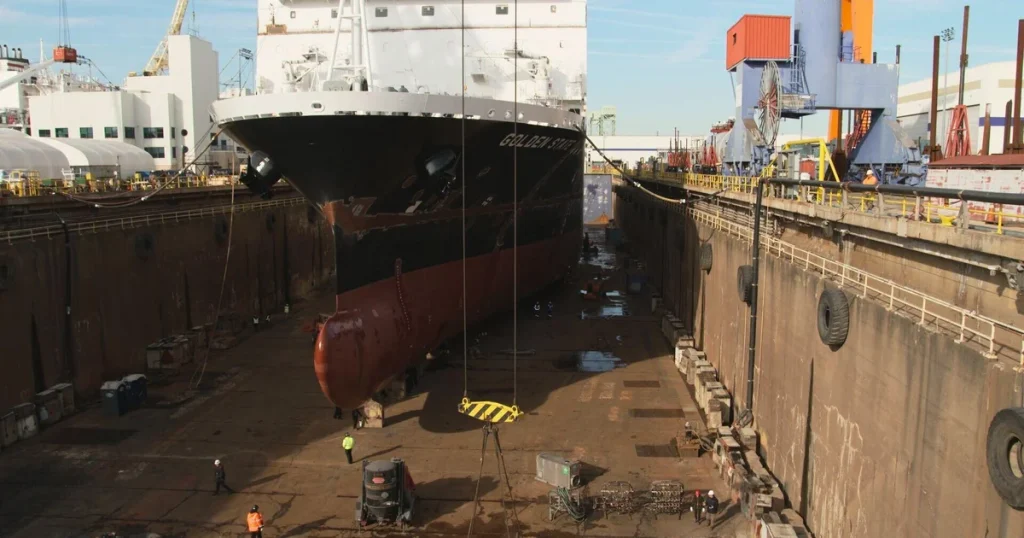
The Philadelphia Shipyard, once a linchpin of American industrial might, now symbolizes the challenges faced by the U.S. in shipbuilding. After being acquired by Hanwha for $100 million in 2024, the facility has seen limited progress, relying on outdated machinery like a 1942 crane. Its production rate—just one to one-and-a-half ships per year—contrasts sharply with Hanwha’s Korean shipyards, which consistently deliver vessels on a weekly basis. The decline of the yard underscores a broader issue: the nation’s struggle to maintain competitiveness against South Korea and China.
Modernizing for the Future
David Kim, Hanwha’s newly appointed director, is driving efforts to transform the Philadelphia Shipyard into a modern, efficient hub. His vision includes integrating automation and robotic systems to streamline operations, a move aimed at closing the productivity gap with Asian counterparts. “We’re not just rebuilding the yard—we’re redefining it,” Kim stated, emphasizing the goal of increasing annual output to 20 ships. This modernization strategy is seen as a critical step in aligning U.S. capabilities with the demands of a global market increasingly dominated by South Korea and China.
Workforce Challenges and Training Initiatives
Despite Hanwha’s investments, the U.S. shipbuilding sector grapples with a shortage of skilled labor. The demands of constructing complex vessels require specialized expertise, which has become increasingly scarce. To address this, the Philadelphia Shipyard has launched a training program designed to onboard 20 new workers at a time, though participants must commit to a three-year training period. For those like Justin, Jeff, and Meg, the opportunity to transition from roles in retail and food service to shipbuilding offers a fresh start. “This is a chance to build something lasting,” said one apprentice, reflecting the hope for a renewed industry.
Strategic Implications of the Shift
Michael Coulter, Hanwha’s U.S. operations leader, highlighted the strategic importance of scaling production to reduce costs. “Building more ships will lower the price per unit significantly,” he explained, noting that the Korean shipyards already operate at full capacity, while the U.S. faces delays due to reliance on imported parts. This dependency not only extends build times but also increases expenses, making it harder for American shipyards to compete. The administration’s push for local manufacturing is seen as a key factor in reshaping the industry’s landscape and ensuring long-term stability against South Korea and China.
Hope for a Competitive Comeback
With a $5 billion investment, Hanwha is positioning the Philadelphia Shipyard as a potential turning point for U.S. shipbuilding. Coulter acknowledged the hurdles but expressed optimism about the project’s potential. “We have a unique moment in time,” he said, suggesting that this initiative could revive American industrial capacity. The success of the shipyard will depend on its ability to attract skilled labor, adopt advanced technologies, and secure a stable supply chain. If these efforts materialize, the U.S. may once again emerge as a leader in the shipbuilding arena, challenging the dominance of South Korea and China in the global market.