
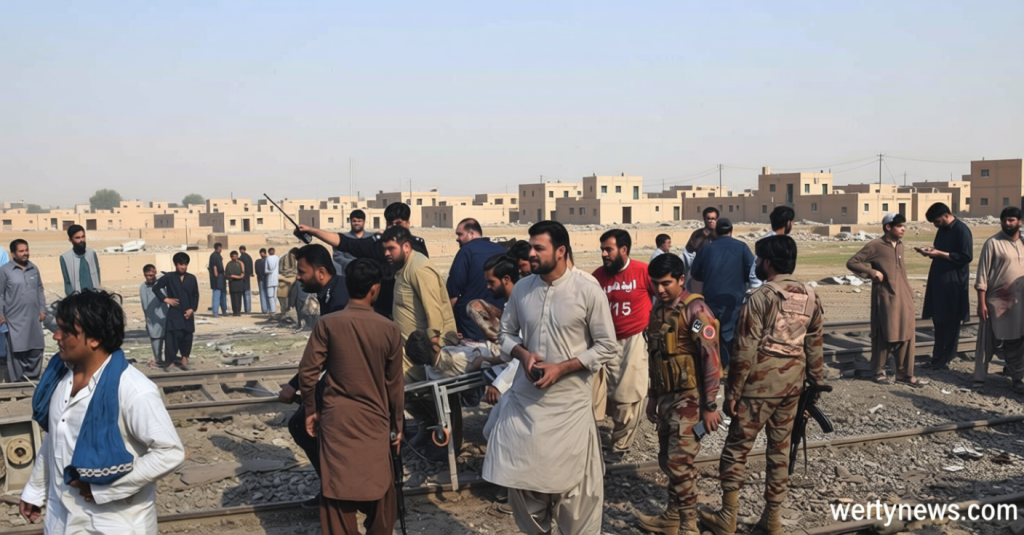
Suicide Bombing in Quetta, Pakistan, Leaves 24 Dead, Dozens Injured
Attack Targeted Railway Track in Faquir Abad
Wertynews.com – A car bomb detonated in Quetta, Pakistan, on Sunday, causing widespread destruction and chaos. Officials confirmed at least 24 fatalities and approximately 70 injured, with the toll expected to climb as rescue operations continue. The explosion occurred near a railway track in the Faquir Abad district, sending shockwaves through nearby neighborhoods and triggering panic among residents.
The blast, described by a senior Balochistan provincial official as “severe,” struck at around 8:00 a.m. local time. Witnesses reported that the explosion shattered windows, knocked buildings off balance, and ignited a fire that spread across parts of a passenger shuttle train. “The force was immense, and the impact was felt for miles,” said one local, adding that the sound of the detonation echoed like a thunderclap. The Associated Press noted that the attack took place in an area where security forces typically maintain a presence, suggesting a deliberate targeting strategy.
“Civilians, including women and children, were among the victims,” stated Balochistan Chief Minister Sarfraz Bugti on social media. The statement underscored the attack’s indiscriminate nature, as the explosion engulfed vehicles waiting at the train crossing. Area resident Aziz Khan told CBS News that the blast jolted his house, leaving him and others in disbelief. “There was a huge bang, very loud,” he recounted. “Many people were killed on the spot due to the intensity of the explosion. Gas cylinders in queuing cars also exploded, compounding the damage.”
Prime Minister Shehbaz Sharif condemned the attack as a “cowardly act of terrorism” on social media, highlighting its brutal impact on everyday citizens. The incident has reignited concerns about security in the southwestern province, which has been a frequent target of insurgent activity. Pakistan Federal Minister for Railways Hanif Abbasi confirmed that the blast derailed the train’s engine and three coaches, while two additional coaches overturned in the aftermath. Photos captured thick black smoke rising from the scene, with paramilitary soldiers and volunteers working to extract survivors from the wreckage.
BLA Claims Responsibility for the Attack
The Balochistan Liberation Army (BLA), a militant group based in Afghanistan, has claimed responsibility for the bombing. The BLA seeks independence for Balochistan, a region known for its oil and mineral resources, and has a history of targeting civilians, soldiers, and police. The U.S. State Department has officially designated the BLA as a foreign terrorist organization, citing its role in escalating violence across Pakistan.
The group’s prior actions include a coordinated series of suicide and gun attacks in February that killed 18 civilians and 15 security personnel. Earlier this year, a similar attack at a train station in the same region resulted in at least 26 casualties, including soldiers and railway staff. These incidents reflect the BLA’s strategy of using high-profile targets to instill fear and disrupt infrastructure critical to the province’s economy.
“Balochistan is the largest but least populated province in Pakistan, and its strategic importance makes it a prime location for such attacks,” explained a regional analyst. The province serves as a cultural and political hub for the Baloch ethnic minority, drawing both support and opposition from within the country. Islamic militants, including the BLA, operate in the area, often exploiting tensions to carry out strikes against government institutions and transportation networks.
The explosion’s location near a railway track raises questions about the group’s ability to access critical infrastructure. Security forces are frequently stationed in the region, yet the BLA managed to execute the attack with precision. The incident has intensified calls for improved coordination between local and national authorities to combat the growing threat of terrorism.
Aftermath and Ongoing Investigation
The attack has left a trail of devastation, with parts of the shuttle train reduced to rubble. Emergency responders struggled to reach victims amid the chaos, and the sight of paramilitary personnel pulling survivors from the wreckage has sparked both outrage and sorrow. An official investigation is underway to determine the exact cause and assess the extent of the damage.
Quetta, the capital of Balochistan, has long been a symbol of the province’s aspirations for self-rule. However, it has also become a focal point for militant groups seeking to challenge the government’s control. The province’s sparse population and vast resources make it a strategic target, as attacks can have significant economic and political repercussions.
Broader Implications for Balochistan
The suicide bombing has intensified debates about the security situation in Balochistan, a region that has endured years of conflict. While the provincial government has implemented measures to protect civilians, the BLA’s attacks continue to disrupt daily life and threaten stability. The U.S. designation of the BLA as a foreign terrorist organization underscores the international concern over its activities, which have caused bloodshed across Pakistan.
Residents expressed frustration over the lack of progress in addressing the root causes of the violence. “We’ve seen this before, but the government hasn’t managed to stop it,” said a local shopkeeper. “Every time they secure one area, another is struck.” The attack has also raised fears about the safety of public transport, a lifeline for many in the province.
Historical Context and Future Outlook
Balochistan’s struggle for independence dates back decades, with the BLA playing a central role in the movement. The group’s tactics, including suicide bombings and coordinated assaults, have evolved to target both military and civilian infrastructure. Analysts suggest that the attack near the railway track was a calculated move to strike a symbolic blow against the provincial government’s control over transportation.
Despite the trauma of the incident, some residents remain hopeful that the government will prioritize security reforms. “They need to invest more in protecting our communities,” said another local. “Otherwise, this will keep happening.” The Provincial Government has vowed to increase patrols and strengthen checkpoints, but the scale of the attack has exposed vulnerabilities in the region’s security framework.
International Response and Regional Impact
The attack has drawn international attention, with the U.S. State Department reaffirming its stance against the BLA. The designation allows for targeted sanctions and military support, which could help bolster Pakistan’s counterterrorism efforts. However, the BLA’s presence in Afghanistan and its ability to coordinate attacks from across the border complicate the situation.
As the investigation continues, the focus remains on understanding the BLA’s motivations and capabilities. The group’s ability to execute such a devastating strike highlights the ongoing threat posed by transnational militant networks. For Quetta and Balochistan, the attack serves as a stark reminder of the challenges faced in maintaining peace and security in a region rife with political and ethnic tensions.
The explosion’s aftermath has also prompted a review of emergency response protocols. Officials are now examining whether the rail system’s security measures were adequate to prevent the attack. Meanwhile, the community mourns the loss of lives and grapples with the psychological impact of the violence. “It’s like living in a war zone,” said one resident. “You never know when the next attack will come.”
With the BLA’s claim of responsibility, the focus shifts to preventing further strikes. The provincial government has called for unity in the face of the threat, urging citizens to remain vigilant. As the investigation unfolds, the incident may serve as a catalyst for renewed efforts to address the security crisis in Balochistan and protect its people from future attacks.