
Dozens of 7,000-Year-Old Headless Skeletons Unearthed in Vráble Ditch
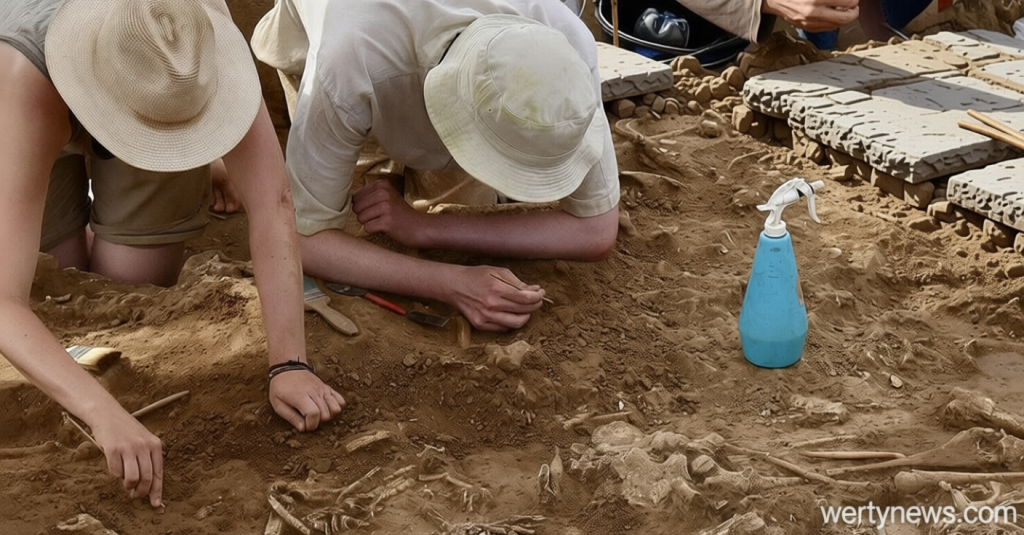
Wertynews.com – Archaeologists have uncovered an astonishing array of 7,000-year-old human remains in a central European ditch, with over 70 of the 78 skeletons found lacking their heads. The discovery, made in the Slovakian town of Vráble, has captivated researchers and the public alike, offering a glimpse into ancient rituals that may have shaped Neolithic society. Described as “a terrifying sight at first glance,” the site has raised intriguing questions about the cultural practices of early farming communities and their relationship with death.
Significance of the Vráble Site
The Vráble ditch, part of a larger prehistoric settlement, dates back to the early Neolithic period, around 5,250 to 4,950 B.C.E. This era marked a significant shift in human history, as people transitioned from nomadic lifestyles to settled agricultural communities. The discovery of 7,000-year-old headless skeletons in this context suggests that the ditch may have served a dual purpose: a boundary marker and a ceremonial space. The site’s proximity to a settlement of approximately 300 homes indicates its central role in the daily lives and spiritual practices of the people who lived there.
Researchers, led by a team from Germany’s Kiel University and the Slovakian Academy of Sciences, have meticulously analyzed the remains. Their findings, published in the Proceedings of the Prehistoric Society, reveal that the decapitations were not random acts but part of a deliberate process. This insight challenges previous assumptions that the skeletons were victims of violence, instead pointing to a structured ritual that may have held symbolic or religious significance.
Rituals and Cultural Practices
The stacked remains, initially interpreted as evidence of a massacre, are now believed to reflect a carefully planned burial tradition. Martin Furholt, a lead author from Kiel University, emphasized that the arrangement of the bodies “appears unusual,” suggesting a deeper cultural meaning. The presence of 7,000-year-old headless skeletons in the ditch raises questions about the role of decapitation in Neolithic societies. Some theories propose that the heads were preserved separately, possibly for veneration or as part of a collective memory.
One of the most striking details is the intact skull of a child, which stands in contrast to the others. This anomaly has prompted speculation about the hierarchy or significance of different age groups within the ritual. Katharina Fuchs, another co-author, noted that the removal of skulls “was likely an intentional act,” pointing to a possible emphasis on the head as a symbol of identity or spiritual importance. Such practices could have been tied to seasonal ceremonies, communal gatherings, or rites of passage, all of which would have been central to Neolithic life.
The ditch’s design and location further support its ceremonial function. Enclosing one of the three neighborhoods in the settlement, it may have acted as a threshold between the living and the dead, or as a space for collective remembrance. The consistent orientation of the skeletons, their placement in layers, and the absence of trauma on the skulls suggest a ritualized process rather than haphazard disposal. These 7,000-year-old headless skeletons provide a rare opportunity to study the symbolic meanings attached to the human body in prehistoric times.
“The intentional manipulation of the bodies indicates a complex system of beliefs,” said Nils-Müller-Scheesel, a co-author of the study. “These 7,000-year-old headless skeletons were not just buried—they were curated as part of a larger narrative.” The team’s analysis highlights how such practices may have reinforced social cohesion, identity, or spiritual connections among the Neolithic population.
This discovery adds to a growing body of evidence about prehistoric rituals involving the head. Similar findings in other regions, such as the decapitated remains in Linearbandkeramik sites, suggest a broader pattern of head removal for ceremonial purposes. The Vráble site, however, offers unique insights due to its well-preserved condition and the clarity of the arrangement. As the 7,000-year-old headless skeletons continue to be studied, they may reshape our understanding of early human societies and their relationship with death, offering a window into the spiritual and cultural practices of a time when humanity was still learning to define its place in the world.