
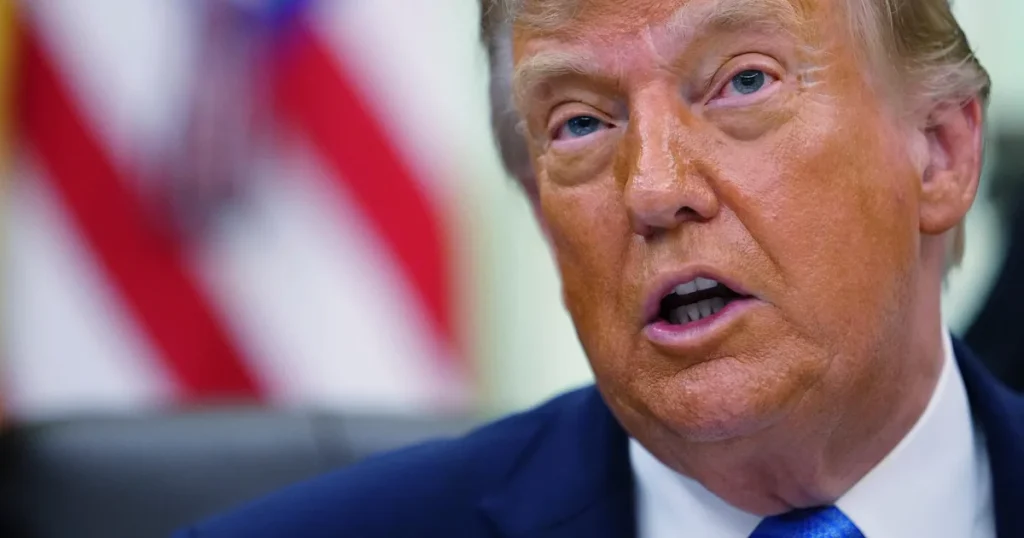
Trump Comments on Inflation Amid Iranian Oil Seizures
Wertynews.com – During a recent press conference, President Donald Trump made a striking remark about inflation, stating, “Trump says I love the inflation” in response to questions about the economic impact of U.S. sanctions on Iranian oil exports. The comment, which drew mixed reactions from media and analysts, came as the nation grappled with rising living costs and a surge in the Consumer Price Index (CPI). Trump’s assertion that the current inflationary environment is a positive outcome reflects his administration’s strategy of leveraging energy policy to stabilize the economy.
The Context of Trump’s Statement
Trump’s remarks were made in the context of a broader economic debate, with the CPI hitting a 4.2% annual increase in July—a figure that has been steadily climbing since the early months of 2023. This rate, which exceeds the 3.8% growth recorded in the prior month, has sparked concerns among economists about its long-term effects on consumer spending and business investment. However, the president framed the situation as a deliberate choice, arguing that the U.S. actions against Iran’s oil infrastructure have been instrumental in driving up global energy prices.
“No, I love it,”
Trump said while addressing a reporter in the Oval Office. He pointed to the U.S. military’s recent operations targeting Iranian oil tankers and shipping vessels, emphasizing that these moves were critical in ensuring energy security. The president claimed that the seizure of 22 Iranian oil ships, conducted under the cover of darkness, had directly contributed to the rise in oil prices. “We took out the other night, 22 ships. Late at night, with no lights. Because they don’t have any radar because we blasted the crap out of it,” he added, illustrating his belief in the effectiveness of aggressive tactics.
Broader Economic Implications
While Trump highlighted the connection between oil seizures and inflation, the broader economic landscape remains complex. Although the price of Brent crude has dipped slightly from its peak of $94 per barrel in early July, it still hovers near $85, a level that Trump argued was insufficient to meet his goals. He contended that the U.S. stock market’s performance—despite inflationary pressures—was a testament to the strength of his economic policies. “The stock market is hitting all-time historical highs,” he declared, suggesting that the market’s resilience could offset the challenges faced by everyday consumers.
Analysts, however, remain divided on the link between the U.S. actions and inflation. Some argue that the disruption of Iranian oil supplies has indeed contributed to price fluctuations, while others note that global factors such as supply chain bottlenecks and geopolitical tensions have played a more significant role. Trump’s comments, though, align with his long-standing approach to economic management, which prioritizes market-driven solutions over traditional regulatory interventions. His repeated emphasis on “Trump says I love the inflation” underscores a narrative that frames inflation as a necessary tool for strengthening the American economy.
Furthermore, the president’s rhetoric has drawn comparisons to his earlier statements about the benefits of a strong dollar and reduced reliance on foreign oil. By linking the rise in inflation to the U.S. seizing Iranian oil, he reinforces the idea that economic challenges are a result of proactive foreign policy rather than domestic mismanagement. This perspective, while controversial, has become a recurring theme in his public addresses, particularly as the country prepares for midterm elections in November.
Public Reaction and Political Strategy
Trump’s “I love the inflation” declaration has ignited a range of responses from political figures and the public. Supporters praise his unapologetic stance, arguing that the current inflationary environment is a necessary sacrifice for long-term economic growth. Critics, however, question whether the policy of seizing Iranian oil is truly the driving force behind rising prices or if other factors, such as the Federal Reserve’s interest rate hikes, are equally responsible.
Despite the mixed reception, Trump’s remarks are part of a larger political strategy aimed at maintaining public confidence in his economic leadership. With the midterm elections approaching, he has sought to position inflation as a positive sign of strength, rather than a symptom of weakness. The president’s focus on “Trump says I love the inflation” serves as a rallying point for his base, reinforcing the narrative that his administration has delivered tangible results in managing the nation’s economic health.