
World’s Largest Whale Graveyard Unveiled by Submersible in Indian Ocean
Wertynews.com – Chinese researchers have uncovered the largest known whale graveyard beneath the Indian Ocean, revealing a vast expanse of both modern and ancient whale remains that sustain extensive deep-sea ecosystems. This site, located approximately 7,000 meters below the surface, is the deepest and oldest recorded whale necropolis, as detailed in a study published in *Nature* on Wednesday. Some of the fossils discovered date back over 5.3 million years, offering a rare glimpse into prehistoric marine life.
Unexpected Discovery
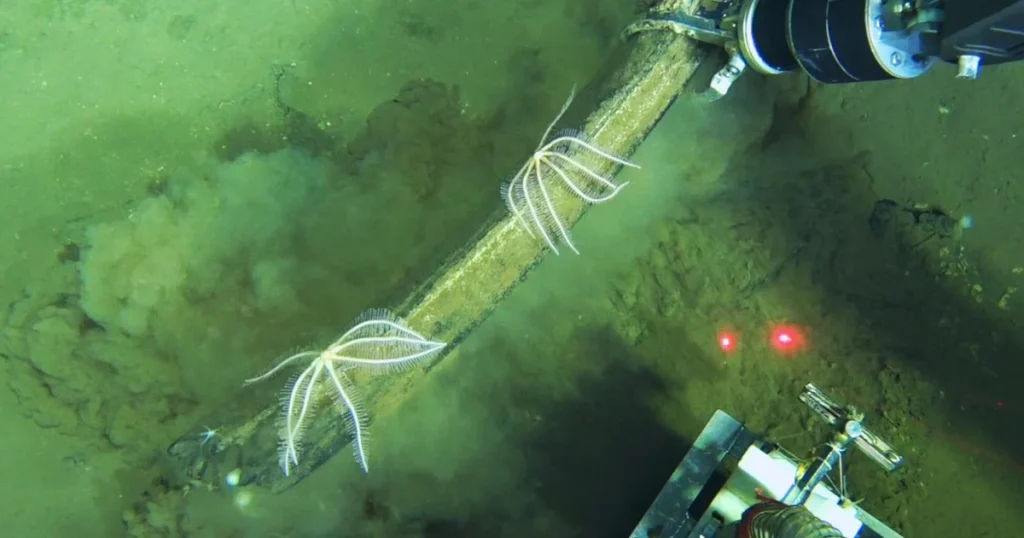
Inside the submersible *Fendouzhe*, the team observed unusual deep-sea organisms, many of which may be previously unknown to science. Among the nearly 500 skeletons cataloged, a new extinct species of whale was identified, further emphasizing the site’s significance. Lead author Xiaotong Peng of the Chinese Academy of Sciences expressed astonishment at the scale of the find, stating it was “completely unexpected.” The size, depth, and age of the graveyard far exceeded prior expectations.
“Discovering a necropolis of this magnitude was unimaginable,” Peng noted. “The distribution and depth of the remains are unlike anything we’ve seen before.”
Ecological Significance
The graveyard’s V-shaped trench likely funnels whale carcasses to the seafloor, creating a nutrient-rich environment for deep-sea life. Over 485 fossils were analyzed, primarily from beaked whale species, but the team estimates the area could hold more than 10 million carcasses. This abundance translates to around 6.7 million tonnes of sequestered carbon, a critical resource for deep-sea organisms.
Animals such as jellyfish, brittle stars, and bone-boring worms thrive in this ecosystem, drawing sustenance from the carcasses. Some species also inhabit hydrothermal vents and cold seeps, suggesting whale falls may serve as bridges between these distinct habitats. The study highlights how these sites act as evolutionary hotspots for sulfide-dependent lifeforms.
Expert Reactions
Xikun Song, a biologist involved in the discovery, explained that the size of whales and the unique chemical properties of their bones contribute to the formation of these underwater habitats. “The deep ocean’s remoteness makes these sites incredibly challenging to locate,” Song remarked in an email. Craig Smith, an oceanographer who discovered the first whale fall in 1987, called the find “extremely exciting,” noting its implications for understanding whale evolution over geological time.
“This remarkable discovery will likely provide many new insights,” said Amy Baco-Taylor, a whale fall researcher at Florida State University. “It could reshape our understanding of chemosynthetic communities, which have been thought to decline due to human whaling activities.”
The study also suggests that similar hidden archives of whale fossils may exist in other regions of the deep ocean, as evidence from trawling operations indicates widespread potential for such ecosystems. This finding underscores the importance of continued exploration in uncharted depths to uncover the ocean’s secrets.