
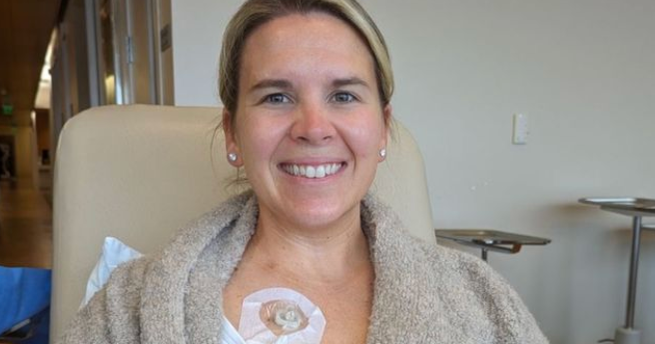
A Mom’s Stage IV Cancer Showed No Symptoms. Groundbreaking Surgery Saved Her Life.
Wertynews.com – A mom’s Stage IV cancer – Amy Piccoli, a 39-year-old mother of three, had no warning signs of her advanced illness. Her son returned home from school with a stomach virus, and like any concerned parent, she anticipated a routine case of illness. However, within days, her condition deteriorated rapidly, culminating in a critical emergency room visit. A CT scan unveiled mysterious abnormalities in her liver, while a subsequent MRI and biopsy confirmed a dire diagnosis: Stage IV colon cancer had metastasized to her liver, leaving her with no symptoms and a life-threatening prognosis.
“My doctor called me and said, ‘We think that the liver spots are cancer that has spread from the colon,’” Piccoli recalled. “I was in complete shock. I had no symptoms … I have no family history of any type of cancer.”
Upon receiving the Stage IV cancer diagnosis the Friday before Memorial Day, Piccoli was left emotionally and physically drained. She had always maintained a rigorous health routine, yet her body had silently harbored this aggressive disease. Despite her initial fear, she remained determined to fight, especially after her oncologist shared promising results from genetic testing. Immunotherapy was recommended, and by July 2024, it was incorporated into her treatment plan. The therapy successfully shrank her tumors, creating a window of opportunity for surgical intervention.
An ‘Extremely Rare’ Diagnosis
Dr. Robin Mendelsohn, a gastroenterologist at Memorial Sloan Kettering Cancer Center, explained that Stage IV cancer without prior symptoms is “extremely rare.” She emphasized how subtle indicators, such as fatigue or unexplained weight loss, often go unnoticed until the disease reaches advanced stages. Piccoli’s case exemplified this rarity, as she had no signs of illness for months. Her treatment team explored multiple options, including chemotherapy, but the outlook was grim. “The combination of two medications worked incredibly well and led to significant shrinkage in the tumors,” Piccoli said. “That allowed surgeons to remove the colon tumor, but the liver lesions remained, requiring an innovative approach.”
A Treatment That ‘Turns Hospice Into Hope’
Dr. Zachary Dietch, a transplant surgeon at Northwestern Medicine, highlighted that chemotherapy alone would offer Piccoli only a 10% chance of surviving more than five years. However, European studies suggested that removing the colon tumor and undergoing a liver transplant could significantly improve survival rates for patients with Stage IV cancer. “For patients who qualify, the procedure turns hospice into hope,” said Dr. Satish Nadig, director of Northwestern’s Comprehensive Transplant Center in Chicago. The process demands stringent criteria: low recurrence risk, absence of cancer elsewhere in the body, and a compatible donor. Piccoli’s situation met these requirements, making her a prime candidate for this life-altering surgery.
The Path to a Living Donor Transplant
After her oncologist connected her with Northwestern’s program, Piccoli began a rigorous evaluation process in September 2025. She was eventually deemed a suitable candidate for a living donor transplant, a decision that brought both hope and uncertainty. Over a dozen friends and family members submitted compatibility forms, and a family friend, Lauren Prior, volunteered to donate a portion of her liver. This procedure, which took place in December 2025, marked a pivotal moment in Piccoli’s journey. “I was just so excited for the surgery. I was excited for a transplant,” she said. “I had no fear around such a major surgery, knowing it could eliminate the Stage IV cancer that had gone undetected for months.”
Following the transplant, Piccoli’s recovery was nothing short of remarkable. The operation not only removed the source of her cancer but also provided a renewed sense of purpose. “It was like the end of a long, terrifying, draining experience,” she reflected. “Now, I wanted to put it past me and live fully.” Her story has since inspired others in similar situations, underscoring the importance of early detection and the potential of innovative treatments for Stage IV cancer. The success of her case has