
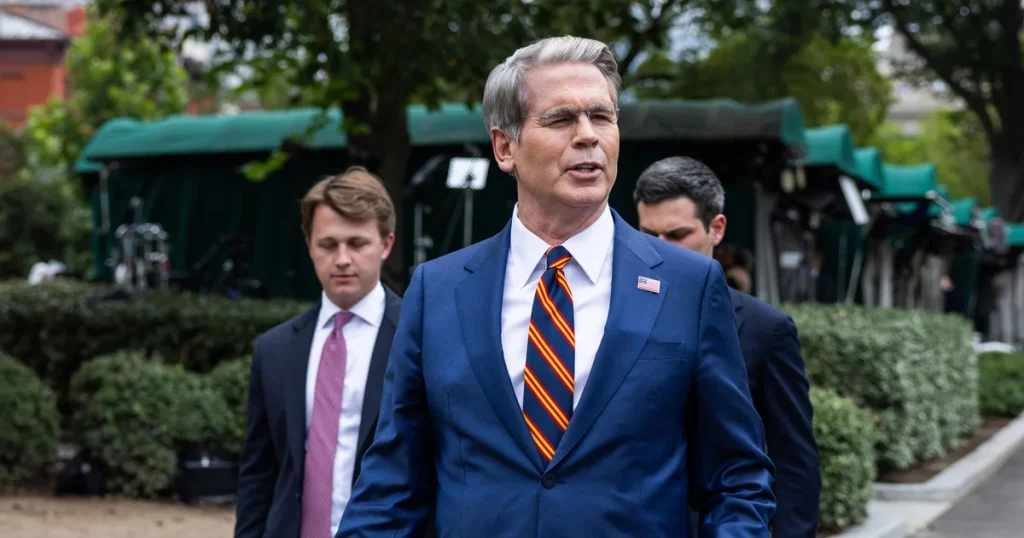
Trump Administration Tightens Financial Oversight for Undocumented Workers
Wertynews.com – Treasury Secretary Scott Bessent announced that the current administration is accelerating efforts to target criminal organizations, cartels, and undocumented immigrants who utilize American financial institutions for payroll arrangements, illicit funding, and various fraudulent activities.
Speaking with banking professionals in Arizona on Thursday, Bessent emphasized that the administration will not accept obvious exploitation of the nation’s financial infrastructure. He stated that extending financial services to individuals without legal status will not be permitted.
“This administration will not tolerate blatant abuse of our financial system, nor will it permit risks posed by the extension of financial services to illegal aliens.”
Bessent explained that the government is counting on banking institutions to support these anti-fraud initiatives. He clarified that while bankers are not expected to take on border enforcement responsibilities, they should leverage their expertise in customer knowledge, risk identification, and early reporting of suspicious behavior.
“We do not ask bankers to assume the burdens of border enforcement,” Bessent said. “But we depend on banks to do what you do best: know your customers, identify risks as they arise, and report suspicious patterns before they metastasize into criminal schemes.”
Executive Order Implementation Timeline
The initiative builds upon an executive directive that President Trump signed during May. Titled “Restoring Integrity to America’s Financial System,” the order was officially signed on May 19 and instructed multiple federal agencies to enhance oversight of financial transactions connected to unauthorized employment.
The directive called upon the Treasury Department, Federal Reserve, Office of the Comptroller of the Currency, FDIC, National Credit Union Administration, and Consumer Financial Protection Bureau to strengthen customer identification protocols and due-diligence requirements. Additionally, these agencies were tasked with reevaluating how financial institutions assess credit risk for borrowers lacking work authorization.
The order established specific implementation milestones. Advisory documents and guidance were required within 60 days, a proposed customer due-diligence regulation within 90 days, and a customer identification proposal within 180 days—all targeting completion by November.
According to Bessent, the Treasury Department has already satisfied the initial deadlines. In June, the Financial Crimes Enforcement Network released guidance designed to assist banks in recognizing patterns associated with unlawful employment, labor brokers, shell companies, payroll tax evasion, and identity theft. Subsequently, the OCC issued an advisory concerning loans to borrowers not authorized to work in the United States, directing financial institutions to evaluate a borrower’s willingness and capacity to repay as part of conventional underwriting practices.
Industry Response and Future Considerations
Bessent highlighted that Arizona’s compliance programs, employee training initiatives, suspicious-activity reporting mechanisms, and information-sharing practices exemplify the collaborative approach envisioned by the executive order. In exchange, he pledged that the Treasury Department would provide banks with improved tools for early fraud detection and promised that Washington officials would pay closer attention to community bankers’ concerns.
Legal and tax experts have cautioned that the order’s success will hinge on regulatory wording. Debevoise & Plimpton, in a June 3 client alert, observed that while the order does not create new compliance obligations for banks, it initiates agency actions that may transform anti-money-laundering compliance, customer due diligence, and lending standards. The CFPB is also considering whether borrowers’ risk of deportation and potential wage losses should influence ability-to-repay determinations.
The law firm noted that the order fell short of an earlier, more comprehensive proposal that would have mandated banks to verify citizenship status for all customers.
KPMG’s Washington National Tax practice provided a similar assessment in June, characterizing the order as “a policy signal rather than an immediate change to any law, rule, or regulation.” However, the firm warned that stricter know-your-customer requirements could result in slower account openings and increased documentation demands for multinational employers and global mobility programs, particularly affecting employees who use Individual Taxpayer Identification Numbers instead of Social Security numbers. This demographic encompasses both authorized and unauthorized workers.
Federal regulators had until July 20 to release credit-risk guidance and the CFPB’s ability-to-repay clarification. The Treasury Department must propose changes to customer due-diligence rules by August 17, with a broader customer identification proposal due by November 16.
Related Reading
Frequently Asked Questions
What is Bessent says Trump admin is cracking?
Bessent says Trump admin is cracking is the main topic of this guide. The article explains the context, practical details, and next steps readers should understand.
Why does Bessent says Trump admin is cracking matter?
Bessent says Trump admin is cracking matters because readers are looking for a useful answer, not just a short summary. Good content should match search intent and help them decide what to do next.