
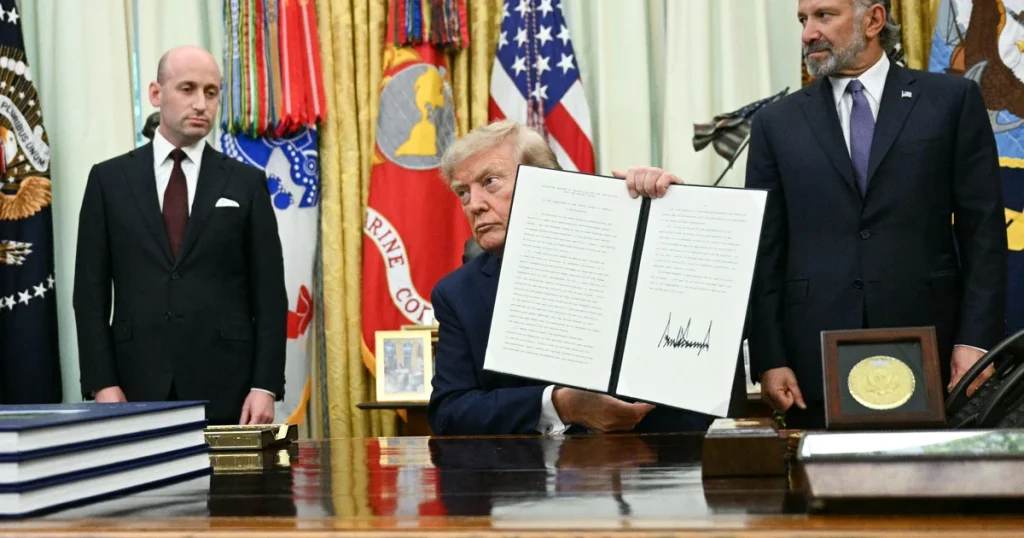
Trump Issues New Executive Orders on Birthright Citizenship After Supreme Court Decision
Wertynews.com – Washington — President Trump issues new executive orders aimed at reshaping birthright citizenship policy following a pivotal Supreme Court ruling that invalidated his initial attempt to restrict automatic citizenship for children born in the United States. During a Thursday Oval Office ceremony, the president signed two separate directives designed to address what he described as loopholes in the current system.
“We had a very unfortunate decision in the Supreme Court concerning birthright, it was close,” Mr. Trump stated during the signing event. “But a very, very unfortunate decision. So we’re making adjustments.”
Targeting Birth Tourism and Expanding Eligibility Criteria
According to White House deputy chief of staff Stephen Miller, one of the executive orders signed Thursday specifically targets commercial “birth tourism,” while the second broadens the categories of individuals ineligible for automatic citizenship. This includes children of foreign citizens who engage in lobbying activities on behalf of their home governments.
“This has been something that people have talked about, not only for years, but for decades,” Miller explained regarding birth tourism practices. “The idea that people come here pretending to be a tourist, pretending to be a visitor, saying they want to go to Disneyland or they want to go visit a monument or go to a national park, but the real reason they’re here is to have a child, to make that child an automatic citizen, leave our country, and then have a U.S. citizen child.”
Miller emphasized the broader implications: “It gives them access, under this broken system, to welfare benefits, ultimately to the voting booth, and all the other rights and privileges that belong solely to Americans.”
Constitutional Debate and Historical Context
Mr. Trump has long expressed frustration with birthright citizenship provisions, arguing alongside allies that the Fourteenth Amendment was originally intended to address the aftermath of slavery rather than create automatic citizenship for all children born on U.S. soil. “This was done right after the Civil War,” Mr. Trump noted on Thursday. “This was for the babies of slaves.”
The Fourteenth Amendment, ratified in 1868, establishes that “all persons born or naturalized in the United States, and subject to the jurisdiction thereof, are citizens of the United States and of the state wherein they reside.” The Supreme Court ruled 6-3 that the president’s first executive order, issued on his first day in office in 2025, was unlawful and inconsistent with this constitutional provision.
When asked whether he believes these new executive orders will withstand constitutional scrutiny, the president responded confidently: “I think it will.”
Birth tourism emerged as a significant topic during Supreme Court oral arguments. Chief Justice John Roberts addressed the issue with U.S. solicitor general John Sauer, noting: “You do agree that that has no impact on the legal analysis before us.” Sauer countered that such tourism demonstrates the negative consequences of the prevailing interpretation of the Citizenship Clause.
“We’re in a new world now … where 8 billion people are one plane ride away from having a child who is a U.S. citizen,” Sauer observed. “Well, it’s a new world. It’s the same Constitution,” Roberts replied.
What This Means for Families and Immigration Policy
The implementation of these new executive orders could significantly impact thousands of families annually who currently benefit from automatic citizenship for children born in the United States. Legal challenges are expected as various stakeholders test the boundaries of the new directives.
For more information on immigration policy changes, visit our immigration policy updates section.
Frequently Asked Questions About the New Executive Orders
What exactly do the new executive orders change?
The two executive orders target commercial birth tourism and expand eligibility criteria for excluding certain children from automatic citizenship, particularly those with parents who lobby for foreign governments.
Will these orders face legal challenges?
Yes, legal challenges are anticipated as various groups test whether the new orders align with the Fourteenth Amendment’s citizenship clause.
How does this affect birth tourism?
The orders specifically address cases where foreign nationals come to the United States primarily to give birth and secure automatic citizenship for their children, rather than for genuine tourism purposes.
When will these orders take effect?
The executive orders were signed on Thursday and are expected to begin implementation immediately, though specific timelines may vary by provision.