
Cambodian Artifacts Stolen from Temples Now in American Museums
Wertynews.com – How Cambodian artifacts stolen from temples have found their way into American museums and private collections is a story of cultural displacement and historical theft. First reported by CBS News on December 17, 2023, this narrative has since expanded to reveal how decades of looting have stripped Cambodia’s temples of their treasures. The practice began during colonial rule under the French, but it escalated in the 1970s, 1980s, and 1990s amid political instability. A network led by Douglas Latchford, a British national, systematically dismantled temples, exporting priceless relics to collectors and institutions across the globe. For 14 years, Cambodia’s government has tirelessly pursued the recovery of these artifacts, seeking to restore its spiritual and artistic heritage.
The Devastation of Ancient Temples
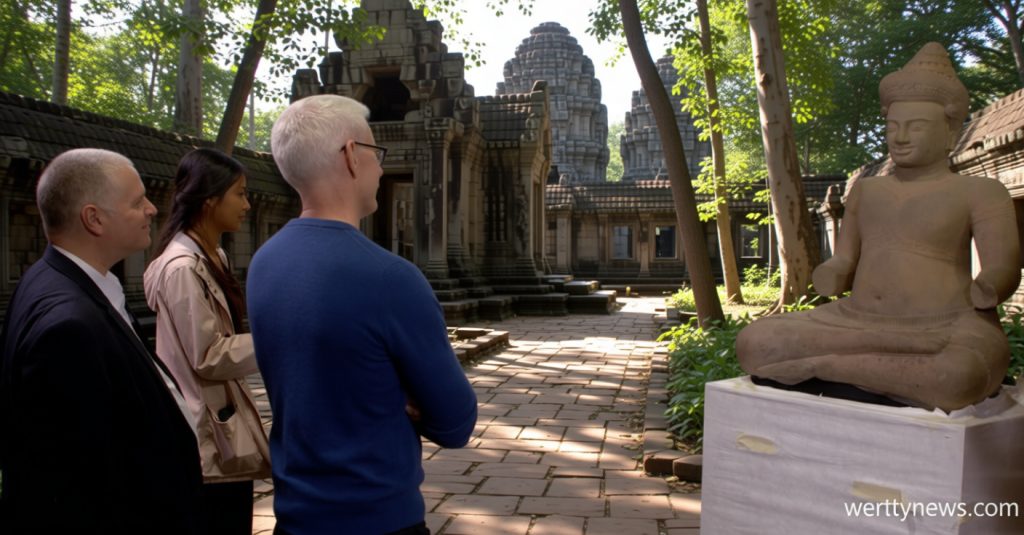
The theft of Cambodian artifacts has left a trail of devastation across centuries-old temple complexes. Angkor Wat, one of the world’s most iconic cultural sites, has been a prime target. Originally constructed as a Hindu temple in the 12th century, its transformation into a Buddhist site over time has not deterred looters from stripping it of its treasures. Statues, once revered and intact, now sit in fragments, with some missing entirely. This loss is not just physical—it symbolizes the erasure of Cambodia’s cultural identity by global collectors.
“They found gold, they found statues, they found many, many things,” Brad Gordon explained.
A Global Trade in Cultural Heritage
During the 1970s to 1990s, the theft of Cambodian artifacts became a booming global trade. Looting networks, often operating in secret, capitalized on the country’s political turmoil to extract thousands of items. These artifacts were then sold to private collectors, auction houses, and even prominent American museums. The process was systematic: statues were removed from their pedestals, transported to distant countries, and displayed as symbols of exotic beauty. This trade not only deprived Cambodia of its heritage but also perpetuated a cycle of exploitation that continues to this day.
“It’s remarkable to me just how much stuff is just scattered on the ground,” Anderson Cooper remarked.
“Yes. It’s like a pedestal graveyard,” Gordon added.
The Sacred Connection to Artifacts
For Cambodians, the stolen artifacts are more than historical objects—they are sacred, believed to carry the spirits of ancestors. Phoeurng Sackona, the country’s culture minister, highlighted this during a visit to a secure warehouse near Angkor Wat. Over 6,000 items from across the nation are stored there, each representing a piece of the ancient Khmer Empire’s legacy. Sackona emphasized the emotional weight of reclaiming these artifacts, stating that they are vital to preserving Cambodia’s cultural soul.
“For us, yes. We believe that we can talk with them,” Sackona said.
“They will hear. They will see. What do you want? What do you see? What do you do in your life, in your house, outside in the society, also? So that—” Sackona continued.
Political Chaos and the Rise of Looting
The Khmer Rouge genocide, which killed nearly two million Cambodians between 1975 and 1979, created an environment ripe for looting. Temples, once protected by communities, became easy targets as chaos reigned. Sackona’s family, like many others, was affected by this period of violence. Even after the regime fell, the country struggled with instability, allowing looters to exploit the situation. The theft of Cambodian artifacts was often a covert operation, with items disappearing before they could be documented or protected.
Efforts to Reclaim Stolen Heritage
In recent years, Cambodia has made significant strides in recovering stolen artifacts. The country’s legal and cultural teams have worked closely with international experts to trace the origins of these items. Some have been returned to their original locations, while others are being restored in museums and conservation centers. The process is slow and challenging, as many artifacts have been sold to private collectors or are housed in institutions with limited cooperation. Despite these hurdles, the government remains steadfast in its mission to reclaim the How Cambodian artifacts stolen, ensuring they are once again part of Cambodia’s living heritage.
The Ongoing Struggle for Cultural Justice
The journey of How Cambodian artifacts stolen from temples to American museums highlights a deeper issue of cultural justice. These artifacts, once central to Cambodia’s spiritual and artistic life, now reside in distant collections, often with little acknowledgment of their origins. The debate over ownership continues, with some arguing that museums have a right to display these items, while others insist that Cambodia deserves to reclaim its history. As the fight progresses, the question remains: how can the global community ensure that the theft of Cambodian artifacts is not repeated, and that cultural treasures are honored as part of their rightful home?