
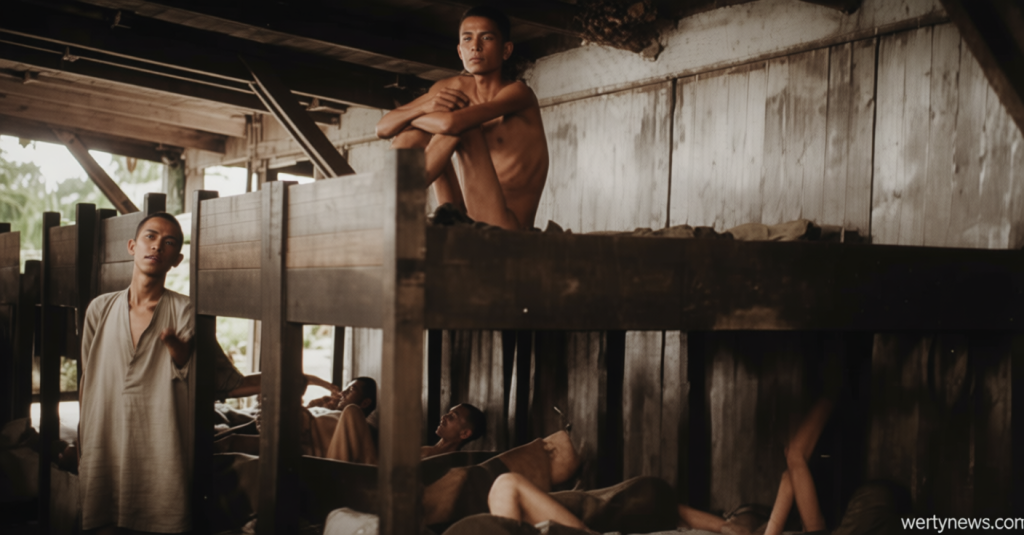
Documenting the horrors of Mauthausen concentration camp
Wertynews.com – Late April 1945 marked the arrival of three infants and their mothers at Mauthausen, a grim symbol of Nazi oppression in Austria. The women, Jewish prisoners enduring months of grueling labor, had concealed their pregnancies from captors. Their survival was remarkable, but the events that followed proved even more astonishing.
Less than a week after their arrival, a small American military unit freed the camp. Among them was LeRoy “Pete” Petersohn, a 22-year-old Illinois Army medic. Petersohn had previously worked as a journalist, and his time at Mauthausen transformed his role into one of witness and record-keeper. He believed the atrocities needed tangible evidence to be believed.
A Testimony in Ink
Petersohn penned a letter dated May 20, 1945, recounting his experience. His son, Brian, later shared the text with 60 Minutes reporter Lesley Stahl. The letter served as more than a personal account—it was a vital historical document.
“This is a story as I witnessed upon arriving here about two weeks ago,” he wrote in the letter.
Brian Petersohn described how his father’s words captured the devastation. “It was a terrible sight upon arriving here,” Petersohn wrote, painting a picture of “piles after piles of dead bodies.” He recounted prisoners collapsing against walls, their bodies stiff and unresponsive, while emaciated survivors rushed to gnaw on grass once the gates opened.
“The sights were horrible,” he wrote. “The camp was almost beyond a human being to stand.”
His father’s account was complemented by photographs and film footage taken by the soldiers. Brian emphasized that Petersohn recognized the need for proof, aligning with General Dwight D. Eisenhower’s directive to document the camps for public awareness. The letter was sent to his wife, who forwarded it to a local newspaper, ensuring its preservation as contemporary evidence.
Stahl noted Petersohn’s role as a witness, and Brian echoed that sentiment. “I’m going to say yes,” he said when asked if his father was a hero. “But he was humble—this was just his duty.”
Preserving the Evidence
Photos and videos from the liberation are credited to the U.S. Holocaust Memorial Museum and Getty Images. The video, originally published on February 15, 2026, was produced by Shari Finkelstein, Collette Richards, and Brit McCandless Farmer, with editing by April Wilson and Scott Rosann.